
Choosing among the best whole home water leak detectors is mainly a question of coverage: do you need wired floor sensors, long-range wireless placement, or flow monitoring at the main line? This selection suits homeowners who want automatic shutoff matched to their plumbing, rooms, and power setup.

Pros
- One-second leak detection reaction
- Four-second automatic valve closing
- Two sensors with 19.69-foot cables
- Sound and light alarm indicators
Cons
- Designed for 3/4 NPT pipe connections
- Sensor cables require placement planning

Pros
- Automatic valve shutoff after leak detection
- Three sensors with 20-foot cables
- Loud alarm continues until reset
- IP65, lead-free brass valve
Cons
- 1-inch valve may not fit every plumbing setup
- No app or remote alerts listed

Pros
- Automatic shutoff for detected leaks
- 120dB alarm with flashing LED alerts
- 19.68-foot water leak sensor cable
- AC power with AA battery backup
Cons
- Requires standard 3/4-inch plumbing
- Four AA backup batteries not included

Pros
- 15-second automatic water shutoff
- LoRa coverage up to 1,640 feet
- Wired and wireless leak sensors included
- Supports up to eight wireless sensors
Cons
- Requires access to the main water line
- Limited to 3/4-inch and 1-inch pipes
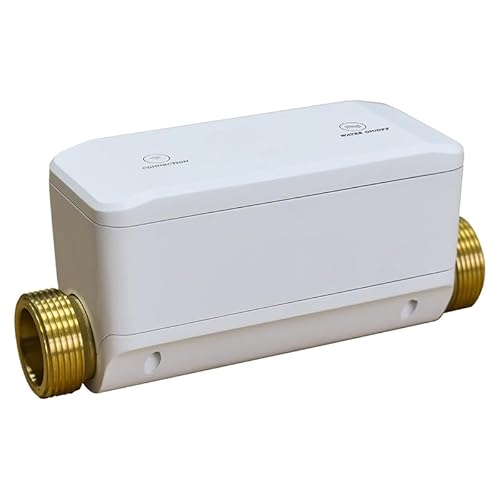
Pros
- NSF certified for potential insurance discounts
- Ultrasonic pressure, temperature, and flow monitoring
- WiFi control and alerts without a hub
- Daily and monthly water usage tracking
Cons
- Requires continuous power, with no built-in battery
- Fits only 3/4-inch DN20 main water lines

Pros
- Shuts off water within 2 seconds
- 80 dB alarm with flashing LED indicators
- 19.68-foot sensor cable reaches tight spaces
- Manual open, close, and reset buttons
Cons
- Requires compatible 3/4-inch NPT plumbing
- Includes only one water-sensing probe
Start With the Leak Zones
A main-line valve can stop water throughout the house, but the sensing method determines what triggers it. Floor probes belong near washing machines, water heaters, sinks, drains, and basement equipment. A flow-based system can identify unusual usage at the supply line, while separate probes can catch a small puddle before it spreads.
Measure the plumbing connection before choosing a valve. Several options here fit 3/4-inch systems, while the U.S. Solid model uses a 1-inch motorized brass ball valve. The AIWSH system supports both 3/4-inch and 1-inch plumbing, which gives it more flexibility when the existing line does not match a common smaller connection.
Pro Tip: Place each floor sensor where water will collect first, not on a raised shelf or behind an appliance that blocks access.
Wired Sensors or Wireless Reach
Wired probes are straightforward when the controller sits near a laundry room, utility room, or water heater. The SHOUMANUAL and E-SDS systems include cables close to 20 feet long, giving you room to route a sensor toward a drain or nearby floor. The U.S. Solid system includes three sensors with 20-foot cables for broader fixed coverage.
Wireless placement helps when the likely leak points are spread across floors or separated by walls. AIWSH uses LoRa communication with stated coverage up to 1,640 feet and supports up to eight wireless sensors. That approach does not depend on household Wi-Fi for the leak connection, while Haozee uses direct 2.4GHz and 5GHz Wi-Fi and adds app control.
| Protection Type | Main Strength | Suitable Location |
|---|---|---|
| Wired probes | Simple fixed coverage | Laundry or utility room |
| LoRa sensors | Long-range placement | Large or multi-level homes |
| Flow monitoring | Supply-line changes | Main water entrance |
For background on likely trouble spots, see where water leaks start in a house. Sensor placement matters because a shutoff cannot prevent water that has already reached an unmonitored area.
Power, Alerts, and Recovery
Automatic closing is useful only if the controller can detect the event and operate the valve. E-SDS includes AC power with battery backup, although its four AA batteries are not included. Haozee requires continuous power and does not include built-in battery backup, so its installation needs a dependable outlet and a plan for outages.
Audible alerts vary as well. E-SDS lists a 120 dB alarm on one model and an 80 dB warning on the other, while SHOUMANUAL uses sound and light alerts. The U.S. Solid alarm continues until the leak is cleared and the system is reset, which can reduce the chance that a brief alert goes unnoticed.
Before You Mount It: Do not treat an automatic valve as a substitute for accessible manual shutoff knowledge. Keep the main valve reachable and learn the basic steps in how to shut off the water main before an emergency.
Expert Examined
From Marcus Bell

I keep the controller and manual shutoff reachable rather than hiding them behind stored boxes. The mistake I see is placing a sensor where a slow drip cannot reach it, so I favor the lowest practical point near the appliance connection.
Read more about Marcus BellMatching the System to Your Home
Certification and connectivity should support your actual installation rather than decide it alone. Haozee lists NSF and FCC certification, while its app can track usage, set flow thresholds, and send remote alerts. The company also states that compatible Haozee leak sensors are sold separately, so account for the sensor arrangement you need.
For general water safety information, the US Consumer Product Safety Commission is a useful public source. You can also review how water sensors shut the water off to separate a simple moisture alarm from a complete valve system.
Which System Fits Your Plumbing
I would point you to Water Leak Detector with Shutoff Valve,Sensors for a household that wants a 3/4 NPT setup with two long-cable sensors, sound and light alerts, manual controls, and a stated one-second detection response. Its eight sensor interfaces also leave room for a more distributed wired arrangement.
For a basement, laundry room, or water-heater area needing three fixed sensing points, I would consider U.S. Solid Water Leak Detector with Auto Shutoff. Its motorized brass valve, IP65 rating, 20-foot sensor cables, and continuing alarm make it a practical fit where the controller can be installed near the monitored plumbing.
I would choose Smart Automatic Water Shutoff Valve & Leak when sensors must reach distant rooms without relying on Wi-Fi. Its LoRa connection, wired and wireless sensors, support for up to eight wireless sensors, and automatic valve self-checking every 15 days suit a larger home with several risk zones.
The Bottom Line
The most common mistake is buying a valve that fits the advertised pipe size while leaving the actual leak-prone rooms outside sensor coverage. Connection size, sensor reach, alert behavior, and backup power deserve equal attention.
If you do only one thing first, map every appliance, drain, and pipe joint that could release water, then choose the valve and sensor format that can reach those locations without awkward cable paths.
FAQs
A flow-monitoring valve can identify unusual water movement, but separate floor sensors detect moisture at specific appliances and rooms. Wired probes suit nearby fixed locations, while wireless sensors help cover distant or difficult areas. Put sensors at low points where water will gather first, including beside water heaters, washing machines, sinks, drains, and basement equipment. Avoid raised shelves, blocked spaces, and locations where a small drip cannot reach the probe. The result depends on the model. E-SDS lists AC power with AA battery backup, while Haozee requires continuous power and has no built-in battery backup. Check the power arrangement before installation. NSF certification indicates that the product meets applicable NSF standards claimed by the manufacturer. It does not replace checking pipe compatibility, installation requirements, sensor coverage, or the availability of backup power.Do whole-home leak detectors need separate floor sensors?
Where should water leak sensors be placed?
What happens if the power goes out?
What does NSF certification mean for a shutoff valve?
Sources
- US Consumer Product Safety Commission www.cpsc.gov
- NFPA www.nfpa.org
- UL Solutions www.ul.com