
Shopping for the best smart thermostats without c wire starts with a wiring check, because many models still require continuous 24V power. The key split is whether your HVAC setup has a usable C-wire or a compatible alternative, making this especially important for older homes and renters.

Pros
- Remote app control and real-time monitoring
- 7-day programmable temperature scheduling
- Backlit LCD for dark rooms
- Temperature control within 2°F
Cons
- Requires a 24V C-wire and no batteries
- Works only with 2.4GHz Wi-Fi

Pros
- ENERGY STAR certified
- Works with Alexa and Ring
- Remote control through the Alexa app
- Automatic home, away, and sleep temperatures
Cons
- C-wire required for installation
- Rebates depend on local energy providers

Pros
- 7-day schedules with 8 periods
- Alexa and Google Assistant compatible
- Energy Star certified
- Temperature alerts and filter reminders
Cons
- C-wire required for installation
- Compatibility check needed before purchase

Pros
- Matter support across major smart-home platforms
- Flexible 24/7 heating and cooling schedules
- Remote app and voice control
- Alerts for filters and system malfunctions
Cons
- C-wire required for some wiring configurations
- Not compatible with electric baseboard heaters
- Compatibility check required before purchase

Pros
- 7-day flexible scheduling
- Geofencing with automatic home and away
- ENERGY STAR certified
- Alexa ready
Cons
- C-wire power adapter required
- Limited with heating-only oil furnaces
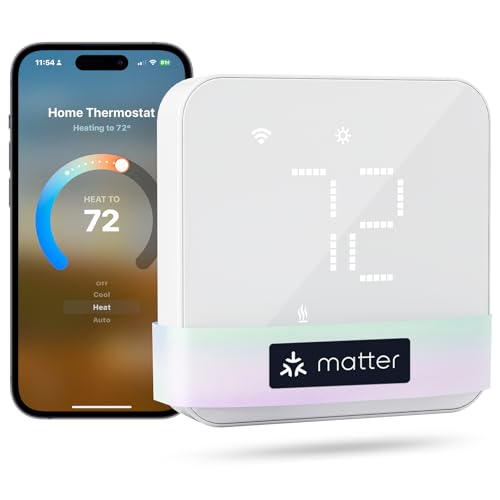
Pros
- Matter support for major smart-home platforms
- Flexible 24/7 heating and cooling schedules
- Remote app and voice control
- Smart alerts for filters and malfunctions
Cons
- C-wire may be required and is not included
- Not compatible with electric baseboard heaters
Start With the HVAC Wiring
None of the listed thermostats is a universal battery-powered replacement for a missing common wire. The Riseem model explicitly requires a C-wire and supports only conventional single-stage, one-heat and one-cool systems. It also excludes heat pumps, multi-stage systems, heat-only systems, and several specialty HVAC types.
The Amazon and Honeywell Home models also require C-wire power, while the vine thermostat describes a C-wire as required for all installations. The two meross models allow some wiring configurations without a C-wire, but their compatibility notes still require careful verification before purchase.
Before You Buy: Do not assume a thermostat will work because the old wall control has several wires. Match the terminals and HVAC type first, and shut off system power before handling wiring.
A useful first step is to photograph the existing terminals and identify whether the system is conventional, a heat pump, boiler, or another configuration. For broader smart-home planning, the Smart Thermostats category provides a related starting point.
Match the System Before the App
Compatibility matters more than voice control. Riseem is narrowly limited to single-stage conventional equipment, while vine covers a broader range that includes two-stage conventional systems, heat pumps, boilers, and heat-only or cool-only systems, provided the wiring check succeeds.
Both meross options are described as suitable for most HVAC systems, including heat pumps, furnaces, boilers, humidifiers, and dehumidifiers. They exclude 110V, 120V, and 240V electric baseboard heaters, millivolt thermostats, and two-wire systems. The newer meross model also notes that some configurations require a C-wire.
| System consideration | What to verify | Suitable direction |
|---|---|---|
| Power arrangement | C-wire or supported configuration | meross first |
| HVAC equipment | Conventional or heat pump | vine or meross |
| Smart platform | Alexa, Google, Apple Home | Match your ecosystem |
Platform support can narrow the choice after the wiring passes. Amazon is designed around Alexa and Ring, vine supports Alexa and Google Home, and meross adds Matter integration with Apple Home, Amazon Alexa, Google Home, Home Assistant, and Samsung SmartThings.
Scheduling and Energy Features
Remote access is available across the group, but the controls differ. Riseem offers app control, seven-day schedules, and a backlit display. Amazon supports Alexa control, home, away, and sleep temperatures, plus optional comfort zones using select Echo devices or an Amazon Smart Air Quality Monitor.
Honeywell Home T5 combines seven-day scheduling with geofencing, automatic home and away behavior, monthly energy reports, and personalized energy tips. Its product information also says scheduling saved some customers between 8 and 16 percent, though actual results depend on household use.
Pro Tip: Check your home Wi-Fi band before ordering. Riseem supports 2.4GHz Wi-Fi only, while compatibility with your preferred voice platform should be confirmed for the other models.
Meross emphasizes flexible 24/7 schedules, usage tracking, filter-life alerts, system-malfunction alerts, and long-operation alerts. Those features may matter more than display style if you want maintenance reminders and control while away. For related connected-home ideas, see these HomeKit-compatible security devices.
Expert Examined
From Marcus Bell

I keep the wiring photo and the HVAC model information together before choosing a smart thermostat. The mistake I see is treating a missing C-wire as a minor installation detail, then discovering that the selected model cannot power itself or control the home’s equipment.
Read more about Marcus BellWhich Model Fits Your Home
I would point you to meross Matter Smart Thermostats for Home when your HVAC system falls within its broad compatibility range and you want Apple Home, Alexa, Google Home, Home Assistant, or Samsung SmartThings support. Its notes about some C-wire configurations mean you should still verify the terminals before ordering.
For a heat pump, boiler, or more involved conventional system, I would consider vine Smart Thermostat for House. It lists support for two-stage heating and cooling, auxiliary or emergency heat, and several operating modes, but its C-wire requirement remains firm.
I would choose Honeywell Home T5 Smart Wi-Fi Thermostat for a household that values geofencing, seven-day programming, energy reports, and a familiar Alexa-ready platform. Its C-wire power adapter requirement makes it a poor match for a home seeking a truly wire-free installation.
The Bottom Line
The biggest mistake is treating “without C wire” as meaning every smart thermostat can operate without one. Most of these models require C-wire power, and even the meross options limit that flexibility to certain wiring configurations and compatible HVAC systems.
If you only do one thing first, turn off power and document the existing terminals and HVAC type. Compare that information with the model’s compatibility notes before considering schedules, voice assistants, display design, or energy features.
FAQs
Most smart thermostats need continuous power from a C-wire or a supported alternative. In this group, the meross models describe some configurations that may not need a C-wire, while the other listed models specify C-wire power requirements. The vine and meross models list heat-pump compatibility, including expanded equipment support. Riseem specifically excludes heat pumps, so its single-stage conventional compatibility should not be applied to that system type. Identify the HVAC type, photograph the current terminal wiring, and compare it with the thermostat’s compatibility notes. Also confirm your Wi-Fi band and preferred smart-home platform before removing the old thermostat. ENERGY STAR certification identifies products that meet the program’s efficiency criteria. It does not guarantee a particular household’s savings, since results depend on schedules, equipment, climate, and how the thermostat is used.Can a smart thermostat work without a C-wire?
Which thermostat is suitable for a heat pump?
What should I check before installing one?
What does ENERGY STAR certification mean here?
Sources
- US Environmental Protection Agency and ENERGY STAR. www.energystar.gov
- US Consumer Product Safety Commission. www.cpsc.gov