
Shopping for the best smart thermostats under $50 starts with identifying your system: IR-controlled room ACs need a controller, while conventional HVAC systems need compatible wall wiring. This selection suits renters, apartment owners, and homeowners replacing basic temperature controls without changing the entire system.

Pros
- 7-day customizable scheduling
- Real-time temperature and humidity monitoring
- Alexa and Google Home compatibility
- Supports 99% of AC brands via IR learning
Cons
- Requires an IR remote-controlled air conditioner
- Not supported by AC brands starting with D

Pros
- Supports 229+ AC brands and 8,000+ models
- Alexa and Google Home voice control
- Daily schedules and smart automation
- Built-in temperature and humidity sensor
Cons
- Requires Tuya Smart or Smart Life app
- Not a standalone AC or heat pump

Pros
- Remote app control and real-time monitoring
- 7-day programmable temperature scheduling
- Backlit LCD for dark rooms
- Temperature control within 2°F
Cons
- Requires a 24V C-wire and no batteries
- Works only with 2.4GHz Wi-Fi
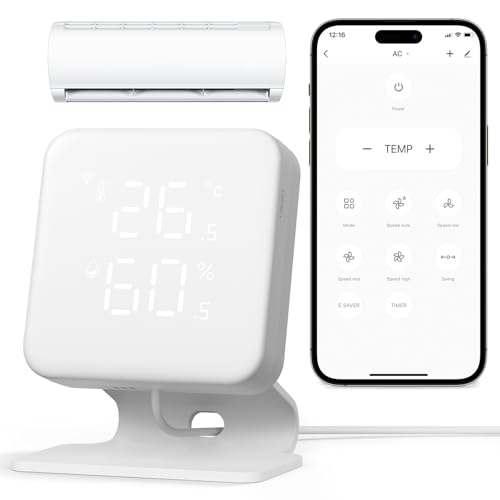
Pros
- Works with 300+ AC brands
- Built-in temperature and humidity display
- Alexa and Google Home control
- 7-day schedules and geofencing
Cons
- 2.4GHz WiFi only, no 5GHz
- Requires IR line of sight

Pros
- 5-2 day scheduling
- Large backlit display with clear font
- Battery powered, no C-wire required
- UWP wall plate simplifies installation
Cons
- Not compatible with electric baseboard heat
- Two AA batteries not included
Match the thermostat to your equipment
The biggest split is between smart AC controllers and wired thermostats. WenzhiIoT, SENCKIT, and WOOX communicate with compatible air conditioners through infrared signals, making them relevant to window, portable, mini-split, or heat pump units. They are not replacements for a central HVAC wall thermostat.
Riseem is designed for conventional single-stage systems with one heat and one cool stage. It requires a 24V C-wire and does not support heat pumps, multi-stage systems, mini-splits, line-voltage heaters, or battery operation. Honeywell Home uses two AA batteries and supports one heat and one cool system without a C-wire, but it is not for electric baseboard heat.
Before You Wire: Do not connect a thermostat until the system type and terminal labels match the product requirements. An incorrect match can cause abnormal operation or leave heating and cooling unavailable.
Smart features that matter in daily use
Remote control is available across the WiFi-focused options, but the control method varies. WenzhiIoT and SENCKIT use app control, Alexa, and Google Home compatibility, while WOOX adds a built-in LED temperature and humidity display plus geofencing. All three use 2.4GHz WiFi, so a 5GHz-only network will not work.
Scheduling can matter more than voice control if your routine is predictable. WenzhiIoT, SENCKIT, WOOX, and Riseem offer seven-day scheduling, while Honeywell Home uses a 5-2 schedule with weekday and weekend settings. WenzhiIoT, SENCKIT, and WOOX also provide temperature and humidity information for automation.
| Device type | Key requirement | Best placement |
|---|---|---|
| IR AC controller | Compatible IR remote | Near AC receiver |
| Wired thermostat | 24V C-wire system | Existing wall plate |
| Battery thermostat | Two AA batteries | Conventional HVAC wall |
For broader device automation, SENCKIT supports smart scenes with lights and fans, while WOOX supports temperature and humidity rules and arrival-based geofencing. If you are building a wider connected home, related equipment such as smart energy and climate controls may help you plan compatible devices.
Pro Tip: Keep an IR controller in the air conditioner’s line of sight, and confirm that the original remote can control the unit before pairing.
Installation, power, and network checks
IR controllers generally avoid wall wiring, but they still need a nearby power connection and a clear signal path. WOOX includes a USB cable and adapter, while WenzhiIoT includes a USB cable. SENCKIT’s listed features focus on app pairing and its built-in sensor rather than a wired HVAC connection.
Riseem’s installation decision is made at the wall: it needs RH, RC, W, Y, G, and C connections, and it only works on 2.4GHz WiFi. Honeywell Home is simpler for homes without a C-wire because it runs on two AA batteries and includes a wall plate intended to simplify installation and later upgrades.
Expert Examined
From Dana Whitfield

I keep seeing thermostat projects fail because the buyer identifies the room unit but not the system behind it. I would photograph the existing terminals and confirm whether the air conditioner uses an IR remote before choosing a controller or wiring a replacement.
Read more about Dana WhitfieldFor broader home-safety planning, you can also review the site’s WiFi smoke and carbon monoxide detector coverage, but keep HVAC compatibility separate from alarm compatibility.
Which thermostat fits your home
I would point apartment dwellers with a remote-controlled window, portable, or mini-split AC toward the Smart Air Conditioner Controller from WenzhiIoT. Its built-in temperature and humidity sensing, seven-day scheduling, Alexa and Google Home compatibility, and IR learning make it a practical way to add control without replacing the AC. Check the exception for air conditioners from brands beginning with the letter D.
For a room with a conventional single-stage HVAC system and an available C-wire, I would choose the WiFi Thermostats for Home Smart Thermostat. It offers seven-day programming, app access, a backlit display, and remote temperature adjustment, but the system exclusions are strict. Homes without a C-wire should instead consider the Honeywell Home X2P Programmable Thermostat, provided the HVAC system is compatible with its battery-powered, single-stage design.
The Bottom Line
The most common mistake is treating every smart thermostat as a universal HVAC replacement. An IR controller belongs with a compatible remote-controlled AC, while Riseem and Honeywell Home depend on the wiring, power, and heating system listed for each model.
If you do only one thing first, identify the equipment type and photograph the existing remote or wall terminals. Then verify the product’s exclusions, WiFi band, power method, and scheduling needs before ordering.
FAQs
A mini-split with an IR remote needs a compatible smart AC controller rather than a conventional wired wall thermostat. WenzhiIoT, SENCKIT, and WOOX are described for compatible mini-split or other IR-controlled AC systems, but you should confirm the remote and brand requirements first. Place it where the air conditioner’s receiver can see its infrared signal, with a clear line of sight. The controller also needs nearby power, and its temperature and humidity readings may be more useful when it is positioned in the room rather than directly beside the AC. Riseem requires a 24V C-wire and cannot run on batteries. Honeywell Home uses two AA batteries and does not require a C-wire, while the IR controllers communicate with compatible AC units and use their included USB-style power accessories. The supplied product information does not identify a safety certification for these models. Do not assume a certification from the product category alone; check the current packaging and manufacturer documentation for any applicable marking.What type of smart thermostat do I need for a mini-split?
Where should an IR AC controller be placed?
Do these thermostats need a C-wire?
Do these products include a safety certification?
Sources
- US Consumer Product Safety Commission www.cpsc.gov
- UL Solutions www.ul.com