
Choosing the best smart thermostats for dual fuel heat pump systems starts with matching the thermostat to your equipment stages, not the app on your phone. The key split is between multi-stage central HVAC control and IR-based mini-split control, so you can avoid buying a convenient-looking device that cannot operate your system.

Pros
- Wi-Fi touchscreen control
- Flexible scheduling and geofencing
- Dual-fuel and ventilation control
- Supports 3H/2C heat pumps
- Apple HomeKit integration
Cons
- Smart features use Honeywell Home platform
- No stated smoke or CO sensing

Pros
- 7-day scheduling for Home, Sleep, and Away
- Phone app control from anywhere
- Family members can share control
- Capacitive touchscreen controls
- Supports electric baseboard, boiler, and heat pump
Cons
- IP20 rating limits environmental protection
- No battery details listed

Pros
- Conventional and heat-pump compatibility
- Matter certified for smart-home integration
- Flexible seven-day scheduling options
- Auto-away and filter reminders
- Indoor humidity display option
Cons
- Requires a 24 VAC C-wire
- Not compatible with 120 to 240V baseboard heat

Pros
- Wi-Fi control through the AprilAire Healthy Air App
- Controls humidifiers, dehumidifiers, or ventilation
- Color graphical display with capacitive touch
- Air filter and HVAC service reminders
Cons
- Requires a matching supported HVAC stage setup
- White finish only
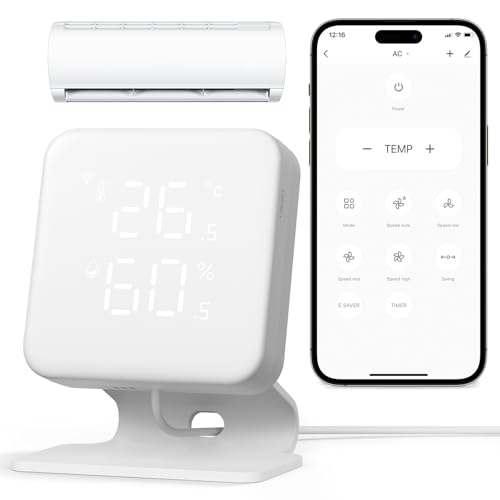
Pros
- Works with 300+ AC brands
- Built-in temperature and humidity display
- Alexa and Google Home control
- 7-day schedules and geofencing
Cons
- 2.4GHz WiFi only, no 5GHz
- Requires IR line of sight
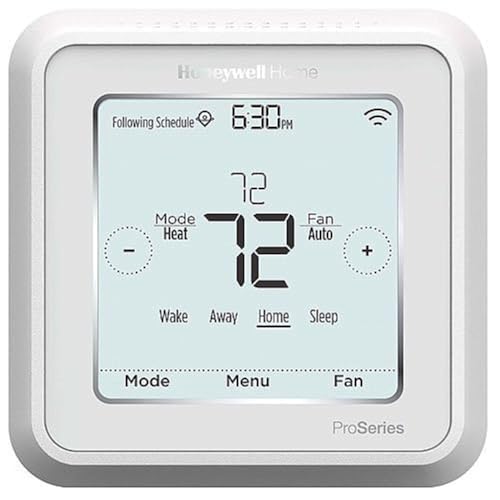
Pros
- Supports heat pumps and conventional systems
- Flexible 7-day and shorter scheduling modes
- Geofencing for location-based control
- Apple HomeKit and Amazon Alexa integration
Cons
- Hardwired installation requires a C-wire
- White finish only
Match the thermostat to the heating system
A dual-fuel installation needs control logic for a heat pump and a second heat source. The Honeywell TH6320WF2003 T6 Pro Smart Thermostat lists dual-fuel control and supports up to 3 heat and 2 cool stages in heat-pump configuration, making stage capacity the first specification I would verify.
The AprilAire S86WMUPR Wi-Fi Programmable Thermostat supports up to 4 heat and 2 cool heat-pump stages. It also adds indoor air quality control for a humidifier, dehumidifier, or ventilation system, which matters if the thermostat is expected to manage more than temperature.
Pro Tip: Confirm the number of heat and cool stages, the backup heat type, and whether a C-wire is present before ordering.
For a simpler installation, the Honeywell Home X2S Smart Wi-Fi Thermostat supports up to 2 heat and 1 cool heat pump with electric backup. It requires a C-wire, while the Honeywell TH6220WF2006/U Lyric T6 Pro Wi-Fi also uses hardwired C-wire power and supports geofencing and multiple scheduling formats.
Central HVAC is different from mini-split control
The WOOX Smart AC Controller is not a wired central-HVAC thermostat. It sends infrared signals to compatible mini-split, window, or portable air conditioners and heat pumps, so it belongs in a room with an IR-controlled ductless unit rather than at a conventional furnace and heat-pump wall plate.
The Yechiry 7 Days Programmable Touchscreen offers app control, daily schedules, and family sharing. Its listed applications include electric baseboard, gas boiler, and heat pump systems, but buyers should still confirm wiring and equipment compatibility before replacing an existing controller.
| Device type | Key control | Best placement |
|---|---|---|
| Central HVAC thermostat | Wired stages | Heat-pump wall plate |
| IAQ thermostat | Air-quality equipment | HVAC control point |
| IR AC controller | Remote signals | Near ductless unit |
That distinction also affects connectivity. WOOX uses 2.4GHz Wi-Fi and requires line of sight to the AC receiver, while the Honeywell Home X2S supports 2.4 or 5GHz Wi-Fi and integrates with Matter, Alexa, Google Assistant, and Apple HomeKit.
Power, scheduling, and indoor comfort
Hardwired power is not a minor detail for a wall thermostat. The two Honeywell T6 Pro options specify C-wire requirements, while the listed Yechiry features emphasize low power consumption, touchscreen operation, and seven-day scheduling rather than a stated central-system power method.
Scheduling choices vary considerably. The T6 Pro models provide flexible schedules or geofencing, the X2S adds auto-away and several programming formats, and WOOX combines hourly schedules with geofencing and temperature or humidity rules through its app.
Before You Mount It: Do not substitute an IR controller for a wired central HVAC thermostat. WOOX specifically is not for central, ducted, or wired systems.
Humidity and air-quality needs may justify choosing a thermostat with broader control. The AprilAire model can adjust connected humidification, dehumidification, or ventilation equipment and includes service reminders for filters and HVAC maintenance. For background on connected home controls, see our Smart Energy and Climate Control coverage.
Expert Examined
From Marcus Bell

I keep seeing thermostat decisions made from the display and app alone, while the wiring and stage count receive little attention. I would photograph the existing terminals and record the equipment model before removing anything, then compare those details with the thermostat’s supported configuration.
Read more about Marcus BellWhich thermostat fits your installation
I would point a higher-stage dual-fuel system toward the smart thermostat category first, then shortlist the Honeywell TH6320WF2003 T6 Pro Smart Thermostat because its listed configuration reaches 3 heat and 2 cool heat-pump stages and specifically includes dual-fuel control. Its Honeywell Home platform, geofencing, flexible scheduling, and Apple HomeKit integration suit a connected central HVAC setup.
For a system with more demanding stage requirements or added air-quality equipment, I would choose the AprilAire S86WMUPR Wi-Fi Programmable Thermostat. Its support for 4 heat and 2 cool heat-pump stages, outdoor temperature sensor, Healthy Air App, and service reminders make it the more capable choice when ventilation or humidity control is part of the installation.
I would reserve the WOOX Smart AC Controller for a compatible ductless unit. Its IR operation, 300-plus brand compatibility, humidity display, schedules, and Alexa and Google Home support are useful for a mini-split, but its line-of-sight requirement and exclusion of central HVAC make the placement decision decisive.
The Bottom Line
The most common mistake is treating every Wi-Fi thermostat as interchangeable. Dual-fuel systems need the right heat-pump stages, backup heat support, wiring, and control type, while a mini-split may need an IR controller instead of a wall thermostat.
If you do only one thing first, identify the existing wires and count the equipment stages. Then select a model whose listed compatibility covers that configuration before considering schedules, voice assistants, or display preferences.
FAQs
A dual-fuel system needs a thermostat that supports heat-pump operation, the available heating and cooling stages, and the secondary heat source. Check the equipment configuration and wiring before selecting a model. No. An IR controller such as WOOX is intended for compatible mini-split, window, or portable units and requires line of sight to the receiver. It is not listed for central, ducted, or wired systems. Some models specify a C-wire, including the Honeywell T6 Pro options in this selection. Verify the existing wiring and the thermostat’s power requirements before removing the old control. Matter is a smart-home connectivity standard that can help compatible devices work across supported platforms. The Honeywell Home X2S is listed as Matter Certified and also supports Alexa, Google Assistant, and Apple HomeKit.What type of thermostat does a dual-fuel heat pump need?
Can an IR controller operate central HVAC?
Does a smart thermostat need a C-wire?
What does Matter certification mean for a thermostat?
Sources
- U.S. Department of Energy, Heat Pump Systems. www.energy.gov
- ENERGY STAR, Smart Thermostats. www.energystar.gov