
Shopping for the best smart door locks with deadbolt gets easier once you decide whether daily entry should rely on fingerprints, codes, a phone, or a physical key. This selection suits homeowners, renters, and property managers comparing connected deadbolts for a front door.

Pros
- Fingerprint access in under one second
- Built-in Wi-Fi, no bridge required
- Up to eight months with eight AA batteries
- BHMA Grade 3 certification
Cons
- Requires eight AA batteries
- IP53 protection, not fully waterproof

Pros
- Built-in WiFi, remote control from anywhere
- Stores up to 100 access codes
- Works with Alexa and Google Home
- Forced-entry alarm and encrypted connection
Cons
- Requires Schlage Home app for smart features
- Four AA batteries last up to six months

Pros
- Multiple entry methods, including fingerprint and passcode
- Matter over Thread supports multiple ecosystems
- Rechargeable battery lasts up to six months
- BHMA-certified with IP65 outdoor protection
Cons
- UWB requires specific Apple devices and a Thread hub
- NFC cards sold separately

Pros
- Fingerprint recognition with self-learning AI chip
- Eight entry methods for flexible access
- Remote user permissions and activity logs
- USB-C emergency port and low-battery alerts
Cons
- G1 Gateway required for remote access
- Four AA batteries not included

Pros
- Fingerprint, passcode, app, key, and voice entry
- Built-in Wi-Fi, no extra hub needed
- Up to 100 custom passcodes
- Auto-lock adjustable from 10 to 180 seconds
Cons
- Batteries not included
- Supports 2.4GHz Wi-Fi only
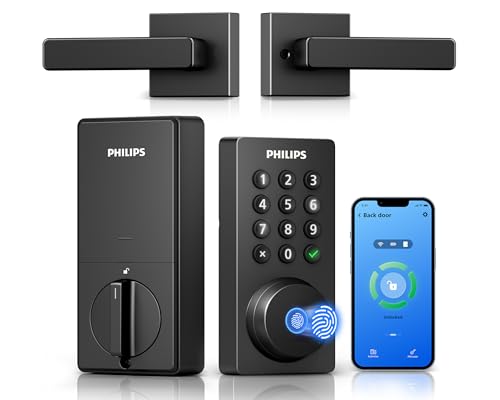
Pros
- Built-in WiFi, no hub required
- Fingerprint entry in 0.3 seconds
- One-time and recurring PIN codes
- Matching handle set included
Cons
- Requires 2.4GHz WiFi within 33 feet
- Batteries not included, alkaline only
Choose the access method you will actually use
Fingerprint entry is convenient for family members who do not want to carry keys. The eufy Security Smart Lock C220, Veise VE017 Fingerprint Smart Door Lock with App, Philips Wi-Fi Smart Deadbolt Lock, Philips WiFi Keypad Deadbolt with Handle, and Aqara UWB Smart Lock U400, Apple Home Key all offer biometric access, while keypad codes remain useful for guests and service workers.
Remote control matters most when you need to let someone in while away or review access activity later. Built-in Wi-Fi makes that direct on the eufy, Schlage, and Philips Wi-Fi models, while the Veise needs its G1 Gateway for remote access and voice control. Aqara adds Apple Home Key and UWB hands-free entry, but that convenience depends on compatible Apple and Thread hardware.
For a wider look at keyless access risks, read how key lock boxes compare with smart locks before choosing your everyday entry method.
Pro Tip: Choose at least two working entry methods, such as a code and physical key, before deleting or disabling any option.
Match connectivity to your home setup
A built-in Wi-Fi lock is simpler if you want phone access without buying a separate bridge. The Philips Wi-Fi Smart Deadbolt Lock supports only 2.4GHz networks and works best with the router within 65 feet, while the Philips WiFi Keypad Deadbolt with Handle specifies a 33-foot distance. Check the intended mounting location before assuming the signal will reach the door.
Aqara uses Matter over Thread and requires a Thread-enabled Matter controller for each supported ecosystem. Its UWB feature also has specific Apple device and operating-system requirements. If you already use eufy doorbells, the eufy model can join routines inside the eufy Security app.
| Access style | Main distinction | Best fit |
|---|---|---|
| Fingerprint | Fast personal entry | Busy households |
| Wi-Fi | Remote app control | Away access |
| Thread or UWB | Smart-home integration | Apple users |
Connectivity is not the same as mechanical protection. Review why the strike plate matters, because the door frame and screws still affect how a deadbolt resists forced movement.
Before You Mount It: Confirm the existing deadbolt, door thickness, backset, and bore size match the lock instructions. A smart interior unit cannot correct a misaligned bolt or a weak frame.
Battery planning and outdoor durability
Battery format and charging habits vary. The eufy C220 uses eight AA batteries and lists about eight months of operation, Schlage uses four AA batteries with up to six months, and both Philips models require alkaline batteries. Veise lists about twelve months from four AA batteries, but batteries are not included.
Aqara uses a removable rechargeable lithium battery that lasts up to six months per charge and can recharge through USB-C. Its exterior is IP65 rated, while eufy is IP53 rated. Those ratings describe resistance to dust and water, not permission to submerge the lock or ignore a covered installation.
Expert Examined
From Marcus Bell

I keep a physical key available for the rare moment a battery warning is missed or the phone is unavailable. The mistake I see is treating app access as the only backup, so set alerts and confirm the mechanical key works before relying on the lock daily.
Read more about Marcus BellUse the low-battery warnings rather than waiting for failure. For practical maintenance steps, see how to reset a smart lock.
Security ratings and household fit
BHMA certification gives buyers a useful reference for mechanical strength, durability, and finish performance. Schlage identifies its lock as having the highest residential BHMA security, durability, and finish rating, while eufy lists BHMA Grade 3 certification and more than 100,000 lock cycles. Aqara also states that its lock is BHMA-certified.
Features such as forced-entry alarms, access history, auto-lock, temporary codes, and away modes address different household needs. Do not confuse a certification with protection from every digital threat; account security, strong passwords, and updated app credentials still matter. The risks of smart-lock hacking are worth considering alongside hardware ratings.
Which lock fits your front door
I would point homeowners already using Apple devices toward the Aqara UWB Smart Lock U400, Apple Home Key, especially when hands-free approach detection, Apple Home Key, and Matter over Thread fit the existing setup. Its rechargeable battery, rekeyable cylinder, and IP65 exterior add useful flexibility, but the required hubs and compatible devices should be confirmed first.
I would put the eufy Security Smart Lock C220 on a front door where built-in Wi-Fi, fingerprint access, voice control, and an eight-month AA battery estimate are more important than advanced smart-home protocols. Its compatibility with most standard deadbolts and no-drilling installation can simplify a replacement.
For a rental, guest suite, or property with changing occupants, I would consider the Veise VE017 Fingerprint Smart Door Lock with App. It supports remotely managed permissions, one-time and recurring codes, activity logs, local AES128-encrypted access data, and an optional gateway for remote features. The Philips WiFi Keypad Deadbolt with Handle is the better fit when replacing the deadbolt and handle together.
The Bottom Line
The mistake most buyers make is focusing on fingerprint speed or app features while overlooking door compatibility and network requirements. A lock that does not fit the existing bore, backset, thickness, or Wi-Fi range will create more trouble than convenience.
Start by measuring the door and checking the router distance. Then select two dependable entry methods, install the lock with a physical backup available, and turn on low-battery, activity, and auto-lock settings only after confirming the door closes and latches correctly.
FAQs
Fingerprint entry is convenient for household members, while keypad codes are easier to share with guests and service providers. A physical key remains valuable as a backup, and app access is most useful when remote control or activity history matters. No. Some locks use built-in Wi-Fi, while others use Bluetooth, Thread, or a separately purchased gateway for certain remote features. Check the model requirements and the distance between the lock and your router or hub. Battery life depends on the model, battery type, and usage. The products listed range from about six months to about twelve months, and rechargeable designs need a charging routine. Keep a physical key available and respond to low-battery alerts. BHMA certification relates to performance areas such as mechanical strength, durability, and finish. It does not guarantee that an app account, wireless network, or phone is secure, so digital access settings still require care.Which entry type is best for a smart deadbolt?
Does a smart deadbolt need Wi-Fi?
How often do smart-lock batteries need attention?
What does BHMA certification mean on a smart lock?
Sources
- Builders Hardware Manufacturers Association and ANSI/BHMA standards. www.buildershardware.com
- UL Solutions and residential door hardware safety information. www.ul.com