
Shopping for the best smart deadbolt locks gets easier once you decide whether daily entry should rely on fingerprints, codes, a phone, or an existing smart-home platform. This selection suits homeowners, renters, and hosts who need remote access without overlooking batteries, door fit, or backup entry.

Pros
- Fingerprint access in under one second
- Built-in Wi-Fi, no bridge required
- Up to eight months with eight AA batteries
- BHMA Grade 3 certification
Cons
- Requires eight AA batteries
- IP53 protection, not fully waterproof

Pros
- Built-in WiFi, remote control from anywhere
- Stores up to 100 access codes
- Works with Alexa and Google Home
- Forced-entry alarm and encrypted connection
Cons
- Requires Schlage Home app for smart features
- Four AA batteries last up to six months

Pros
- Multiple entry methods, including fingerprint and passcode
- Matter over Thread supports multiple ecosystems
- Rechargeable battery lasts up to six months
- BHMA-certified with IP65 outdoor protection
Cons
- UWB requires specific Apple devices and a Thread hub
- NFC cards sold separately

Pros
- Fingerprint recognition with self-learning AI chip
- Eight entry methods for flexible access
- Remote user permissions and activity logs
- USB-C emergency port and low-battery alerts
Cons
- G1 Gateway required for remote access
- Four AA batteries not included

Pros
- Fingerprint, passcode, app, key, and voice entry
- Built-in Wi-Fi, no extra hub needed
- Up to 100 custom passcodes
- Auto-lock adjustable from 10 to 180 seconds
Cons
- Batteries not included
- Supports 2.4GHz Wi-Fi only
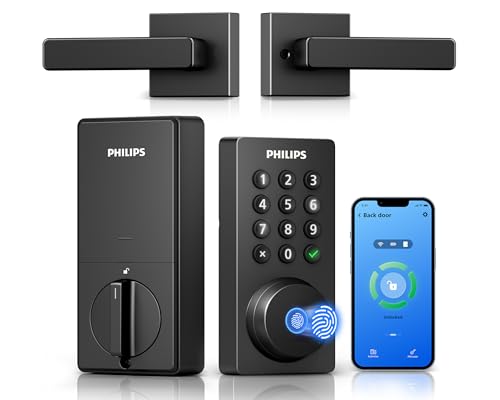
Pros
- Built-in WiFi, no hub required
- Fingerprint entry in 0.3 seconds
- One-time and recurring PIN codes
- Matching handle set included
Cons
- Requires 2.4GHz WiFi within 33 feet
- Batteries not included, alkaline only
Match Entry Methods to Your Household
Fingerprint readers are useful when family members want fast daily access without remembering a code. The eufy Security Smart Lock C220 and Veise VE017 Fingerprint Smart Door Lock with App both center that experience, while Philips adds fingerprint access to either a Wi-Fi deadbolt or a handle set.
Codes remain more practical for guests, cleaners, and short-term access. Schlage supports up to 100 access codes, Philips Wi-Fi Smart Deadbolt Lock supports up to 100 custom passcodes plus temporary options, and Veise provides one-time, duration, permanent, and recurring codes.
If your household already uses Apple Home, Alexa, Google, or Home Assistant, check the required controller before buying. The Aqara UWB Smart Lock U400, Apple Home Key has the broadest listed platform support, but hands-free UWB requires specific Apple hardware and software.
Pro Tip: Choose one primary entry method for daily use, then confirm that every resident can use a separate backup method.
Wi-Fi, Thread, and Hub Requirements
Built-in Wi-Fi keeps remote control simple because eufy, Schlage, and both Philips models connect without an added bridge. Philips specifies a 2.4GHz network, and the handle model calls for the lock to remain within 33 feet of the router with few obstacles.
Aqara takes a different path with Matter over Thread. That can suit a multi-platform home, but each ecosystem needs its own Thread-enabled Matter controller. Veise remote features and voice control require the separate G1 Gateway, so include that requirement in your installation plan.
Before choosing remote control, read about what a smart lock bridge does. A lock that works locally with a code or key remains useful even when the home network is unavailable.
| Connection type | Main requirement | Best fit |
|---|---|---|
| Built-in Wi-Fi | 2.4GHz network | Simple remote access |
| Matter over Thread | Compatible controller | Multi-platform homes |
| Gateway-based | Separate G1 Gateway | Veise remote features |
Battery Planning and Door Fit
Battery schedules vary considerably. eufy lists about eight months from eight AA batteries, Schlage lists up to six months from four AA batteries, Philips Wi-Fi Smart Deadbolt Lock requires AA alkaline batteries, and Philips WiFi Keypad Deadbolt with Handle lists up to six months. Veise lists about 12 months from four AA batteries, while Aqara uses a removable rechargeable battery lasting up to six months per charge.
Keep the physical key available even if fingerprints and codes are your preferred methods. The C220 fits most standard deadbolts and can accommodate bores under 54mm after spacer removal, while the Schlage model fits standard doors from 1 3/8 to 1 3/4 inches thick with either listed backset.
Before You Mount It: Do not assume every front door has the same bore, backset, or thickness. Confirm the existing deadbolt dimensions and check that the bolt moves freely before relying on motorized operation.
For broader door hardware context, review why the strike plate matters. A stiff bolt or poorly aligned plate can cause trouble regardless of the app or keypad.
Expert Examined
From Marcus Bell

I keep a mechanical key in a consistent, secure location rather than treating the app as the only fallback. The mistake I see is choosing a feature-rich lock before checking whether the existing deadbolt and door frame move smoothly.
Read more about Marcus BellSecurity Ratings and Outdoor Exposure
Certification and weather ratings answer different questions. BHMA certification addresses areas such as mechanical strength and durability, while an IP rating describes resistance to dust or water at the exterior. Aqara lists BHMA certification and IP65, while eufy lists BHMA Grade 3 and IP53.
Schlage lists the highest residential Security, Durability and Finish rating from BHMA industry experts, along with a customizable alarm for movement and forced-entry attempts. Veise lists local AES128 encryption for access data, while Philips provides alerts, access history, and Away Mode that restricts entry to the master code.
The UL Solutions site can help explain how safety certification differs from a manufacturer feature claim. You should still follow the lock maker’s door, battery, and weather instructions.
Which Lock Fits Your Door
I would point you to the key lock box versus smart lock discussion if you are deciding between electronic access and a protected spare key. For a straightforward Wi-Fi setup with fingerprint access, I would choose the eufy Security Smart Lock C220. Its built-in Wi-Fi needs no bridge, it offers six entry methods, and its listed battery life reaches about eight months.
For an Apple-centered household that wants hands-free arrival, I would consider Aqara UWB Smart Lock U400, Apple Home Key. Its UWB feature has strict Apple device and hub requirements, so it suits a compatible setup rather than every home. For a rental, guest suite, or property with frequent code changes, I would choose Veise VE017 Fingerprint Smart Door Lock with App, especially when remote user permissions and activity logs matter.
The Bottom Line
The mistake most buyers make is comparing fingerprint speed or app features before checking door dimensions, network requirements, and the backup entry method. A smart deadbolt must fit the existing hardware and remain usable when batteries are low or the network is offline.
If you do one thing first, measure the door thickness, backset, bore, and existing bolt movement. Then choose the entry method your household will use every day and verify whether the selected lock needs a hub, gateway, controller, or a specific Wi-Fi band.
FAQs
Fingerprint models can make daily entry fast for household members, while keypad access is often easier for guests and service workers. A model offering both gives you flexibility, but you should still keep a physical key or another backup method available. Check door thickness, bore size, backset, and whether the existing bolt moves freely. Also confirm the lock’s Wi-Fi, Thread, or gateway requirements before removing the current hardware. Battery life depends on the model and how often the lock operates. Watch low-battery alerts, use the specified alkaline or rechargeable format, and keep the physical key accessible for emergencies. BHMA certification relates to assessed areas such as mechanical strength, durability, and reliability. It does not automatically describe Wi-Fi security, battery life, or resistance to every weather condition.Are fingerprint smart deadbolts better than keypad models?
What should I check before installing a smart deadbolt?
How often do smart lock batteries need attention?
What does a BHMA rating mean on a smart lock?
Sources
- Builders Hardware Manufacturers Association and ANSI/BHMA standards. www.buildershardware.com
- UL Solutions and product safety information. www.ul.com