
Choosing the best heat detectors without wifi means deciding where smoke alarms are unsuitable and how your alarm should respond to rising heat. This selection suits homeowners who want hardwired protection, battery backup, or interconnection without depending on a wireless network.

Pros
- Rate-of-rise technology detects rapid temperature increases
- Microprocessor control minimizes nuisance false alarms
- Remote test and mute via household remotes
- Hardwired setup backed by 9V battery
Cons
- Requires hardwired electrical installation
- Compatible remote control is sold separately
- Heat detector only, does not sense smoke

Pros
- Smoke and carbon monoxide detection
- Heat sensor for garage unit
- Interconnects up to 24 devices
- 85dB alarm with self-tests
Cons
- Hardwired installation requires an existing circuit
- Garage heat detection is placement-specific

Pros
- 135°F heat detection
- 85-decibel alarm
- 9-volt battery backup
- Interconnects up to 18 alarms
Cons
- Hardwired installation required
- Backup uses a 9-volt battery
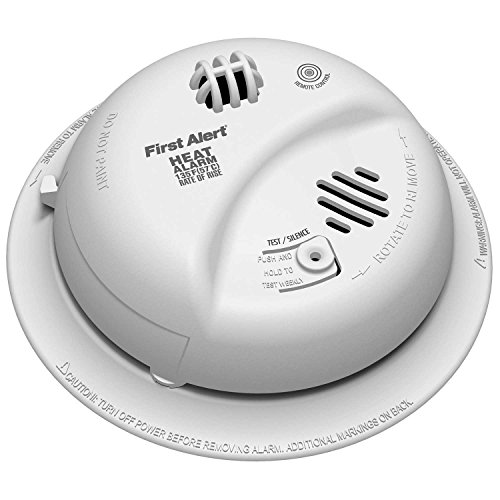
Pros
- Hardwired power with battery backup
- Ionization heat alarm format
- White finish
- 4.2 out of 5 rating
Cons
- Hardwired installation required
- CO sensing not specified

Pros
- 90dBA temporal-3 piezo horn
- 9V battery backup with low-battery indicator
- Interconnects with current Gentex alarm models
- Quick-disconnect wiring harness
Cons
- Requires 220V hardwired installation
- Heat alarm rather than smoke detector
Match the Sensor to the Room
Heat detectors are useful in locations where dust, humidity, cooking vapors, or vehicle exhaust could cause unwanted smoke-alarm alerts. Garages are the clearest example, but the right placement still depends on the room and the manufacturer’s installation instructions.
Rate-of-rise sensing responds to a rapid temperature increase, while fixed-temperature designs respond after the surrounding air reaches a set point. First Alert lists advanced rate-of-rise sensing, while the Kidde and Gentex models specify temperature-based operation. For broader context, see what a heat alarm is.
Before You Mount It: Do not treat a heat detector as a universal replacement for smoke alarms. Keep smoke alarms in the areas where they are appropriate, and use a heat detector only where its operating method suits the environment.
Power and Interconnects Matter
Every model in this comparison uses hardwired power, but the backup format and network capacity differ. The Kidde Hardwired Smoke, Carbon Monoxide & Heat includes a 10-year battery backup and can interconnect up to 24 devices. Other models use a 9-volt battery backup, while the Kidde Heat Detector supports up to 18 Kidde alarms.
Interconnection can be more important than app access in a larger home. When compatible alarms are linked, one alarm can alert occupants in another part of the house. Confirm that the detector matches your existing alarm family before buying, since interconnect compatibility is not universal.
| Device type | Distinguishing specification | Suitable location |
|---|---|---|
| Smoke, CO, heat | 10-year battery backup | Garage or home network |
| Rate-of-rise heat | Rapid temperature sensing | Areas prone to false alarms |
| Fixed-temperature heat | 135°F response models | Garage or utility space |
A hardwired unit also needs suitable wiring and a compatible junction box or harness. Gentex lists a quick-disconnect wiring harness and mounting hardware that adapts to standard junction boxes, while the Kidde model includes a quick-connect power harness.
What the Alarm Must Communicate
Sound output, status indicators, and maintenance features affect how useful an alarm is after installation. Several models specify an 85-decibel alarm, while Gentex lists a 90-decibel temporal three horn and a solid-state LED condition indicator.
Look for practical controls as well as loud output. The Kidde Heat Detector has a Test-Hush button, First Alert allows remote testing and muting with almost any household remote control, and Gentex lists a low or missing battery indicator.
Pro Tip: Before connecting an interlinked system, identify the compatible alarm family and plan how occupants will hear the alarm from bedrooms and enclosed rooms.
Expert Examined
From Marcus Bell

I keep seeing homeowners focus on wireless features even when the intended location is a dusty garage. The more useful question is whether the alarm has suitable heat sensing, backup power, and compatible wiring for that space.
Read more about Marcus BellFor broader fire-safety planning, the garage smoke-alarm placement discussion can help clarify why heat detection may be more appropriate there. The NFPA publishes widely used fire-safety guidance, but local requirements can still vary.
Which Alarm Fits Your Home
I would point you to the Kidde Hardwired Smoke, Carbon Monoxide & Heat if you want one hardwired unit to cover smoke, carbon monoxide, and heat, especially where a wider interconnected system matters. Its 10-year battery backup and capacity for up to 24 devices make it the most feature-rich option in this group.
For a garage or utility room needing a dedicated heat alarm, I would put the First Alert BRK Hardwired Heat Alarm with Battery high on the shortlist. Its rate-of-rise sensing, microprocessor control, remote mute capability, and 85-decibel alarm fit rooms where false alerts are a concern.
I would choose the Kidde Heat Detector, Hardwired with Battery Backup when you want a dedicated 120V heat detector with a 9-volt backup and Kidde interconnect support. Its Test-Hush button, red LED, and connection capacity for up to 18 Kidde alarms make it practical for a compatible existing system.
The Bottom Line
The biggest mistake is assuming a heat detector can replace every smoke alarm in the home. Heat alarms are intended for places where smoke alarms may be unsuitable, so room conditions and placement should guide the purchase.
If you do one thing first, identify the exact room and check the existing wiring and alarm family. Then choose the sensing method, backup battery format, and interconnect capability that match that location.
FAQs
Heat detectors can be more suitable for garages and other areas where dust, humidity, fumes, or routine activity may cause unwanted smoke-alarm alerts. They should not replace smoke alarms in areas where smoke alarms are appropriate. Rate-of-rise sensing responds to a rapid increase in temperature. Fixed-temperature sensing responds after the surrounding air reaches a specified threshold, such as the 135°F rating listed by some models. The models in this comparison include battery backup, but the battery format and duration vary. Check the listed backup specification and maintain the battery indicator or replacement requirements. UL certification indicates that the product has been evaluated against applicable safety requirements through UL Solutions. It does not determine the best mounting location for your home, so follow the product instructions and local requirements.Are heat detectors better than smoke alarms for garages?
What is the difference between rate-of-rise and fixed-temperature sensing?
Do hardwired heat detectors work during a power outage?
What does UL certification mean for a heat detector?
Sources
- National Fire Protection Association www.nfpa.org
- UL Solutions www.ul.com
- US Fire Administration www.usfa.fema.gov