
Installing the best hardwired smoke and carbon monoxide detectors eliminates the single point of failure that leaves distant bedrooms unprotected. The critical choice involves balancing replacement battery maintenance against sealed long-life cells while verifying interconnect protocols. Homeowners modernizing older junction boxes need direct compatibility to avoid pulling fresh wire.

Pros
- Dual smoke and carbon monoxide detection
- Precision Detection curbs cooking false alarms
- Interconnect links up to 18 compatible devices
- 9V battery backup protects during power outages
- Visual indicator marks the initiating alarm unit
Cons
- Hardwired setup requires existing home electrical wiring
- 9V backup battery requires periodic replacement

Pros
- Combination smoke and carbon monoxide detection
- Precision Detection cuts cooking nuisance alarms
- Hardwired interconnect triggers all compatible BRK alarms
- Latching indicator visually identifies the alarm source
- 9V battery backup protects during power outages
Cons
- Requires AC electrical hardwiring for installation
- Replaceable 9V battery requires periodic maintenance swaps

Pros
- Photoelectric smoke and carbon monoxide dual detection
- Hardwired 120V AC with 10-year battery backup
- Interconnects with up to 18 compatible alarms
- Conforms to UL 217 and UL 2034
- Includes mounting bracket and wiring harness
Cons
- Requires hardwired 120V AC electrical installation
- Interconnection limited to 18 compatible units

Pros
- Voice alerts announce threat type and 11 locations
- Cross-brand interconnect with Kidde, BRK, and FireX
- Meets UL217 8th Edition and UL2034 standards
- Universal adaptors enable installation without rewiring
- Ten-year warranty with end-of-life chip indicator
Cons
- Requires 120-volt hardwired electrical installation
- Cannot operate as a battery-only detector

Pros
- Photoelectric smoke and carbon monoxide dual sensing
- Voice alerts state specific fire or CO hazard
- Front-loading door simplifies 9V battery changes
- Alarm memory identifies previous smoke or CO events
Cons
- Hardwired AC connection required for primary power
- Replaceable 9V battery lacks sealed ten-year lifespan
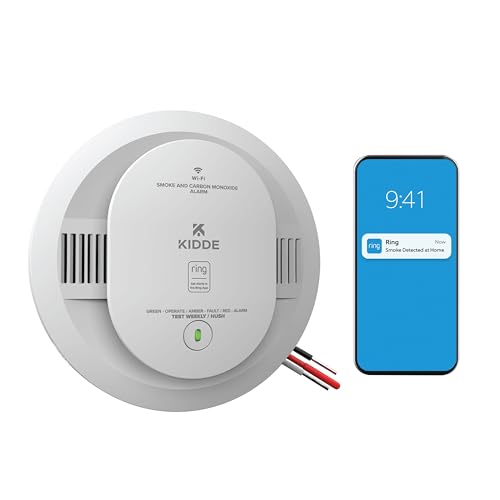
Pros
- Smoke and carbon monoxide double detection
- Free real-time Ring app notifications
- Spoken voice alerts and Alexa compatibility
- UL 217 and FCC safety certified
Cons
- Requires hardwired electrical installation
- 24/7 professional monitoring requires paid subscription
- Uses replaceable AA batteries instead of sealed cell
Interconnect Wiring and Cross-Brand Compatibility
Modern residential building codes require hardwired alarms to communicate across a dedicated traveler wire. When one detector identifies combustion particles or toxic gas, the signaling voltage commands every linked horn to sound simultaneously. Choosing matching units across your floor plan guarantees that someone sleeping upstairs receives an instant alert if a smoldering fire begins downstairs.
Interconnect protocols are rarely universal across different manufacturers. Connecting mismatched hardware can trigger false alarms or prevent signaling voltage from passing between junction boxes during an emergency. Upgrading existing setups through dedicated home safety detection devices requires checking connector pinouts or selecting units that bundle verified wiring harnesses.
Wiring Hazard: Never connect the red interconnect wire to standard 120-volt line voltage or ground. Feeding high voltage into signaling lines destroys internal sensor circuits and disables whole-house communication across all connected alarms.
Sensor Performance and Cooking Nuisance Standards
Updated fire safety criteria set by agencies like the National Fire Protection Association emphasize reducing false triggers from cooking vapor. Advanced photoelectric sensing chambers analyze particle size to distinguish between high-temperature grease fires and burnt toast. Alarms meeting current UL 217 specifications react promptly to modern synthetic materials while preventing the nuisance chirps that tempt occupants to disconnect power.
| Sensor Type | Target Threat | Primary Room |
|---|---|---|
| Photoelectric | Smoldering smoke | Hallways and bedrooms |
| Electrochemical | Carbon monoxide | Furnace and living spaces |
| Dual Detection | Smoke and gas | Central hallways |
Carbon monoxide requires electrochemical detection cells because it is completely odorless and undetectable by human senses. Unlike smoke, which rises toward the ceiling on thermal currents, carbon monoxide mixes evenly into ambient room air. Combination units place both monitoring components onto a single mounting plate, cutting ceiling clutter in half while maintaining dual protection.
Backup Power and Routine Maintenance
Hardwired detectors draw continuous current from your electrical panel, but severe storms and grid failures demand reliable battery backup. Traditional alarms rely on replaceable 9V or AA cells that require annual swap-outs to stop low-battery warnings. Models equipped with sealed ten-year lithium cells eliminate recurring replacements entirely, providing continuous operation through utility blackouts without routine maintenance.
Outage Protection: Check the manufacture date stamped on the back of the alarm housing before mounting. Both smoke sensors and carbon monoxide cells degrade over time, meaning even continuously powered hardwired units must be retired after ten years in service.
Front-loading battery compartments solve the persistent hassle of taking down the entire mounting plate just to silence a low-power chirp. When updating multiple alarms, check our safety maintenance blog for seasonal checklists. Regular vacuuming around the exterior vents also prevents household dust from accumulating inside the optical sensor chamber.
Expert Examined
From Marcus Bell

I frequently see homeowners disconnect hardwired alarms entirely when low-battery chirps begin in the middle of the night. Leaving an empty junction box creates an invisible hazard, so keeping a spare battery or selecting a sealed 10-year backup model avoids dangerous gaps in protection.
Read more about Marcus BellMatching Combination Detectors to Your Home
For homes with mixed existing wiring, I recommend installing the First Alert Combination Smoke & Carbon Monoxide. Its included universal adaptors link into older harnesses from Kidde, BRK, and FireX without rewiring junction boxes. Programmable voice announcements specify both the hazard type and danger location across up to eleven distinct rooms, giving occupants clear evacuation directions.
If you prefer to eliminate ladder climbs for annual battery changes, I would point you toward the 911 EverGuard Hardwired Smoke & Carbon Monoxide. It features a sealed ten-year lithium backup alongside compliance with the newest UL 217 tenth edition standards. The system links up to eighteen compatible units across large multi-story residences for widespread coverage.
For households that rely on mobile notifications, I suggest the Kidde Smart Smoke & CO Detector with Ring. Adding just one unit bridges your entire hardwired alarm circuit to the Ring app, sending instant mobile notifications during emergencies and pairing smoothly alongside broader home security systems without requiring an ongoing monthly fee.
The Bottom Line
The biggest oversight buyers make is assuming all hardwired alarms communicate across brand lines right out of the box. Installing incompatible hardware on an active traveler wire can silence linked alarms in bedrooms or trigger erratic middle-of-the-night false alarms. Always verify whether a replacement unit uses your existing harness or provides verified universal wiring adaptors.
Before ordering replacements, turn off the breaker and unclip a single ceiling unit to inspect the mounting bracket and electrical connector pins. Identifying whether your junction boxes use two-wire or three-wire connections narrows your choices immediately and prevents unexpected electrical work during installation. If you are also evaluating comprehensive property protection, consider how these hardwired circuits coordinate with monitored home security systems.
FAQs
Do hardwired smoke and carbon monoxide detectors still need batteries?
Yes, hardwired units require battery backups to remain functional during residential electrical blackouts. Power outages often coincide with severe weather or heating equipment malfunctions, which represent peak periods for carbon monoxide accumulation. Backups come as replaceable alkaline cells or integrated ten-year sealed lithium packs.
How do interconnected hardwired alarms communicate with each other?
Interconnected alarms share a third dedicated traveler wire, typically colored red or orange, inside the electrical junction box. When one detector detects smoke or carbon monoxide, it sends a specific DC voltage signal down this line. That signal instantly commands all compatible connected units across the household to sound simultaneously.
When should hardwired combination detectors be replaced?
All combination smoke and carbon monoxide alarms must be replaced ten years from their manufacture date stamped on the chassis. While the hardwired electrical connection continues supplying power indefinitely, internal optical chambers and chemical carbon monoxide sensing substrates degrade over a decade, leaving the unit unable to detect hazards reliably.
Can different alarm brands be interconnected on the same circuit?
Standard interconnect lines generally require matching brands or verified cross-compatible models to communicate properly. Mixing Kidde and First Alert units on the same traveler wire often causes intermittent chirping or failure to trigger secondary alarms. Some models include universal adaptors designed to bridge specific multi-brand wiring harnesses safely.
Sources
- National Fire Protection Association www.nfpa.org
- U.S. Consumer Product Safety Commission www.cpsc.gov
- Underwriters Laboratories Standards www.ul.com