
Shopping for the best ecobee smart thermostats means deciding whether basic schedule control is enough or whether your home needs room sensing and security features. Renters, larger households, and homes with hot or cold spots usually benefit from a different model than a small space with one consistent temperature.

Pros
- Two sensors for room-by-room comfort
- Tracks temperature and occupancy
- Works up to 60 feet away
- Wireless mounting with no tools required
Cons
- Requires a compatible ecobee thermostat
- Security alerts require an active subscription

Pros
- Energy Star certified
- Color touchscreen and app control
- Works with Alexa, Google Assistant, and HomeKit
- Compatible with 85% of systems
Cons
- Power Extender Kit sold separately
- SmartSensor sold separately

Pros
- Built-in Alexa
- Room sensor included
- Programmable thermostat
- White finish
Cons
- Alexa may not suit every buyer
- White is the only listed color

Pros
- Included SmartSensor manages hot and cold spots
- Built-in air quality monitor with alerts
- Energy STAR certified, saves up to 26%
- Siri, Alexa and Google Home support
Cons
- Smoke alerts require an ecobee security subscription
- Siri requires an Apple home hub

Pros
- Radar occupancy sensing, up to 16-foot range
- Included SmartSensor manages room comfort
- Up to 26% annual heating and cooling savings
- ENERGY STAR certified
- Built-in air quality monitor and filter reminders
Cons
- Entry and motion alerts require a subscription
- Compatible with 95% of systems, not all
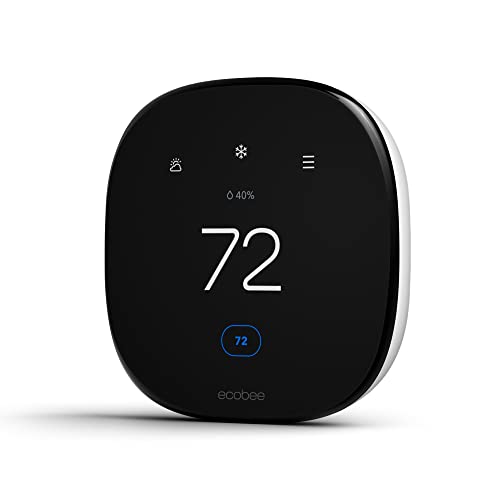
Pros
- Up to 26% potential annual energy savings
- Built-in occupancy sensing adjusts comfort automatically
- Power Extender Kit included for homes without C-wire
- Works with Alexa, Google Assistant, and HomeKit
Cons
- SmartSensors for room-by-room comfort sold separately
- HVAC compatibility should be confirmed before installation
Start With HVAC Compatibility
Before choosing a thermostat, identify the equipment already connected to your wall control. The ecobee Smart Thermostat Essential works with 85% of systems, while the ecobee Smart Thermostat Enhanced supports 90% and the Premium models support 95%, according to the supplied product specifications.
Use ecobee’s Compatibility Checker before ordering, especially if you have a heat pump, boiler, dual-fuel setup, or conventional system with several heating and cooling stages. The Essential can work without a C-wire when paired with a separately sold Power Extender Kit, while Enhanced and Premium models include the kit.
Installation is still a wiring decision even when the process is designed for do-it-yourself setup. If your system does not match the listed equipment types or the existing wiring is unclear, pause before removing the old thermostat and consult a qualified HVAC professional.
Check the Wiring First: A missing C-wire is not automatically a deal breaker, but compatibility should be confirmed before installation. Do not guess at terminals or connect wiring while the HVAC circuit is powered.
Room Sensors Change the Comfort Strategy
A thermostat mounted in a hallway can miss the room where your family spends the evening. SmartSensors detect occupancy and temperature, then share that information with a compatible ecobee thermostat so the system can prioritize rooms that matter most.
The ecobee SmartSensor 2-Pack suits homes with two priority spaces, such as a bedroom and living room. It mounts on a stand or wall, needs no wiring or tools, works from up to 60 feet away even through walls and floors, and uses a CR2477 battery rated for up to five years.
The Enhanced accepts SmartSensors separately, while the Premium includes one. The Comfort and Security Bundle also includes a SmartSensor and adds entry, motion, smoke-alarm sound, and air-quality features, although some security alerts require an ecobee Smart Security subscription.
| Device type | Main distinction | Best placement |
|---|---|---|
| Essential thermostat | Schedule and app control | Homes needing basics |
| Enhanced thermostat | Occupancy and humidity | Everyday whole-home comfort |
| Premium or bundle | Sensor and security tools | Larger connected homes |
For more room-by-room planning, compare the features here with the broader Smart Thermostats category. A sensor helps only when it is placed in a room you actually want the thermostat to prioritize.
Pro Tip: Place a SmartSensor in the bedroom if overnight comfort matters, and use the second sensor in the main living area rather than beside the thermostat.
Decide How Much Smart Home Control You Need
All of the thermostat-focused choices are designed around app control and smart-home integration, but the included features differ. The Essential works with Apple HomeKit, Google Assistant, Alexa, and Siri, while Enhanced also supports SmartThings.
The Premium adds a built-in speaker with Siri or Alexa, Spotify and podcast playback, a large display, air-quality alerts, filter reminders, and the ability to listen for smoke-alarm sounds. Its live doorbell view and two-way talk require the compatible ecobee doorbell setup, and Siri requires an Apple home hub.
If smoke detection is a major concern, the Wi-Fi smoke and carbon monoxide detector coverage can help you think through whether a thermostat feature should supplement, rather than replace, dedicated alarms. The US Consumer Product Safety Commission also provides household safety guidance at CPSC.gov.
Expert Examined
From Ray Okafor

I keep seeing homeowners focus on the display while overlooking the room that controls comfort. The mistake is placing every sensor near the thermostat; instead, give each sensor a clear job, such as tracking the bedroom overnight or the living room during the day.
Read more about Ray OkaforWhich ecobee Fits Your Home
I would point you to the ecobee Smart Thermostat Essential if you want app and schedule control without paying for advanced room or security functions. It suits a home with a compatible HVAC system where one thermostat location already represents comfort well, and its compatibility checker should be your first step.
I would choose the ecobee Smart Thermostat Enhanced for a household that wants occupancy-based adjustments, humidity support, broad smart-home compatibility, and the option to add sensors later. It is a practical middle path for homes with changing schedules and rooms that are not equally occupied.
For a larger connected home, I would put the ecobee Comfort and Security Bundle ahead of the standalone Premium. Its included SmartSensor, air-quality monitoring, entry notifications, motion detection, and smoke-alarm sound alerts address comfort and security together, though subscription requirements apply to some alerts.
The Bottom Line
The most common mistake is choosing by screen or voice assistant alone while ignoring HVAC compatibility and the rooms that actually need temperature priority. A premium display cannot correct an unsuitable system match or a poorly placed sensor.
If you do only one thing first, use ecobee’s Compatibility Checker and identify the two rooms where temperature matters most. That decision will quickly narrow the choice between Essential, Enhanced, Premium, and a sensor-equipped bundle.
FAQs
A SmartSensor is useful when the thermostat location does not represent the rooms you use most. It can share temperature and occupancy information so a compatible ecobee thermostat can prioritize spaces such as a bedroom or living room. The Essential can use SmartSensors, but the two-pack is sold separately. Place it in a room where comfort matters and occupancy changes the temperature priority. A bedroom can be useful for overnight control, while a living room may better reflect daytime activity. Keep the sensor away from locations that do not represent normal room conditions. The ecobee SmartSensor 2-Pack includes CR2477 batteries rated for up to five years of power. Actual maintenance depends on use and battery condition, so check the app or sensor status when available and replace the battery when required. ENERGY STAR certification indicates that the qualifying thermostat meets energy-efficiency requirements established through the ENERGY STAR program. It does not guarantee identical savings in every home, because schedules, weather, insulation, HVAC equipment, and settings affect energy use.Do I need an ecobee SmartSensor with my thermostat?
Where should an ecobee SmartSensor be placed?
How long does the SmartSensor battery last?
What does ENERGY STAR certification mean here?
Sources
- ENERGY STAR program and certified products. www.energystar.gov
- US Consumer Product Safety Commission home safety information. www.cpsc.gov