
Shopping for the best deadbolt smart locks means deciding whether daily convenience or broad access control matters more, especially if your household uses fingerprints, codes, phones, or physical keys. Renters, families, and hosts each need a different balance of battery upkeep, remote access, and installation fit.

Pros
- Fingerprint access in under one second
- Built-in Wi-Fi, no bridge required
- Up to eight months with eight AA batteries
- BHMA Grade 3 certification
Cons
- Requires eight AA batteries
- IP53 protection, not fully waterproof

Pros
- Built-in WiFi, remote control from anywhere
- Stores up to 100 access codes
- Works with Alexa and Google Home
- Forced-entry alarm and encrypted connection
Cons
- Requires Schlage Home app for smart features
- Four AA batteries last up to six months

Pros
- Multiple entry methods, including fingerprint and passcode
- Matter over Thread supports multiple ecosystems
- Rechargeable battery lasts up to six months
- BHMA-certified with IP65 outdoor protection
Cons
- UWB requires specific Apple devices and a Thread hub
- NFC cards sold separately

Pros
- Fingerprint recognition with self-learning AI chip
- Eight entry methods for flexible access
- Remote user permissions and activity logs
- USB-C emergency port and low-battery alerts
Cons
- G1 Gateway required for remote access
- Four AA batteries not included

Pros
- Fingerprint, passcode, app, key, and voice entry
- Built-in Wi-Fi, no extra hub needed
- Up to 100 custom passcodes
- Auto-lock adjustable from 10 to 180 seconds
Cons
- Batteries not included
- Supports 2.4GHz Wi-Fi only
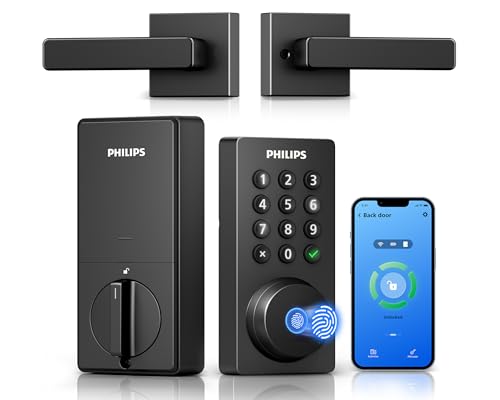
Pros
- Built-in WiFi, no hub required
- Fingerprint entry in 0.3 seconds
- One-time and recurring PIN codes
- Matching handle set included
Cons
- Requires 2.4GHz WiFi within 33 feet
- Batteries not included, alkaline only
Start With the Way You Enter
Fingerprint access is useful when you want to leave keys and phones behind. The eufy Security Smart Lock C220 offers fingerprint, app, keypad, physical-key, Apple Watch, and voice options, while the Veise VE017 Fingerprint Smart Door Lock with App adds fob-card access and several temporary or recurring code types.
Keypad access is often the better fit for guests, cleaners, or short-term occupants because you can share a code without handing over a key. Schlage supports up to 100 access codes, and the Philips Wi-Fi Smart Deadbolt Lock supports up to 100 custom passcodes plus one-time and scheduled codes.
Pro Tip: Choose one primary entry method for daily use, then confirm that every household member has a practical backup such as a code or physical key.
Remote control also varies. Built-in Wi-Fi appears on the eufy, Schlage, and Philips models, while the Veise VE017 needs the G1 Gateway for remote access and voice control. The Aqara U400 uses Matter over Thread and requires a Thread-enabled Matter controller for each supported ecosystem.
Match Connectivity to Your Smart Home
If you want a lock that works without an added bridge, built-in Wi-Fi is the simplest path, although the Philips models require a 2.4GHz network and have stated distance limits from the router. The eufy model also works without a bridge and can join routines with a compatible eufy doorbell.
The Aqara U400 is the most platform-focused option in this group. It supports Apple Home Key, HomeKit, Alexa, Google, and Home Assistant through Matter over Thread, plus UWB hands-free unlocking on compatible Apple hardware. That flexibility is valuable only if your existing hubs and phones meet its requirements.
Smart-home access deserves a security check rather than an assumption that every platform behaves alike. For broader context on digital entry risks, read about whether a smart lock can be hacked, and review the manufacturer requirements before buying a hub-dependent model.
FYI: BHMA certification refers to recognized grades for lock performance, strength, durability, and finish. The product data identifies BHMA certification or Grade 3 status, but the certification label does not replace checking your door’s fit.
| Entry style | Connectivity | Useful placement |
|---|---|---|
| Fingerprint and code | Built-in Wi-Fi | Main front door |
| Apple Home Key and UWB | Matter over Thread | Apple-connected home |
| Code and physical key | App or gateway | Guest access door |
Check Power, Weather, and Hardware
Battery planning is easy to overlook because the locks use different power systems. The eufy C220 runs on eight AA batteries for around eight months, Schlage uses four AA batteries for up to six months, and the Philips WiFi Keypad Deadbolt with Handle also states up to six months. The Veise VE017 lists about 12 months with four AA batteries, but its batteries are not included.
The Aqara U400 uses a removable rechargeable lithium battery lasting up to six months per charge, with USB-C charging and a low-battery alert below 20 percent. The Philips Wi-Fi Smart Deadbolt Lock does not include batteries and supports AA alkaline batteries only, so check the required battery type before installation.
Before You Mount It: Do not assume a deadbolt will fit every door. Confirm the existing deadbolt, bore, backset, door thickness, and router location, and remember that the Philips Wi-Fi Smart Deadbolt Lock does not include a door sensor.
Outdoor exposure matters at the entry door. The eufy C220 is IP53-rated and the Aqara U400 is IP65-rated, while the Schlage and Veise descriptions emphasize security features and battery alerts without providing an IP rating. For door hardware basics, see why the strike plate matters.
Expert Examined
From Marcus Bell

I keep spare batteries where they are easy to reach, not buried in a utility drawer. The mistake I see is waiting for a low-battery alert and then discovering that the correct battery type or emergency charging method is unavailable.
Read more about Marcus BellInstallation requirements deserve equal attention. Several models are designed for screwdriver installation, but the Philips WiFi Keypad Deadbolt with Handle includes a matching handle set, making it a different hardware project from a replacement deadbolt alone.
Which Lock Fits Your Door Routine
I would point families that want many entry choices to the eufy Security Smart Lock C220. Its fingerprint, keypad, app, key, Apple Watch, and voice options cover varied routines, and built-in Wi-Fi avoids a bridge. The stated eight-month AA battery life and IP53 rating also suit a typical front-door installation.
I would put the Schlage Encode Smart WiFi Deadbolt Lock on a door where code management is the priority. It supports up to 100 access codes, history, notifications, auto-lock, Alexa and Google Home, and a physical backup key. Its BHMA-certified security rating and built-in alarm add useful features for a household managing several users.
For an Apple-centered home, I would choose the Aqara UWB Smart Lock U400, Apple Home Key. Apple Home Key, fingerprint access, NFC cards, passcodes, app control, and physical keys give you alternatives, while UWB can provide hands-free entry when the required Apple hardware and software are already in place.
The Bottom Line
The mistake most buyers make is choosing the most appealing unlocking feature without checking the required hub, phone, battery, network, or door hardware. A fingerprint reader cannot solve a poor fit, and remote access may depend on Wi-Fi or a separately required gateway.
If you do one thing first, inspect the existing deadbolt and write down your preferred everyday entry method. Then choose the model whose connectivity, power system, and access controls match that door and routine.
FAQs
Fingerprint and keypad models avoid the need to carry a phone or key. Models such as the eufy C220, Veise VE017, and Philips locks combine those options with app or physical-key access, giving different household members a practical choice. Some models have built-in Wi-Fi and do not need an extra bridge, including the eufy C220 and Schlage Encode. The Veise VE017 requires the G1 Gateway for remote access and voice control, while the Aqara U400 requires Thread-enabled Matter controllers for its supported ecosystems. Battery life depends on the model and use. The listed estimates range from about six months to around 12 months for AA-powered locks, while the Aqara uses a rechargeable battery lasting up to six months per charge. Keep the required replacement or charging method available. BHMA certification indicates recognized evaluation of lock performance, strength, durability, or finish. It is useful evidence about the lock, but you still need to confirm door compatibility, installation, and the physical security of the surrounding frame.Which type of smart lock is easiest for family entry?
Can a smart deadbolt work without a hub?
How often should I plan for battery maintenance?
What does BHMA certification mean on a smart lock?
Sources
- Builders Hardware Manufacturers Association and hardware standards information. www.buildershardware.com
- UL Solutions and safety certification information. www.ul.com