
Installing the best CCTV security cameras protects a property against the signal dropouts and dead batteries that plague consumer wireless gear. The primary hurdle is deciding whether to run digital Ethernet cabling to an IP hub or use traditional coaxial lines linked to a central recorder. Property layouts dictate the right choice long before any mounting brackets go up.

Pros
- Built-in 10.1-inch monitor on 4K NVR
- Pre-installed 1TB drive without subscription fees
- AI human detection filters pet false alerts
- Expandable system supports up to 10 channels
Cons
- One-way audio with no two-way talk
- Requires plug-in power outlets for cameras

Pros
- Smart person and vehicle detection
- Pre-installed 2TB hard drive
- High-definition 5MP resolution
- Plug and play PoE setup
Cons
- Requires wired Ethernet installation
- Limited to one additional HDD

Pros
- Pre-installed 1TB drive with no monthly fees
- Eight IP66 weatherproof cameras with 80ft night vision
- AI smart motion identifies people, vehicles, and pets
- Local recording operates without an internet connection
Cons
- Requires running physical BNC cables to every camera
- Camera resolution is limited to 1080p

Pros
- Pre-installed 500GB hard drive for 24/7 recording
- AI human and vehicle motion detection
- 80ft infrared night vision with 24 LEDs
- Expandable 8-channel DVR accepts 4 extra cameras
Cons
- Requires running physical BNC wires to DVR
- Includes only four cameras for an 8-channel DVR

Pros
- IK10 vandal-proof and IP67 weatherproof dome housing
- AI detection filters human and vehicle movement
- Included 4TB hard drive expandable to 16TB
- Up to 100ft night vision on 5MP cameras
- Single-cable PoE carries power and video simultaneously
Cons
- Fixed 2.8mm lenses lack optical zoom or PTZ controls
- Requires physical network cable runs for 16 cameras
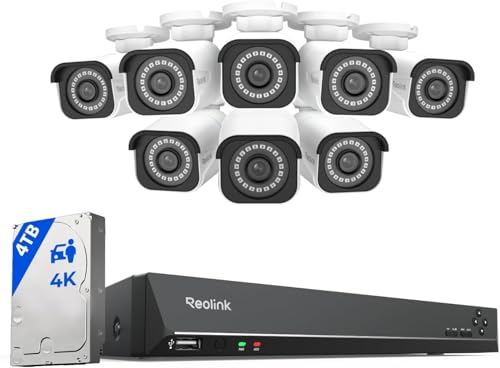
Pros
- 8MP 4K resolution with digital zoom
- Smart person and vehicle shape detection
- Pre-installed 4TB HDD expandable to 16TB
- PoE network cables reach up to 330 feet
Cons
- Cameras only work with Reolink PoE NVRs
- No compatibility with Alexa or smart home systems
- Wired PoE only with no Wi-Fi support
PoE Network Systems Versus Coaxial DVRs
Cabling structure dictates video reliability over long distances. Power over Ethernet feeds video, audio, and camera electrical current across a single Cat5 or Cat6 strand up to 330 feet without signal degradation. Understanding what is an NVR and how is it different from a DVR prevents costly wiring mistakes behind finished drywall.
Analog systems utilize BNC coaxial lines with attached direct-current power leads. Coax remains functional across existing retrofit wiring, but running high-definition video over extended coaxial distances risks analog noise and radio interference. If you plan to pull new wires through attic spaces, Ethernet delivers superior bandwidth and simpler connections.
| System Type | Transmission Cable | Max Native Detail |
|---|---|---|
| PoE NVR | Cat5 or Cat6 | 4K 8MP Digital |
| Analog DVR | BNC Coaxial | 5MP Lite Compressed |
| Stand-Alone Wi-Fi | Wireless Spectrum | 5MP Compressed |
Pro Tip: Pull raw bulk Cat6 network cable through exterior conduits rather than pre-terminated patch cables. Terminating RJ45 heads after pulling wires allows you to drill tiny half-inch holes rather than punching large gaps through siding.
Local Hard Drive Storage and Retention Limits
Continuous around-the-clock recording demands dedicated surveillance-grade storage rather than standard desktop computer disks. Surveillance hard drives handle constant multi-stream write cycles without overheating or dropping frames during busy daytime hours. Modern H.265 compression reduces stream file sizes significantly, extending how long a 1TB or 2TB drive stores continuous footage before overwriting older events.
Clear historical footage proves invaluable during property boundary disputes or insurance investigations. Knowing whether is security camera footage admissible in court reinforces the necessity of zero dropped frames and accurate timestamping. Setting detection zones to record only vehicle and human movements also stretches drive life while keeping event timelines manageable.
Expert Examined
From Marcus Bell

I frequently see homeowners point outdoor lenses toward bright skies or street lamps, which washes out the foreground exposure. Align your lens downward so the horizon occupies the upper quarter of the frame, ensuring infrared LEDs illuminate faces instead of open night sky.
Read more about Marcus BellCamera Housing and Weather Durability
Outdoor cameras face driving rain, freezing moisture, and direct summer heat. Hardware bearing an IP66 rating resists windblown dust and strong water sprays, making it solid for covered soffits. Premium commercial enclosures step up to IP67 waterproofing and IK10 impact protection, which prevents vandals from disabling feeds with thrown rocks or blunt impacts.
Heads Up: Avoid running camera cabling along exterior walls without metal conduit or protective junction boxes. Exposed low-voltage wiring invites rodent damage and leaves your security system vulnerable to quick snips with garden shears.
Hardware diagnostics also matter once units are attached high under the eaves. Checking what do the lights on a security camera mean helps you confirm solid link status and infrared night vision operation without unmounting hardware. Standards organizations like the Federal Communications Commission mandate basic RF compliance, ensuring local digital transmitters do not disrupt surrounding home appliances.
Matching Hardware to Your Property
For standard single-family residential layouts needing pristine resolution, I would point you to the REOLINK 8CH 5MP PoE Security Camera System. Its digital PoE architecture, 2TB hard drive, and plug-and-play network cables provide reliable day-and-night vehicle detection without cloud subscription fees.
Outbuilding surveillance and larger commercial lots demand heavier builds. For multi-building setups or perimeter monitoring across sprawling walls, the 4COVR 16 Channel PoE Security Camera System delivers 16 IK10 vandal-proof dome cameras backed by a spacious 4TB recorder.
If you face tight budget constraints or already own pre-run coaxial wiring from an older setup, the ZOSI 8CH 3K Lite Home Wired Security Camera handles basic coverage affordably. It leverages analog BNC connections and AI vehicle alerts to guard driveways without monthly fees.
The Bottom Line
The single error most buyers commit is underestimating the difficulty of running physical cables to perimeter eaves. Purchasing high-channel equipment before checking attic clearances or wall voids leads to abandoned hardware and cluttered installs.
Map your cable pathways from the central recorder out to each exterior corner before purchasing hardware. Confirming straightforward access points ensures you get the full reliability of a hardwired surveillance grid without unnecessary renovation headaches.
FAQs
Do wired CCTV camera systems work without an internet connection?
Yes, closed-circuit security camera packages operate completely offline when connected to a local recorder and dedicated monitor. An active internet link is only required if you want remote mobile alerts and live phone streaming away from home.
What is the difference between PoE and traditional coaxial CCTV cameras?
PoE systems route power and digital data over a single network cable, preserving high resolution across long runs. Coaxial systems use analog cables with dual-lead power connections, which are simpler for legacy upgrades but more prone to signal noise.
How many days of footage does a 1TB security hard drive hold?
A 1TB hard drive recording four 1080p cameras continuously under modern H.265 compression typically holds between seven and ten days of video. Storage duration increases significantly if the recorder is switched to motion-triggered recording modes.
Can CCTV security cameras withstand sub-zero winter temperatures?
Most outdoor CCTV cameras with an IP66 or IP67 rating function safely down to minus 13 degrees Fahrenheit. Internal electronic components generate a small amount of operating warmth that helps keep the camera housing clear of condensation.
Sources
- Federal Communications Commission Technical Standards www.fcc.gov
- US Consumer Product Safety Commission Guidelines www.cpsc.gov