
Shopping for the best 15 amp smart plugs is mainly a platform decision: Matter offers broad compatibility, while HomeKit-focused models suit Apple households. You are choosing between compact single-outlet control, offline operation, energy monitoring, and the pack size that fits your rooms.

Pros
- Matter support across major smart home platforms
- Compact design helps preserve nearby outlet access
- UL certified flame-retardant design
- Scheduling, timers, app, and voice control
Cons
- 2.4 GHz Wi-Fi only
- Limited to 15A/1800W maximum
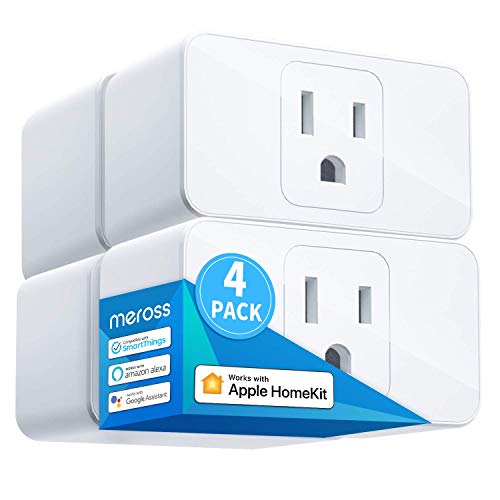
Pros
- Apple HomeKit, Alexa, Google Assistant compatible
- 15A capacity for appliances up to 1800W
- Compact design leaves room for two plugs
- Scheduling supports sunrise and sunset settings
Cons
- HomeKit remote control needs an online bridge
- Requires a 2.4GHz Wi-Fi network

Pros
- Apple HomeKit and Siri support
- Works with Alexa, Google Assistant, SmartThings
- Compact design preserves the adjacent outlet
- UL certified flame-retardant design
Cons
- 2.4GHz Wi-Fi only
- HomeKit remote control needs an Apple device

Pros
- Matter support for Apple Home, Alexa, Google Home
- Energy monitoring tracks usage over time
- Compact design helps preserve adjacent outlet space
- UL-certified flame-retardant design and 2-year warranty
Cons
- Requires 2.4GHz Wi-Fi
- 15A/1800W maximum load

Pros
- Matter support across major smart-home platforms
- 15A/1800W capacity for household electronics
- Remote control, timers, and scheduling
- FCC certified with overload protection
Cons
- Hub required for most listed platforms
- 2.4GHz Wi-Fi and IPv6 network only

Pros
- Matter support for major smart home platforms
- 15A/1800W capacity
- Remote app control from anywhere
- Voice control with Siri and Alexa
- Timers and schedules for automation
Cons
- Requires 2.4GHz Wi-Fi and IPv6
- Hub required for most Matter platforms
Match the plug to your smart home
Matter is the broadest route in this group. The TP-Link Tapo Matter Supported Smart Plug Mini, Kasa Matter Smart Plug with Energy Monitoring, and both Linkind models work with certified platforms including Apple Home, Alexa, Google Home, and SmartThings. That makes them easier to place in a mixed-platform home.
Apple households have another clear option. The Tapo Apple HomeKit Smart Plug Mini, 15A supports Siri, Alexa, and Google Home as well as Apple HomeKit, although Apple Home remote control requires an additional networked Apple device at home. The meross Smart Plug 15A, Works with Apple Home also requires a HomeKit bridge for remote control.
For broader smart-home planning, the smart sensors and home automation section can help you think about how plugs fit alongside other connected devices.
Pro Tip: Choose Matter when several household members use different smart-home platforms. Check hub or controller requirements before setup, especially for Apple Home, Alexa, Google Home, or SmartThings.
Offline control and network requirements
The Matter models support local-area-network control, so compatible Matter devices can continue communicating within the home when the internet is offline. That does not mean every remote feature works without internet, but it can reduce dependence on cloud access for local control.
All six choices use 2.4GHz Wi-Fi. Linkind adds an IPv6 requirement and says its Matter plugs need a certified controller for Apple Home, Alexa, Google Home, and SmartThings, while the AiDot app can be used without a hub. Those details matter more than voice-assistant names on the box.
| Device type | Key distinction | Best fit |
|---|---|---|
| Matter plug | Broad platform support | Mixed smart homes |
| HomeKit plug | Apple-focused setup | Siri households |
| Energy-monitoring plug | Tracks usage over time | Consumption tracking |
Before buying several units, confirm that your network and preferred app meet the product’s requirements. For related Apple-device decisions, see these HomeKit-compatible security options.
Capacity, compactness, and safety details
Every product listed is rated for 15A and 1800W, but the pack sizes differ. The Tapo Matter model comes as a three-pack, the Tapo HomeKit model and Kasa Matter model come as four-packs, meross comes as a four-pack, Linkind offers a four-pack, and another Linkind listing provides two plugs.
Compact designs help preserve access to the neighboring outlet. Tapo and Kasa describe UL-certified flame-retardant construction, meross lists ETL and FCC certification, and Linkind lists ETL or FCC certification depending on the model. Certification markings should be treated as product information, not permission to exceed the stated capacity.
Check the Load: Never connect an appliance that exceeds the plug’s stated 15A/1800W capacity. A smart plug adds control, not a higher electrical limit, and flame-retardant materials do not make overloading safe.
For broader household electrical-safety context, the US Consumer Product Safety Commission publishes consumer guidance about electrical products and hazards. If your intended appliance has unusual startup demands, ask a qualified electrician before using a smart plug.
Expert Examined
From Marcus Bell

I keep the setup simple by assigning one plug to one clearly labeled appliance. The mistake I see is buying a multi-pack first and only later discovering that the chosen app, hub, or network requirement does not match the household’s existing system.
Read more about Marcus BellWhich plug fits your rooms
I would put the TP-Link Tapo Matter Supported Smart Plug Mini in a mixed-platform home that needs compact plugs for lamps, fans, humidifiers, or seasonal lights. Matter support covers Apple Home, Alexa, Google Home, and SmartThings, while local-network control and Bluetooth onboarding make its feature set especially useful when several people share control.
I would point Apple-focused households toward the Tapo Apple HomeKit Smart Plug Mini, 15A when Siri control is the priority. Its compact, UL-certified design, scheduling, timer functions, and support for Alexa and Google Home leave room for a household that may expand beyond Apple Home later.
For someone who wants consumption information as well as switching, I would choose the Kasa Matter Smart Plug with Energy Monitoring. It combines Matter compatibility with usage tracking over time, making it the most suitable choice for rooms where you want to understand how connected appliances are being used. The Linkind two-pack is the practical alternative when you need a smaller starting quantity and accept its controller requirements.
The Bottom Line
The mistake most buyers make is treating every 15A smart plug as interchangeable. Platform support, hub requirements, local control, 2.4GHz Wi-Fi, pack size, and energy monitoring can change whether a plug fits your home.
If you only do one thing first, identify the app or platform that everyone in the household will use. Then select a Matter model for broad compatibility, a HomeKit model for an Apple-centered setup, or the Kasa option when energy tracking is the deciding feature.
FAQs
The Matter models support certified platforms including Apple Home, while the Tapo HomeKit and meross models specifically list Apple HomeKit support. Remote Apple Home control may require an additional networked Apple device or a compatible Matter controller, depending on the model. The Matter models describe local-area-network control, allowing compatible Matter devices to communicate locally when home internet is offline. Remote control from outside the home is a separate function and may require internet access. The listed models are rated for appliances up to 15A and 1800W, including examples such as lamps, fans, humidifiers, and seasonal lights. Do not exceed the stated capacity, and seek professional advice for unusual loads. The product data identifies UL certification for several Tapo and Kasa models and ETL certification for meross and Linkind models. These markings provide safety and conformity information, but they do not increase the plug’s rated electrical capacity.Do these 15 amp smart plugs work with Apple Home?
Do smart plugs still work if the internet goes out?
What appliances can I use with a 15A smart plug?
What does UL or ETL certification mean here?
Sources
- US Consumer Product Safety Commission www.cpsc.gov
- UL Solutions www.ul.com