
Shopping for the best Wi-Fi thermostats for vacation home means confirming the HVAC system before choosing remote access. The key split is whether your property uses conventional central heating and cooling, a broader HVAC setup, or a ductless AC, making this selection useful for owners who want to manage an empty home from anywhere.

Pros
- Remote app control and real-time monitoring
- 7-day programmable temperature scheduling
- Backlit LCD for dark rooms
- Temperature control within 2°F
Cons
- Requires a 24V C-wire and no batteries
- Works only with 2.4GHz Wi-Fi

Pros
- Matter support across major smart-home platforms
- Flexible 24/7 heating and cooling schedules
- Remote app and voice control
- Alerts for filters and system malfunctions
Cons
- C-wire required for some wiring configurations
- Not compatible with electric baseboard heaters
- Compatibility check required before purchase

Pros
- Remote control through Smart Life App
- Alexa and Google Home compatible
- 7-day or 5-1-1 scheduling
- Supports non-programmable mode
Cons
- Requires C-wire, cannot use batteries
- Not compatible with multi-stage systems
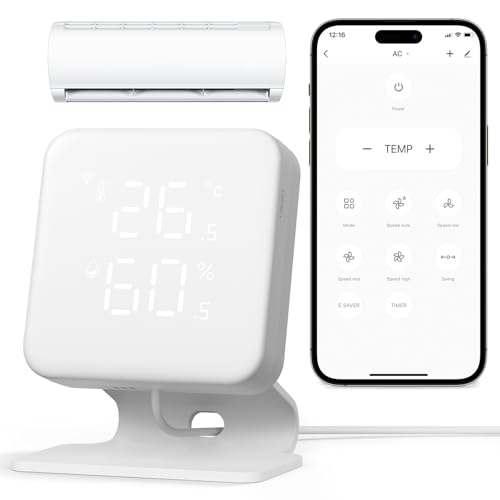
Pros
- Works with 300+ AC brands
- Built-in temperature and humidity display
- Alexa and Google Home control
- 7-day schedules and geofencing
Cons
- 2.4GHz WiFi only, no 5GHz
- Requires IR line of sight

Pros
- 5-2 day scheduling
- Large backlit display with clear font
- Battery powered, no C-wire required
- UWP wall plate simplifies installation
Cons
- Not compatible with electric baseboard heat
- Two AA batteries not included

Pros
- Smart alerts for filters and system malfunctions
- Remote control through the meross app
- Matter, Apple Home, Alexa, Google Assistant compatible
- Flexible schedule and child lock
Cons
- C wire required for some setups
- Not compatible with 110V, 120V, or 240V baseboards
Start With the HVAC Match
A vacation property may sit empty for days, so an incompatible thermostat can create a bigger problem than a missing convenience feature. The Riseem model is limited to conventional single-stage 1 Heat/1 Cool systems and requires a C-wire, while the Honeywell Home X2P supports 1 Heat/1 Cool systems without a C-wire because it uses two AA batteries.
The meross Matter Smart Thermostats for Home and meross Smart WiFi Thermostats for Home cover a wider range that includes heat pumps, furnaces, boilers, dehumidifiers, and humidifiers, although neither supports electric baseboard heaters, millivolt thermostats, or two-wire systems. The XuLuaba option supports several system types but excludes multi-stage systems and heat pumps with auxiliary or emergency heat.
Before You Wire: Do not assume a thermostat works because the wall plate looks similar. Match your system and terminal wiring first, especially if the property has a heat pump, multiple stages, or a line-voltage heater.
| Device type | Main requirement | Best fit |
|---|---|---|
| Conventional thermostat | System and C-wire check | Central HVAC |
| Battery programmable | 1 Heat/1 Cool | C-wire-free homes |
| AC controller | IR line of sight | Ductless units |
Remote Control Needs a Reliable Connection
Remote control is especially useful for a second home because you can adjust the temperature before arrival and change schedules while away. Riseem, XuLuaba, and both meross models offer app control, while the meross choices also add voice-platform compatibility and alerts related to filters, malfunctions, or long-term operation.
Check the property’s Wi-Fi band before ordering. Riseem and WOOX specify 2.4GHz Wi-Fi only, and WOOX pairs with ductless, window, and portable AC units through infrared signals rather than central HVAC wiring.
For broader home automation, the Smart Thermostats category provides useful context, while Matter support on the meross models can connect locally with Apple Home, Alexa, Google Home, Home Assistant, and Samsung SmartThings.
Pro Tip: Save the thermostat’s system type, wiring details, and Wi-Fi band in your property notes before traveling. That makes remote troubleshooting easier when nobody is nearby.
Schedules Matter More in an Empty Home
Vacation properties benefit from schedules that reduce unnecessary heating or cooling while preserving a comfortable arrival temperature. Riseem supports seven-day programming, XuLuaba supports seven-day and 5-1-1 options, Honeywell Home uses a 5-2 schedule, and both meross models provide flexible scheduling for home, away, and sleep periods.
WOOX adds a different approach for ductless systems, combining hourly seven-day schedules with geofencing. Its built-in display shows temperature and humidity, and the app can create rules based on either reading. If indoor air quality is also a concern, consider pairing climate planning with Wi-Fi smoke and carbon monoxide detection.
Expert Examined
From Dana Whitfield

I keep seeing remote-control plans fail at the compatibility stage rather than the app stage. I would photograph the existing wiring and identify the HVAC type before removing anything, then arrange help locally if the property will be unoccupied during installation.
Read more about Dana WhitfieldWhich Thermostat Fits Your Vacation Property
I would point you to the meross Matter Smart Thermostats for Home if your second home uses a supported heat pump, furnace, boiler, humidifier, or dehumidifier and you want Matter connections across several smart-home platforms. Its 24/7 scheduling, app control, and system alerts suit owners who want both remote adjustments and status information.
I would choose the WiFi Thermostats for Home Smart Thermostat for a conventional single-stage 1 Heat/1 Cool system when seven-day programming and app control are priorities, provided a C-wire and 2.4GHz network are available. For a ductless mini-split, window AC, or portable AC, I would choose the WOOX Smart AC Controller instead because it uses IR control and does not require central HVAC wiring.
The Bottom Line
The biggest mistake is treating every smart thermostat as a universal replacement. Wiring, system type, C-wire needs, heat-pump limitations, and the difference between central HVAC and an IR-controlled ductless unit determine whether the device is appropriate.
If you do one thing first, identify the existing HVAC system and photograph every thermostat terminal. Then confirm the required wiring and Wi-Fi band against the product details before choosing remote scheduling or smart-home integration.
FAQs
A ductless mini-split, window AC, or portable AC needs a different approach from central HVAC. The WOOX Smart AC Controller uses IR signals, supports compatible ductless units, and requires line of sight to the AC receiver. Several models require a C-wire, including Riseem and XuLuaba, while the meross models require one for some configurations. Honeywell Home X2P uses two AA batteries and does not require a C-wire, but compatibility remains limited to supported systems. Yes. The listed smart models provide app control and scheduling, with options ranging from seven-day programming to 5-1-1 or 5-2 schedules. The meross models also support flexible home, away, and sleep routines. Matter is a smart-home connection standard supported by the meross models in this selection. Their listed compatibility includes Apple Home, Alexa, Google Home, Home Assistant, and Samsung SmartThings.Which thermostat type suits a vacation home with ductless AC?
Do these smart thermostats need a C-wire?
Can I schedule temperatures while I am away?
What does Matter mean for a vacation-home thermostat?
Sources
- U.S. Department of Energy www.energy.gov
- U.S. Consumer Product Safety Commission www.cpsc.gov