
Choosing the best smart thermostats for mitsubishi mini split starts with one practical check: your indoor unit must accept signals from an infrared remote for most controller-style options. This selection suits homeowners deciding between basic app control, richer climate sensing, and multi-zone management.

Pros
- 7-day customizable scheduling
- Real-time temperature and humidity monitoring
- Alexa and Google Home compatibility
- Supports 99% of AC brands via IR learning
Cons
- Requires an IR remote-controlled air conditioner
- Not supported by AC brands starting with D

Pros
- Smart ductless mini-split controller
- Compact 3.6-inch square design
- Lightweight 0.58-pound package
- Black finish
Cons
- No sensor type specified
- No installation method specified

Pros
- Built-in air quality sensor
- Controls compatible AC and mini splits
- Geofencing helps reduce wasted cooling
- Apple HomeKit, Google Home, Alexa support
Cons
- Requires a remote-controlled AC unit
- App and WiFi or Bluetooth setup required
Pros
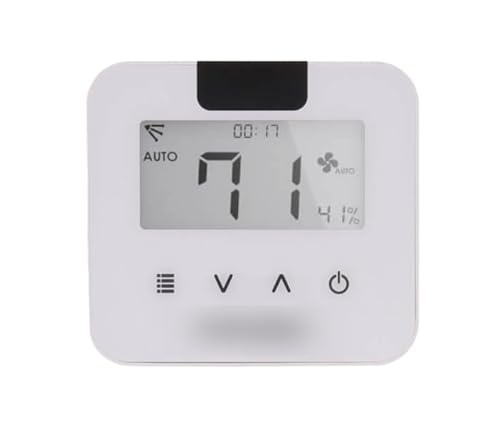
- Genuine OEM-quality replacement
- Infrared Bluetooth control
- Programmable thermostat settings
- Straightforward installation process
Cons
- Designed for MRCOOL ductless mini splits
- Generic brand labeling
Pros
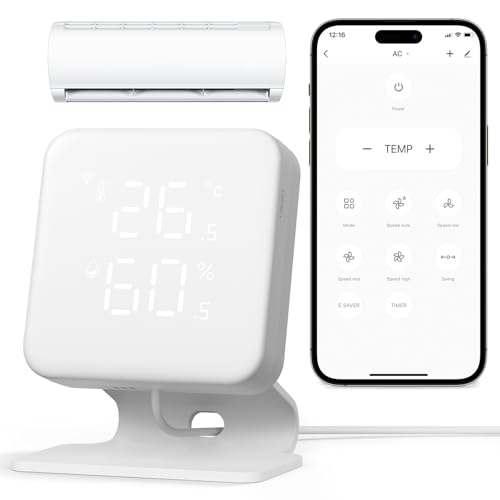
- Works with 300+ AC brands
- Built-in temperature and humidity display
- Alexa and Google Home control
- 7-day schedules and geofencing
Cons
- 2.4GHz WiFi only, no 5GHz
- Requires IR line of sight

Pros
- Works with over 20,000 AC models
- AI-based Comfy Max climate control
- Schedules continue during internet outages
- Alexa, Google, SmartThings, and IFTTT support
Cons
- 2.4 GHz Wi-Fi required
- IR remote compatible units only
Confirm the Control Method First
These products are not all the same kind of thermostat. The Smart Air Conditioner Controller, WOOX Smart AC Controller, Cielo Breez Max Smart WiFi Thermostat for Mini-Split, and Sensibo Air PRO work with remote-controlled air conditioners through infrared signals. That makes the indoor unit’s remote receiver and line of sight central to placement.
The Honeywell Home D6 Smart Mini-Split Ductless is described as an HVAC control thermostat, while the MTSK02 Mini-Stat Infrared Bluetooth Thermostat is presented as a replacement part for MRCOOL equipment. Check the equipment relationship carefully before treating either as a universal add-on.
Before You Mount It: Do not assume every Mitsubishi system will accept an infrared controller. Confirm that the indoor unit uses an IR remote, then place the controller where its signal can reach the AC receiver.
Match Sensors and Automation to the Room
Built-in temperature and humidity sensing separates the more capable room controllers from simple remote accessories. WenzhiIoT reports temperature and humidity readings, WOOX adds an LED display and history trends, and Cielo Breez Max includes sensors that can be calibrated in its app.
Sensibo Air PRO adds an air quality sensor, plus geofencing and Climate React features that use temperature and humidity information. For households focused on schedules, WOOX and WenzhiIoT offer seven-day programming, while Cielo adds Home, Away, and Sleep presets.
| Controller type | Distinguishing feature | Placement priority |
|---|---|---|
| IR smart controller | Remote app and voice control | Clear receiver line |
| Climate-focused controller | Temperature and humidity sensing | Representative room location |
| Replacement thermostat | OEM-style equipment fit | Confirm unit compatibility |
Smart-home support also varies. WenzhiIoT and WOOX list Alexa and Google Home compatibility, Cielo adds Google Home, Alexa, IFTTT, and SmartThings, and Sensibo lists Apple HomeKit alongside Google Home and Alexa. You can find related ecosystem ideas in our Smart Thermostats category.
Plan for WiFi, Power, and Zones
WOOX and Cielo specify 2.4GHz WiFi, and WOOX does not support 5GHz. Cielo also states that schedules can continue when internet connectivity is lost, which matters if routine comfort should continue during a temporary connection problem.
Cielo Breez Max is the clearest fit for a multi-zone mini-split arrangement because one controller can be paired with each indoor unit to help avoid mode conflict. Sensibo may suit a home or office with several remote-controlled units, but the listed product is a three-pack, so consider whether that quantity matches your rooms.
Expert Examined
From Marcus Bell

I keep seeing the same installation mistake with IR climate controllers: the device gets tucked behind furniture or placed where the indoor unit cannot see it. I would reserve a visible spot near the room’s living area and verify the AC receiver location before fixing anything to a wall.
Read more about Marcus BellFor broader home-safety planning, the Smart Energy and Climate Control category can help you organize related automation choices. The U.S. Consumer Product Safety Commission is also a useful authority for general household product safety information.
Which Controller Fits Your Mitsubishi Setup
I would point you to the Smart Air Conditioner Controller if you want a low-complexity way to add app, voice, humidity, and seven-day schedule functions to an IR-controlled mini-split. Its IR learning feature is useful when your exact AC model is not automatically recognized, though the stated exception for brands beginning with “D” deserves attention.
I would choose the Breez Max Smart WiFi Thermostat for Mini-Split for a household that wants on-device controls, AI-based comfort automation, usage history, filter status tracking, and multi-zone coordination. Its 6-to-12-foot placement guidance gives you a clear starting point for positioning it.
For a room where air quality is a major priority, I would consider the 3 Pack Sensibo Air PRO – Air Conditioner. It combines an air quality sensor with geofencing, humidity-aware climate control, and broad smart-home integration.
The Bottom Line
The mistake most buyers make is treating every mini-split thermostat as a wired replacement for the original control system. The products here mainly depend on IR communication, so compatibility and line of sight matter before app features or scheduling.
If you do only one thing first, locate your Mitsubishi indoor unit’s remote receiver and confirm that its supplied remote uses infrared control. Then select the controller whose sensing, smart-home platform, and zone features match the room.
FAQs
Most controller-style options in this selection require an air conditioner with IR remote control. If the unit does not accept infrared signals, the controller may not apply, so confirm the indoor unit and remote setup first. Place it where the AC receiver can see it without furniture blocking the signal. Cielo specifies a 6-to-12-foot range for Breez Max, while WOOX and other IR devices also require a clear line of sight. The listed controllers are described with USB cables, adapters, or WiFi setup instructions rather than battery operation. Review the included power accessories and place the controller near a suitable outlet. OEM means original equipment manufacturer quality or a part designed around the manufacturer’s equipment standards. It does not automatically mean universal compatibility, so match the replacement part to the specified unit.Do Mitsubishi mini splits need an infrared thermostat?
Where should a mini-split smart controller be placed?
Do these smart thermostats need batteries?
What does OEM mean for a mini-split thermostat?
Sources
- U.S. Consumer Product Safety Commission www.cpsc.gov
- UL Solutions www.ul.com