
Shopping for the best smart thermostats for mini split systems starts with one compatibility check: your indoor unit must respond to an IR remote. The real choice is whether you want simple remote control, richer climate sensing, or multi-zone automation, especially if you are replacing a window, portable, or ductless controller.

Pros
- 7-day customizable scheduling
- Real-time temperature and humidity monitoring
- Alexa and Google Home compatibility
- Supports 99% of AC brands via IR learning
Cons
- Requires an IR remote-controlled air conditioner
- Not supported by AC brands starting with D

Pros
- Smart ductless mini-split controller
- Compact 3.6-inch square design
- Lightweight 0.58-pound package
- Black finish
Cons
- No sensor type specified
- No installation method specified

Pros
- Built-in air quality sensor
- Controls compatible AC and mini splits
- Geofencing helps reduce wasted cooling
- Apple HomeKit, Google Home, Alexa support
Cons
- Requires a remote-controlled AC unit
- App and WiFi or Bluetooth setup required
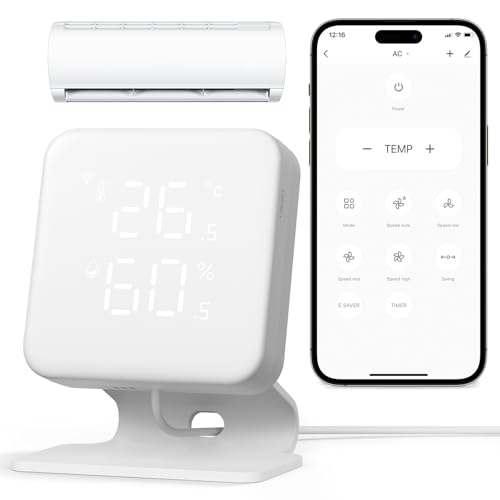
Pros
- Works with 300+ AC brands
- Built-in temperature and humidity display
- Alexa and Google Home control
- 7-day schedules and geofencing
Cons
- 2.4GHz WiFi only, no 5GHz
- Requires IR line of sight
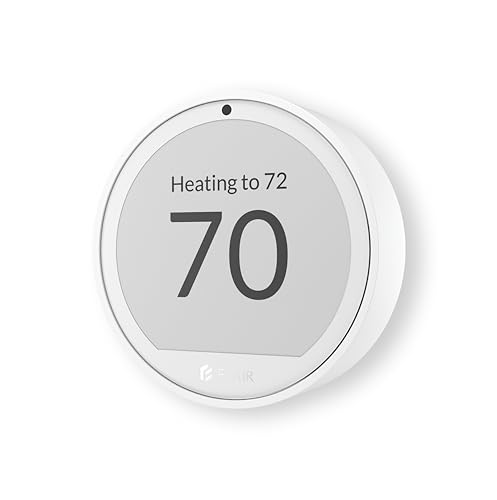
Pros
- Room-by-room temperature and humidity monitoring
- Works with 200+ mini split brands
- Up to 1-year battery life
- Alexa and Google Assistant support
Cons
- Flair Bridge required for central HVAC
- Smart Vents needed for airflow balancing

Pros
- Works with over 20,000 AC models
- AI-based Comfy Max climate control
- Schedules continue during internet outages
- Alexa, Google, SmartThings, and IFTTT support
Cons
- 2.4 GHz Wi-Fi required
- IR remote compatible units only
Start With IR Compatibility
These products communicate with the air conditioner through infrared signals rather than replacing a wired HVAC thermostat. That makes them suitable for many remote-controlled mini-splits, window units, and portable ACs, but not for central HVAC, ducted systems, or units without IR control.
Placement matters because the controller needs a clear path to the AC receiver. WOOX specifically requires line of sight, while Cielo Breez recommends positioning Breez Max within 6 to 12 feet. Before buying, confirm that the controller can face the indoor unit from a practical shelf or wall location.
Before You Mount It: Do not hide an IR controller behind furniture or inside a cabinet. A blocked signal can prevent temperature, mode, and fan commands from reaching the AC.
Match Sensing to the Room
A basic remote controller can be enough if you mainly want app access, voice commands, and schedules. WenzhiIoT, WOOX, and Cielo Breez add temperature and humidity sensing, while Sensibo Air PRO also includes an air quality sensor for rooms where indoor conditions matter beyond temperature.
Sensor location changes the meaning of every automation. A controller near a supply vent may read a different temperature from the seating area, so place it where people spend time while keeping the IR path open. For broader room control, Flair Puck 2 can provide room-level sensing and works with Flair Smart Vents in central HVAC setups.
| Device approach | Main sensing | Best placement |
|---|---|---|
| IR controller | Temperature and humidity | Open view of AC |
| Air quality controller | Air quality plus climate | Main living area |
| Room sensor thermostat | Room temperature and humidity | Occupied room |
For background on connected climate equipment and related home systems, see the Smart Thermostats category.
Schedules, Zones, and Power
Weekly schedules are useful when your routine is predictable. WenzhiIoT and WOOX offer seven-day scheduling, while Cielo Breez adds Home, Away, and Sleep presets, geofencing, usage history, and schedules that continue operating if internet connectivity is lost.
Multi-zone homes need extra care because indoor units can conflict when they are assigned different modes. Cielo Breez Max is specifically designed for multi-zone coordination, with one unit paired to each indoor unit. Flair Puck 2 is battery-powered, but its Bridge is required for central HVAC and optional for mini-splits in USB-powered Solo Mode.
Expert Examined
From Marcus Bell

I keep seeing the same installation mistake in this category: the controller gets placed where its display is convenient instead of where its infrared signal is reliable. Put signal visibility first, then confirm the sensor is not sitting beside a vent or heat source.
Read more about Marcus BellConnectivity also varies. WOOX and Cielo Breez use 2.4GHz Wi-Fi, and WOOX does not support 5GHz. If your router combines bands, check that the controller can join the required network during setup. The Smart Energy and Climate Control section covers related device categories.
Which Controller Fits Your Home
I would point you to Smart Air Conditioner Controller when you want a low-complexity way to add app, Alexa, Google Home, humidity, and seven-day schedule control to an IR-controlled unit. Its universal IR learning is useful when your AC brand is not obvious, although WenzhiIoT notes an exception for brands starting with the letter D.
For a home with several indoor units, I would choose Breez Max Smart WiFi Thermostat for Mini-Split. Its multi-zone mode coordination, local controls, Comfy Max automation, geofencing, and offline schedule operation make it the more focused fit for a ductless setup with several zones.
I would reserve 3 Pack Sensibo Air PRO – Air Conditioner for households that specifically want air quality monitoring across multiple spaces. Its geofencing, Climate React features, indoor and outdoor monitoring, and support for Apple HomeKit, Google Home, and Alexa give it a wider climate-management role than a basic IR blaster.
The Bottom Line
The mistake most buyers make is treating every mini-split thermostat as a wired replacement. These products depend on IR communication, line of sight, compatible Wi-Fi, and a sensible sensor location, so a feature-rich controller will still disappoint if the indoor unit cannot receive its signal.
Before choosing a model, identify the AC remote receiver and confirm your home network supports the required 2.4GHz connection. Then select the simplest controller that provides the sensing, scheduling, voice platform, or zone coordination you will actually use.
FAQs
Can a smart thermostat control any mini-split?
Most options here require an air conditioner with IR remote control. They are not intended for central HVAC, ducted, or wired systems, and compatibility can vary by brand and model.
Where should I place a mini-split controller?
Place it in the occupied room with a clear line of sight to the indoor unit. Avoid hiding it behind furniture or placing it beside a vent, because both signal delivery and sensor readings can be affected.
Do these controllers need batteries?
Power formats differ. Flair Puck 2 is battery-powered, while some other controllers use a USB cable or adapter. Check the required power arrangement and Wi-Fi band before mounting the device.
What does IR compatibility mean?
IR compatibility means the controller can send the same type of infrared commands as the original remote. The AC must have an IR receiver, and the controller generally needs to face that receiver.
For general consumer safety information related to household products, consult the US Consumer Product Safety Commission.
Sources
- US Consumer Product Safety Commission www.cpsc.gov
- UL Solutions www.ul.com