
Shopping for the best 4 wire smart thermostats is mainly a wiring and HVAC compatibility decision, not a screen-style decision. You need a model that matches your system stages and power setup, whether you are replacing a conventional thermostat or controlling a heat pump.

Pros
- Wi-Fi touchscreen control
- Flexible scheduling and geofencing
- Dual-fuel and ventilation control
- Supports 3H/2C heat pumps
- Apple HomeKit integration
Cons
- Smart features use Honeywell Home platform
- No stated smoke or CO sensing

Pros
- Supports heat pumps and multi-stage systems
- Seven-day programmable scheduling
- Alexa and Google Home voice control
- Bright color touch screen
Cons
- Requires a C-wire for operation
- Smart features depend on app connectivity

Pros
- Conventional and heat-pump compatibility
- Matter certified for smart-home integration
- Flexible seven-day scheduling options
- Auto-away and filter reminders
- Indoor humidity display option
Cons
- Requires a 24 VAC C-wire
- Not compatible with 120 to 240V baseboard heat
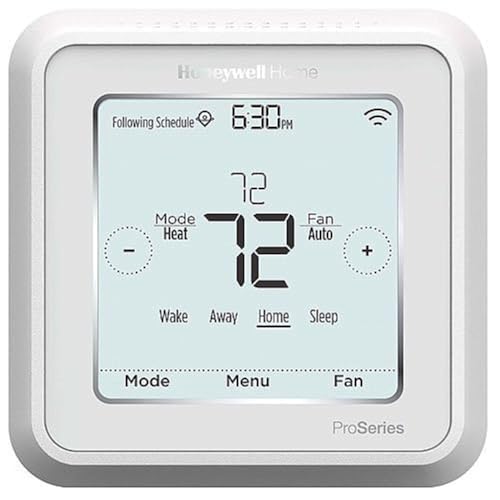
Pros
- Supports heat pumps and conventional systems
- Flexible 7-day and shorter scheduling modes
- Geofencing for location-based control
- Apple HomeKit and Amazon Alexa integration
Cons
- Hardwired installation requires a C-wire
- White finish only

Pros
- Energy Star certified
- Works with conventional systems and heat pumps
- Free C-wire adapter included
- Remote control through iOS and Android app
Cons
- Not compatible with mini split systems
- Remote features depend on the mobile app

Pros
- Supports up to 3H/2C heat pump systems
- Works with 2H/2C conventional systems
- 2.4GHz and 5GHz WiFi connectivity
- Alexa and Google Assistant compatible
Cons
- Smart control depends on WiFi connectivity
- White color is the only listed finish
Start With the HVAC Wiring
A four-wire setup does not automatically identify the heating and cooling equipment. Conventional systems, heat pumps, auxiliary heat, ventilation, and dual-fuel arrangements can use different terminal combinations, so check the existing wiring and equipment documentation before choosing a replacement.
The C-wire deserves special attention. SASWELL Smart Thermostat 3H/2C and Honeywell Home X2S Smart Wi-Fi Thermostat, White both list a C-wire requirement, while Cielo Smart Thermostat Eco for Central HVAC includes a C-wire adapter. That difference can decide whether the installation is straightforward or needs additional planning.
Before You Mount It: Do not assume wire colors identify terminal functions. Turn off HVAC power, photograph the existing terminal labels, and confirm compatibility before moving any wire.
Match Stages, Not Just Connectivity
Heat pump owners should pay close attention to the number of heat and cool stages. Honeywell TH6320WF2003 T6 Pro Smart Thermostat and TH2320WF4010/U FocusPRO S200 Smart WiFi support up to 3H/2C heat pump systems, while Honeywell Home X2S Smart Wi-Fi Thermostat, White supports up to 2H/1C heat pump systems with electric backup.
Conventional-system owners still need to check the heating and cooling stage limits. A thermostat that supports more stages than your equipment is not automatically a better match, but selecting one with too few stages can prevent the system from using its available controls.
| System type | Key check | Useful feature |
|---|---|---|
| Conventional HVAC | Heat and cool stages | Flexible scheduling |
| Heat pump | Auxiliary heat support | Remote control |
| No C-wire home | Adapter requirement | DIY installation |
For broader HVAC planning, the Smart Thermostats category provides related context. Keep the thermostat away from a location that could distort its temperature reading, such as direct sunlight or a nearby heat source.
Choose the Control Style You Will Actually Use
Every model here focuses on connected control, but the platforms differ. SASWELL Smart Thermostat 3H/2C works with Tuya Smart, Smart Life, Google Home, and Alexa, while Cielo Smart Thermostat Eco for Central HVAC adds Siri Shortcuts, SmartThings, IFTTT, Home Assistant, and Cielo Linked.
Honeywell Home X2S Smart Wi-Fi Thermostat, White is Matter Certified and supports Alexa, Google Assistant, and Apple HomeKit. Honeywell TH6320WF2003 T6 Pro Smart Thermostat integrates with Apple HomeKit, while the Lyric model supports Apple HomeKit and Amazon Alexa. Select the ecosystem already used by your household instead of adding another app without a reason.
Pro Tip: Save the existing thermostat settings and wiring labels before installation. That record makes it easier to restore the original arrangement if the new setup does not match your HVAC terminals.
I keep smart-home compatibility separate from HVAC compatibility because one does not guarantee the other. The mistake I see is choosing an app first, then discovering the thermostat cannot control the home’s heat-pump stages or requires a C-wire that is not present.
Expert Examined
From Marcus Bell

I pay closest attention to the terminal requirements and system type before considering appearance. A clear wiring photo, the HVAC model information, and the thermostat’s stage limits usually prevent the most frustrating installation mistakes.
Read more about Marcus BellWhich Model Fits Your Home
I would point heat-pump households with more demanding stage requirements toward smart thermostat options for HVAC systems such as Honeywell TH6320WF2003 T6 Pro Smart Thermostat. Its listed support reaches 3H/2C heat pump and 2H/2C conventional systems, and it adds dual-fuel and ventilation control, flexible scheduling, geofencing, and Apple HomeKit integration.
For a home without a C-wire, I would put Cielo Smart Thermostat Eco for Central HVAC near the top because its package includes a C-wire adapter and it supports conventional systems up to 2H/2C and heat pumps up to 4H/2C. Its vacation mode, energy-use insights, and broad smart-home support suit owners who want more than remote temperature changes.
For a lower-complexity conventional or heat-pump installation that already has a C-wire, I would consider SASWELL Smart Thermostat 3H/2C. Its seven-day programming, touchscreen, Tuya Smart and Smart Life access, Alexa support, and Google Home compatibility make it a practical match when those platforms fit your household.
The Bottom Line
The biggest mistake buyers make with four-wire smart thermostats is treating the wire count as proof of compatibility. Stage limits, heat-pump configuration, auxiliary heat, and C-wire requirements matter just as much.
If you only do one thing first, photograph the current terminals and confirm the HVAC type and stages against the thermostat specifications. Then choose the connected platform and scheduling features that fit your routine.
FAQs
A four-wire connection alone does not confirm heat-pump compatibility. Check whether the thermostat supports your heat-pump stages, auxiliary heat, and required terminals before replacing the existing unit. No. Some models require a C-wire, while others include an adapter for homes without one. Confirm the power requirements and adapter instructions before starting installation. Place it where the indoor temperature is representative, away from direct sunlight, drafts, and nearby heat sources. Avoid choosing a location simply because it is convenient for wiring. Matter Certified indicates compatibility with the Matter smart-home standard. It can make control across supported platforms easier, but it does not replace checking HVAC wiring and system compatibility.Can a four-wire thermostat control a heat pump?
Do smart thermostats always need a C-wire?
Where should a smart thermostat be placed?
What does Matter Certified mean for a thermostat?
Sources
- U.S. Department of Energy, Energy Saver www.energy.gov
- ENERGY STAR, Smart Thermostats www.energystar.gov