
Shopping for the best smart locks for glass doors starts with the mortise pocket and frame width, not the fingerprint reader. The right choice depends on whether your patio door accepts a 2085 or 2885 mortise and how many people need access.

Pros
- Five entry methods for family or rental access
- Stores up to 300 users
- Reversible handle for left or right opening
- IP65 weatherproof housing with emergency power backup
Cons
- Not a universal fit without mortise measurements
- Battery operation requires monitoring low-power alerts
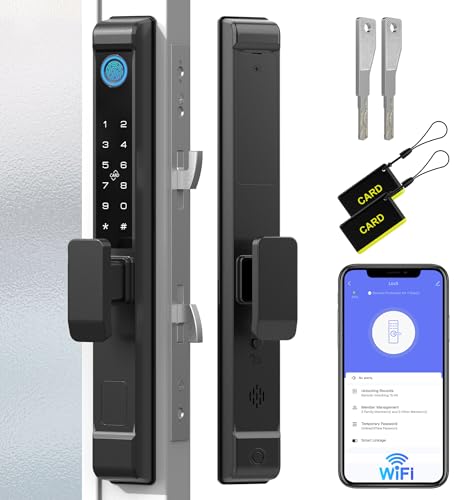
Pros
- Five entry methods, including fingerprint access
- WiFi remote control through mobile app
- Tamper alarm and 90-second lockout
- Low-battery warning with power-bank backup
Cons
- Requires compatible mortise and door dimensions
- Battery life rated for about eight months

Pros
- Five entry methods with built-in WiFi
- Fits 22 to 110mm door thicknesses
- No-drill installation in 10 to 15 minutes
- Reversible handle for left or right doors
Cons
- Four AAA batteries not included
- Requires aluminum frame at least 35mm wide

Pros
- Five entry methods
- Stores up to 300 users
- Reversible handle for left or right opening
- IP65 weatherproof housing
Cons
- 2885 mortise requires a 1.8-inch frame
- Careful door measurements required before ordering

Pros
- Multiple entry methods, including fingerprint and RFID
- Supports up to 300 users
- One-time codes and remote app access
- Four AAA batteries last about eight months
Cons
- Four AAA batteries are not included
- Requires careful fit and clearance measurements
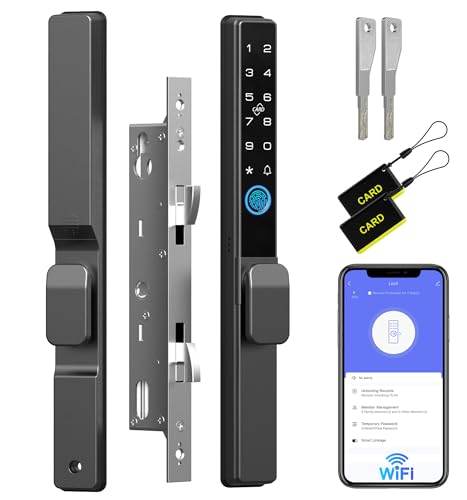
Pros
- Five access methods, including fingerprint and RFID
- WiFi remote control through mobile app
- 90-second shutdown after five invalid attempts
- Up to eight months of battery life
Cons
- Requires compatible mortise and door dimensions
- Frame must be at least 1.6 inches wide
Measure the Door Before Choosing Features
A sliding glass door lock can offer several entry methods and still be unusable if its mortise does not match the existing pocket. The Eseesmart Sliding Door Smart Lock supports 2085 and 2885 pockets, while the Anweller 2885 Mortise Sliding Glass Door Lock requires a frame at least 1.8 inches wide.
Frame clearance also separates these models. The eLinkSmart option requires a frame at least 1.38 inches wide and supports door thicknesses from 0.87 to 4.33 inches. The Anweller 2085 Mortise Smart Sliding Glass Door requires at least 1.6 inches of frame width, so measure the door edge, pocket, and surrounding frame before ordering.
Pro Tip: Measure the door thickness, mortise depth, frame width, and clearance around the lock edge before selecting a model.
Access Methods for Families and Rentals
Fingerprint entry is useful for household members who do not want to carry a key, while passcodes work better for visitors and service workers. RFID cards and backup keys add alternatives when a finger is wet or a phone battery is low.
For rentals or multi-unit properties, user capacity and temporary access matter more than the number of entry methods. The Eseesmart models support up to 300 users and temporary codes, while Dhiedas supports 300 users, including nine administrators and 291 ordinary users.
Remote control varies between products. The eLinkSmart model has built-in Wi-Fi and does not need a hub for Tuya app access. Dhiedas states that remote opening can work through its app without Wi-Fi or a gateway, so confirm the exact operating method before relying on it for guests.
| Mortise type | Frame requirement | Best fit |
|---|---|---|
| 2085 | Varies by model | Standard patio doors |
| 2885 | Often 1.8 inches | Deep-pocket frames |
| Wi-Fi model | At least 1.38 inches | Remote app access |
Battery Life and Emergency Entry
Battery planning is important because a glass door may be a primary entrance. Eseesmart, Anweller, and Dhiedas specify up to eight months of battery life, while eLinkSmart specifies up to 12 months with four AAA batteries. The eLinkSmart batteries are not included.
Low-battery alerts appear across the product choices, but emergency power differs in the details. Several models provide a power-bank or USB emergency option, and all listed choices include a physical key. Keep the backup key accessible without placing it directly beside the door.
Before You Mount It: Do not assume a USB emergency port charges the internal batteries. Dhiedas specifically says its port supplies emergency power only, so follow the product instructions and maintain the physical-key backup.
Expert Examined
From Marcus Bell

I keep seeing sliding-door projects fail because the buyer measures the glass panel instead of the lock edge and frame. I would photograph the mortise area, record every clearance, and confirm the pocket type before drilling or removing hardware.
Read more about Marcus BellWeather exposure deserves attention too. The Eseesmart models list IP65 housing and an operating range from -13°F to 149°F, while the other listings provide different battery and protection details. For any installation exposed to rain, check the stated housing protection instead of assuming every patio lock has the same rating.
For broader access planning, compare a smart lock with a key lock box using this key lock box safety comparison. Also consider whether a bridge is needed when an app depends on a separate hub, as explained in what a smart lock bridge does.
Which Lock Fits Your Door
I would point most standard US patio-door shoppers toward the Eseesmart Sliding Door Smart Lock because it supports both 2085 and 2885 pockets, fits door thicknesses from 7/8 to 4-3/4 inches, and includes a drilling template. Its 300-user capacity, temporary codes, emergency power-bank support, IP65 housing, and 24-month warranty make it especially suitable for families, rental hosts, and property managers who can confirm the measurements first.
I would choose the Sliding Glass Door Lock 2085 Ultra-Slim eLinkSmart when built-in Wi-Fi and scheduled app access are priorities. It requires a frame at least 1.38 inches wide, supports door thicknesses from 0.87 to 4.33 inches, and uses four AAA batteries. For a deep-pocket door with the required 1.8-inch frame, I would consider the Anweller 2885 Mortise Sliding Glass Door Lock, particularly where wrong-entry shutdown and a tamper alarm matter.
The Bottom Line
The single mistake most buyers make is selecting a lock by its access features before confirming the mortise pocket and frame dimensions. A fingerprint reader cannot compensate for a body that does not fit the sliding door.
If you do only one thing first, measure the door thickness, pocket depth, frame width, and lock-edge clearance. Then match those figures to the manufacturer requirements before choosing app access, user capacity, or battery preferences.
FAQs
Compatibility depends on the mortise pocket, door thickness, frame width, and clearance. The listed models have different requirements, including 2085 or 2885 pockets and minimum frame widths, so measure the door edge before ordering. Fingerprint entry is convenient for regular users, while passcodes, RFID cards, mobile apps, and physical keys provide alternatives. A model with temporary codes can suit guests, cleaners, renters, or service workers. Use the low-battery alert, replace batteries according to the product instructions, and keep the physical backup key available. Some models also support emergency power through a power bank or USB port. IP65 is a housing protection rating stated by Eseesmart for its listed models. It does not mean every lock has the same weather protection, so check the exact product specification before installing in an exposed location.Are smart locks for glass doors compatible with every patio door?
Which entry method is best for a household?
How should I prepare for a dead battery?
What does IP65 mean on a sliding door lock?
Sources
- UL Solutions www.ul.com
- U.S. Consumer Product Safety Commission www.cpsc.gov