
Installing the best outdoor security cameras for home perimeter safety begins with a choice between continuous power or battery convenience. Homeowners often underestimate how drastically power delivery dictates recording habits and mounting locations.

Pros
- Full 360-degree pan and 180-degree tilt coverage
- Color night vision for dim low-light areas
- Supports up to 512GB microSD local storage
- IP65 weather resistance for year-round durability
Cons
- Outdoor operation requires separate outdoor power adapter
- Incompatible with 5GHz Wi-Fi networks

Pros
- Free person and motion detection filtering
- Daily run time from 45 minutes of direct sun
- Color night vision with spotlights up to 30 feet
- MicroSD slot supports local storage up to 512GB
Cons
- Solar charging halts in temperatures below 32°F
- Cloud storage requires an optional Tapo Care subscription

Pros
- Sharp 2.5K QHD resolution with color night vision
- Quick magnetic mounting on metal surfaces
- Local storage support for cards up to 256GB
- IP65 weatherproof rating protects against dust and rain
- Integrated spotlight, loud siren, and two-way talk
Cons
- Brief 5 to 7 day battery life between charges
- Incompatible with 5 GHz Wi-Fi bands
- Micro SD card not included for local storage

Pros
- Solar panel power with battery backup
- 2K video resolution with color night vision
- 360-degree pan-tilt-zoom area coverage
- Adjustable PIR human detection to 29 feet
Cons
- No 24/7 continuous recording option
- Requires 2.4GHz Wi-Fi, unsupported on 5GHz
- Micro SD card not included

Pros
- Anti-glare 2K lens films directly through glass
- Full-color starlight night vision without infrared glare
- Dual-band WiFi supports 2.4GHz and 5GHz networks
- Wide 130-degree field of view minimizes blind spots
Cons
- MicroSD card up to 256GB not included
- Indoor placement required to monitor outside areas
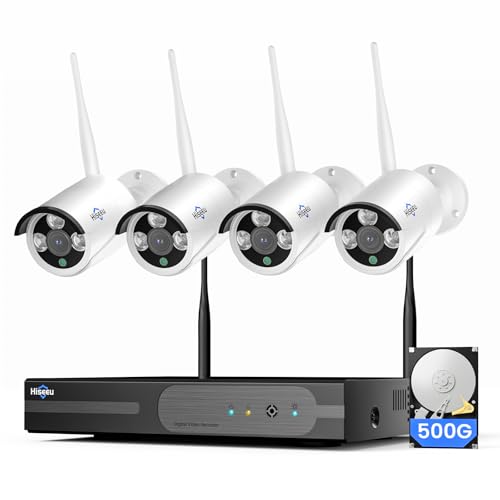
Pros
- Pre-installed 500GB hard drive without subscription fees
- Dual-band WiFi connectivity plus standalone local monitoring
- Expandable 16-channel NVR with 4K color night vision
- Weatherproof IP66 housings rated from minus 13 degrees
Cons
- Plug-in wired power requires nearby outdoor outlets
- Comes with four cameras despite sixteen channel capacity
Power Architecture and Continuous Recording Realities
Outdoor surveillance hardware splits sharply into corded units and battery-dependent equipment. Battery and solar options operate primarily on motion wake-up routines to conserve energy, which means they skip recording quiet stretches of driveway activity entirely. If your household requires round-the-clock observation, a plug-in setup or dedicated recorder prevents gaps between short event triggers.
For high-traffic perimeters, solar panels eliminate the chore of ladder climbs to recharge batteries. However, solar recharging requires direct exposure to sunlight and often slows significantly below freezing temperatures. If you need uninterrupted 24/7 logging, understanding what is an NVR and how is it different from a DVR helps clarify why dedicated hard drives outperform standalone battery cards for whole-property capture.
| Power Source | Recording Style | Best Placement |
|---|---|---|
| Battery or Solar | Motion Triggered | Fence Lines and Sheds |
| Wired AC Plug | Event or 24/7 | Porches and Garages |
| Dedicated NVR | Continuous 24/7 | Perimeter Rooflines |
Field of View, Weatherproofing, and Night Illumination
A camera exposed to open weather demands an ingress protection rating of at least IP65 to survive windblown rain and dust storms. Many owners focus purely on resolution figures while overlooking illumination hardware. Built-in spotlights produce vibrant color night vision that makes vehicle colors and clothing patterns visible after dark.
Stationary lenses cover fixed entry paths well, but open backyards often benefit from remote pan-and-tilt motorized bases. Motorized traversal lets you sweep across broad fence lines without purchasing multiple stationary housings. Before permanently securing hardware, checking what do the lights on a security camera mean helps prevent status LED reflections against nearby soffits or glass.
Mounting Caution: Never aim an outdoor lens directly into early morning or late afternoon sun paths, as severe backlighting blinds optical sensors and causes constant false human triggers.
Network Reliability and Bandwidth Demands
Most wireless exterior cameras operate solely on 2.4 GHz radio frequencies to pierce exterior stucco, brick, and siding. While dual-band hardware that reaches 5 GHz provides rapid data throughput near the router, higher frequencies struggle to pass through exterior walls. The Federal Communications Commission oversees consumer radio spectrum standards that regulate these wireless equipment transmissions.
Expert Examined
From Marcus Bell

The mistake I see most often is mounting an outdoor camera before checking Wi-Fi signal strength at that exact ladder height. Exterior building materials severely degrade signals, leaving cameras with delayed alerts and choppy live feeds unless you verify connectivity first.
Read more about Marcus BellLocal storage through onboard microSD cards allows you to retain clips without monthly fees, though local cards can be stolen along with the camera. Encrypted local recording paired with off-site cloud storage provides a safety net if physical hardware is tampered with on your porch.
Pro Tip: Format your microSD cards directly inside the manufacturer companion app rather than a computer to ensure proper file system partitioning and loop recording stability.
Selecting Hardware for Your Property
For detached workshops, garages, or distant fence corners lacking electrical outlets, I would point you to the Tapo SolarCam C402 KIT 1080p Outdoor. Its modular solar design and separate 13-foot panel lead let you place the lens under deep eaves while positioning the collector in clear daylight. For general yard monitoring where a wide sweep is critical, the WYZE Cam Pan v3, Indoor/Outdoor Security Camera delivers full motorized tracking and customizable patrol waypoints across a broad area.
If you require uncompromised perimeter security across multiple angles with permanent local archiving, I recommend the Hiseeu 4K 8MP Home Security Camera System Outdoor. Its 500GB local hard drive handles continuous recording across four cameras without subscription requirements or Wi-Fi wake-up delays.
The Bottom Line
The single most frequent mistake homeowners make is buying battery-powered motion cameras and expecting them to perform like continuous commercial monitors. Battery models prioritize power conservation, meaning they will inevitably miss the first few seconds of fast-moving vehicles or distant yard activity.
Before purchasing hardware, measure the distance from your router to each prospective mounting location and confirm power outlet availability. Establishing your power and signal infrastructure first ensures whichever cameras you mount function reliably from day one.
FAQs
Outdoor cameras use artificial intelligence algorithms to differentiate human shapes from animals or vehicles. While high-resolution lenses clearly capture facial features for identification, true biometric verification requires specific specialized software, as explained in our guide on whether security cameras have facial recognition capabilities. Extreme cold temporarily reduces lithium-ion battery capacity and slows chemical discharge rates. Solar panels will also suspend recharging when ambient temperatures drop below freezing to prevent permanent battery cell damage. Homeowners may legally point outdoor cameras toward public spaces like sidewalks and streets where there is no reasonable expectation of privacy. However, pointing cameras into neighbor bedroom windows or fenced private enclosures violates privacy ordinances. Most passive infrared motion sensors trigger effectively within 16 to 30 feet of the lens. Motion detection sensitivity decreases significantly at greater distances or when movement approaches head-on rather than across the field of view.Can security cameras detect human faces accurately outdoors?
What happens to outdoor cameras during winter freezes?
Are outdoor cameras allowed to record public sidewalks?
How far away can outdoor cameras detect movement?
Sources
- Federal Communications Commission www.fcc.gov
- Underwriters Laboratories Standards www.ul.com