
Mounting the best outdoor 360 degree security cameras solves the blind-spot penalty of fixed lenses, but it forces a clear trade-off between compact Wi-Fi pan units and heavy motorized optical rigs. Buyers monitoring a tight back patio need completely different hardware than someone tracking a two-hundred-foot gravel driveway. Matching motor speed and power delivery to your property layout prevents missing fast-moving activity.

Pros
- Sharp 3K 5MP video with color night vision
- Complete 360-degree pan and tilt motion tracking
- Subscription-free detection for people, pets, and vehicles
- Weatherproof IP65 housing fits indoor or outdoor use
- Local microSD storage supports cards up to 512GB
Cons
- Operates exclusively on 2.4 GHz Wi-Fi bands
- MicroSD card must be purchased separately
- Mandatory setup through the proprietary Tapo app

Pros
- Full 360-degree pan and 180-degree tilt coverage
- Color night vision for dim low-light areas
- Supports up to 512GB microSD local storage
- IP65 weather resistance for year-round durability
Cons
- Outdoor operation requires separate outdoor power adapter
- Incompatible with 5GHz Wi-Fi networks
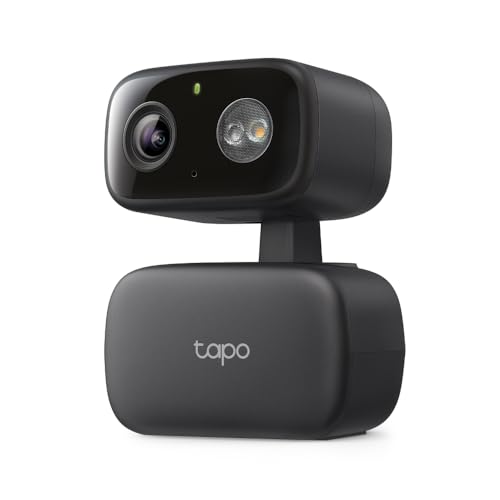
Pros
- Motorized 360-degree pan and 146-degree vertical tracking
- Subscription-free person and baby cry detection
- Spotlight-assisted color night vision mode
- Local storage support up to 512GB microSD card
Cons
- Requires a 2.4 GHz Wi-Fi network
- MicroSD card sold separately
- Video resolution limited to 1080p Full HD

Pros
- 20X optical zoom captures distant details clearly
- True 4K 8MP sensor for crisp target identification
- Motorized 360-degree pan and 90-degree tilt coverage
- AI auto-tracking follows detected human movement
Cons
- Wired installation requires PoE or 12V DC cabling
- Large 12.2-inch housing requires substantial mounting clearance

Pros
- Full 360-degree pan and 180-degree tilt coverage
- Continuous plug-in power with 16-foot cable
- Sharp 2K resolution with color night vision
- Smart detection for people, vehicles, and packages
Cons
- Paid subscription required for video history and AI
- Requires nearby outdoor outlet for wired power
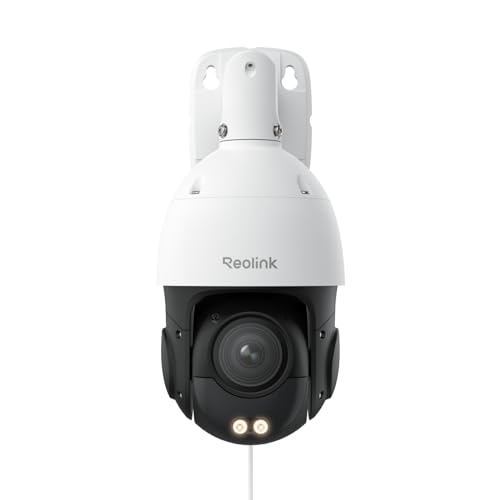
Pros
- 16X optical zoom with 3D target centering
- 4K UHD resolution with spotlight color night vision
- 360-degree endless pan with auto tracking
- Smart detection for people, vehicles, and animals
Cons
- Requires an IEEE802.3at PoE network switch
- Large 14.6-inch body demands sturdy exterior mounting
Power Delivery and Network Latency Outdoors
Motorized pan-and-tilt hardware draws substantially more sustained current than static cameras, especially when mechanical gears, infrared arrays, and auto-tracking processors engage at the same time. While plug-in Wi-Fi models offer fast physical installation, wireless signal drops can interrupt remote panning controls precisely when an intruder crosses the yard.
Running Power over Ethernet eliminates wireless interference and delivers continuous wattage over a single network line. Homeowners building larger installations often pair these units with a centralized recorder, making it helpful to learn what is an NVR and how is it different from a DVR before running structured wiring. For exterior runs, outdoor-rated Cat6 cable prevents jacket degradation caused by moisture and sun exposure.
Power Supply Hazard: Never connect an indoor-rated DC power brick to an exterior receptacle without a weatherproof in-use cover, as driving rain causes sudden ground faults that destroy motorized gimbal mechanisms.
Optical Zoom Versus Digital Magnification
True 360-degree coverage allows an exterior lens to swivel across an entire property line, but identifying a distant face requires optical magnification rather than digital cropping. Digital zoom merely enlarges recorded pixels, which turns license plates into illegible blurs at fifty feet. High-end PTZ models use motorized glass elements to magnify distant subjects before light hits the image sensor.
| Camera Style | Optical Reach | Ideal Placement |
|---|---|---|
| Compact Wi-Fi | Fixed Focal | Patios and Porches |
| Mid-Range Plug-in | 2K to 3K Digital | Driveway Corners |
| PoE Commercial | 16X to 20X Glass | Acreage and Barns |
When selecting cameras with advanced detection algorithms, remember that auto-tracking works best when the target stays within the optical focal plane. Some buyers wonder do security cameras have facial recognition, but outdoors the real priority is reliable human and vehicle filtering to prevent false tracking loops triggered by windblown branches.
Expert Examined
From Marcus Bell

I keep seeing homeowners mount pan-tilt cameras flush inside recessed porch corners where the motorized turret ends up filming the house siding during patrol sweeps. Place your camera on an open building corner with at least eighteen inches of clearance so the lens maintains an unobstructed field of view across both walls.
Read more about Marcus BellPatrol Sweeps and Environmental Durability
An outdoor motorized housing contains physical gears, belts, and bearings that must endure sub-zero freezes and summer heat waves. An IP65 or higher enclosure rating prevents wind-driven rain and road dust from penetrating the rotational seals. Cheaper mechanical enclosures frequently seize if fine grit settles between the rotating base and stationary bracket.
Auto-patrol waypoints allow a camera to cycle between gates, driveways, and side yards automatically. Understanding status indicators is vital during routine maintenance, so review what do the lights on a security camera mean to confirm whether your device is actively recording or stuck in a reboot cycle. The Federal Communications Commission regulates outdoor wireless broadcast frequencies, ensuring dual-band Wi-Fi units communicate cleanly alongside other household radio gear.
Pro Tip: Program your camera to return to a designated home position thirty seconds after motion tracking ends so the lens does not remain pointed at an empty fence indefinitely.
Matching the Camera to Your Property Boundaries
For standard suburban entryways and covered decks, I would point you toward the Tapo 3K 5MP Pan/Tilt Indoor/Outdoor Security. It combines crisp 3K clarity with subscription-free on-device filtering for people, vehicles, and pets, making it an exceptional self-contained option that records straight to high-capacity local microSD cards.
If you need wide-angle residential monitoring tied into a unified app ecosystem, the Arlo Essential Outdoor Pan Tilt Zoom Security delivers clean 2K resolution, dual-band Wi-Fi connectivity, and a long sixteen-foot power lead that simplifies mounting along garage eaves.
For monitoring long fence lines, open acreage, or commercial outbuildings, I would install the REOLINK RLC-823S2 4K 16X Optical Zoom PoE Security. Its 16X optical zoom and 4K sensor capture sharp identifying details at significant distances, while single-cable PoE wiring ensures unbroken video transmission regardless of exterior weather conditions.
The Bottom Line
The most common mistake buyers make with 360-degree cameras is expecting a single swiveling lens to protect two opposite zones simultaneously. When an auto-tracking camera pans left to follow a stray dog, your front gate on the right sits entirely unmonitored. Motorized rotation expands operational reach, but it does not replace overlapping fields of view for critical security zones.
Before purchasing hardware, locate an exterior mounting point that offers an unobstructed ninety-degree field of sweep and access to reliable continuous power. Verify your Wi-Fi signal strength at that exact exterior stud, or run an exterior-rated Ethernet drop so your camera never drops offline during critical perimeter patrols.
FAQs
Can a 360 degree security camera see in all directions at once?
No, motorized pan-tilt models point their lens in one direction at a time, moving mechanically across a 360-degree horizontal radius. While the camera can rotate to cover blind spots or auto-track movement, whatever lies behind the current lens orientation remains unmonitored during that moment.
Do pan and tilt security cameras wear out faster than fixed cameras?
Yes, cameras with physical gears, rotational belts, and drive motors experience mechanical wear that fixed lenses avoid. In freezing conditions, unheated motorized housings can seize if ice accumulates along the rotational seams, making weather ratings and sheltered soffit placement essential for long-term reliability.
What happens to an outdoor pan-tilt camera during a power outage?
Unless connected to an uninterruptible power supply or battery-backed network switch, hardwired and plug-in cameras shut down instantly during a blackout. When power restores, most units run an automated calibration sequence, spinning the turret across its physical stops before settling back into its designated home view.
Is local microSD storage safe on an outdoor camera?
Local cards eliminate monthly cloud subscriptions, but physical cards remain vulnerable if someone vandalizes or steals the camera body. To balance convenience and physical security, look for cameras that support simultaneous recording to an interior network recorder or encrypted secondary off-site cloud storage.
Sources
- Federal Communications Commission www.fcc.gov
- National Fire Protection Association www.nfpa.org