
Installing the best long range security cameras means solving an optical and transmission challenge rather than a simple coverage issue. Property owners must decide whether to narrow the field of view with an adjustable telephoto lens or push a wireless signal across acreage to an outbuilding.
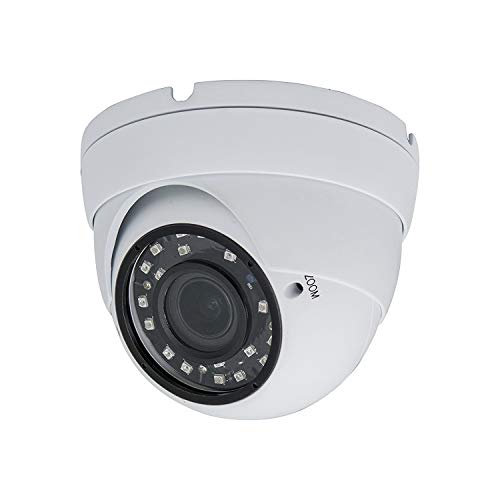
Pros
- Adjustable 2.8 to 12mm varifocal lens
- High definition 1080p video resolution
- 98 foot infrared night vision range
- Weather resistant metal casing
Cons
- Requires manual lens adjustment
- Limited one year manufacturer warranty

Pros
- 1/2.9-inch IMX323 sensor handles 0.01 Lux lighting
- Adjustable 5-50mm varifocal CS zoom lens
- H.264 compression reduces storage and bandwidth demands
- Driver-free UVC operation over standard USB 2.0
Cons
- Requires direct wired USB connection without battery
- Video capture limited to 30fps at 1080p

Pros
- Uncompressed 1080p video with zero signal delay
- Versatile 5-50mm manual varifocal telephoto lens
- Dual 3G/HD-SDI digital and CVBS analog outputs
- Smooth fast-motion capture at up to 60fps
Cons
- Manual varifocal lens lacks motorized remote zoom
- Requires specialized SDI or CVBS receiving hardware

Pros
- Detailed 4K video via 8MP sensor
- Active deterrence warning light and siren
- IR night vision up to 135 feet
- IP67 weatherproof down to minus 40 degrees
Cons
- Requires a compatible Lorex hardware recorder
- Color night vision needs ambient lighting

Pros
- Sharp 4K video resolution at 3840x2160
- Manual 2.8 to 12mm varifocal lens for adjustable angles
- Night vision coverage up to 100 feet with 18 IR LEDs
- Power over Ethernet simplifies cabling
Cons
- Full 8MP resolution capped at 15 frames per second
- Zoom adjustments require manual physical setting at the unit

Pros
- Wi-Fi HaLow reaches up to 2,000 feet
- Integrated solar charging eliminates battery swaps
- Sharp 4K Ultra HD video resolution
- Color night vision up to 100 feet
Cons
- Requires an existing MaxRanger4K Hub system
- Add-on camera cannot operate standalone
Optical Reach Versus Digital Zoom
A standard wide-angle security lens spreads pixels across a broad field, which degrades facial recognition beyond twenty feet. Optical reach relies on physical focal length, measured in millimeters, to gather detail at a distance. When you choose a varifocal lens that adjusts up to 12mm or 50mm, you preserve full sensor resolution on a gate or driveway entry instead of cropping a grainy digital image.
High sensor resolution complements glass optics. An eight-megapixel 4K sensor captures enough pixel density to read lettering and identify vehicles far past the threshold of standard 1080p cameras. For owners learning do security cameras have facial recognition, high pixel density at the target distance is the baseline requirement for reliable identification.
Focal Length Basics: A 2.8mm lens offers an expansive 100-degree field of view for yards. A 50mm telephoto lens narrows the scene to capture crisp vehicle plates hundreds of feet away.
Transmission Protocols for Outlying Buildings
Running cameras across massive perimeters exposes the limitations of standard consumer Wi-Fi, which rarely penetrates exterior brick or travels past a few hundred feet. Wiring cameras with Power over Ethernet provides continuous data and electrical supply over network runs up to 328 feet, which avoids signal interference completely. You will need to understand what is an NVR and how is it different from a DVR when planning these cable topologies.
| Connection Type | Max Practical Reach | Best Application |
|---|---|---|
| PoE Network | 328 feet per run | Perimeter fence lines |
| Wi-Fi HaLow | Up to 2,000 feet | Detached barns and gates |
| Analog / Coaxial | Up to 1,000 feet | Legacy farm upgrades |
For detached structures where trenching conduit is impractical, long-range wireless protocols provide a viable path. Emerging Wi-Fi HaLow technology uses sub-gigahertz frequencies to punch through tree canopies and external walls across thousands of feet. In critical installations, understanding is security camera footage admissible in court reinforces why steady signal integrity without frame dropouts matters.
Expert Examined
From Marcus Bell
The mistake I see most often on large lots is placing a wide-angle camera on a house corner and expecting to read a gate latch sixty yards away. I always separate perimeter boundary monitoring from general yard coverage by installing dedicated narrow-beam lenses on the choke points.
Read more about Marcus BellIlluminating Distant Targets at Night
Standard infrared emitters wash out after thirty feet, leaving deep shadows across driveways and pastures. High-power infrared arrays can illuminate targets up to 135 feet away in complete darkness, casting invisible light that sensors translate into sharp monochrome video. Devices certified by UL Solutions for outdoor enclosures prevent moisture ingress that quickly fogs up lens covers during heavy weather shifts.
Infrared Washout: Positioning an infrared camera behind standard glass causes blinding reflection back into the sensor at night. Mount long-distance hardware externally under eaves or directly on posts.
Active deterrence lights offer an alternative for properties that require visual confirmation without running supplemental floodlights. Built-in spotlights bring full color vision to night footage while making it obvious to trespassers that the perimeter is watched. Deciding between invisible infrared and visible spotlights often dictates whether you deter intruders at the fence or monitor them quietly.
Selecting the Right Camera for Your Property
For expansive rural properties where running conduit to an access road is impossible, I would point you to the Swann MaxRanger4K Wireless Solar Security Add-On. Its Wi-Fi HaLow signal reaches up to 2,000 feet in open air, and the integrated solar panel provides continuous power without trenching lines.
If you need extreme optical magnification for reading plates down a narrow driveway, I recommend the MOKOSE 3G / HD SDI Camera. The manual 5-50mm varifocal telephoto lens lets you pull distant subjects tight into the frame without digital artifacting. For general estate perimeters where a stable network cable already exists, the GW Security 4K 8MP Outdoor/Indoor 2.8-12mm delivers sharp 4K resolution, 100 feet of night vision, and Power over Ethernet stability in a rugged weatherproof housing.
The Bottom Line
Most buyers mistakenly purchase standard fixed-lens cameras and rely on digital zoom to cover a hundred yards of yard. Digital magnification only enlarges existing pixels, resulting in an unreadable blur right when you need clear evidence of an incident.
Start by measuring the exact distance between your planned mounting spot and the specific boundary gate or entry you must monitor. Match that distance to an appropriate optical lens length and a confirmed transmission method before you mount any hardware to your exterior walls.
FAQs
How far can a long range security camera see?
A long-range camera with a 5-50mm varifocal lens can resolve human activity and vehicle details past 150 to 200 feet. General detection of movement can occur much farther, but identifying specific facial features requires sufficient pixel density and optical magnification.
What is the advantage of Wi-Fi HaLow for security?
Wi-Fi HaLow operates on lower frequency bands around 900 MHz rather than the standard 2.4 GHz or 5 GHz bands. This lower frequency penetrates walls, dense foliage, and structures while maintaining connections over distances up to 2,000 feet.
Can security cameras read license plates at night?
Standard cameras struggle with plate capture due to glare from vehicle headlights and reflective coatings on license plates. Reading plates at distance requires a dedicated telephoto varifocal lens, fast shutter speeds, and targeted infrared illumination aimed directly at the approach path.
What does a varifocal manual zoom lens do?
A varifocal manual zoom lens allows an installer to physically adjust the focal length and angle of view during setup. You can widen the scene for yard monitoring or narrow the view to focus all sensor detail on a remote driveway entry.
Sources
- UL Solutions Standards for Video Surveillance Equipment www.ul.com
- Electronic Security Association Standards Guide esaweb.org