
Investing in the best closed circuit security cameras protects your property without surrendering personal video feeds to monthly cloud subscriptions. The real dividing line centers on signal transmission: whether to run single-cable Power over Ethernet lines or rely on dedicated wireless recorder bridges. Homeowners wanting absolute uptime without network interference will find their answers in standalone local hardware.

Pros
- Pre-installed 3TB drive with no monthly fees
- Eight 5MP cameras expandable to ten channels
- IP66 waterproof rating withstands -13°F to 122°F
- AI human detection filters pet false alerts
Cons
- Wired plug-in power required at camera locations
- One-way audio lacks two-way talk capability

Pros
- 5MP HD video detail
- Person, pet, and vehicle detection
- Up to 100-foot night vision
- Built-in microphone for audio
Cons
- Hardwired PoE installation required
- NVR ships without a hard drive

Pros
- Built-in 10.1-inch monitor on 4K NVR
- Pre-installed 1TB drive without subscription fees
- AI human detection filters pet false alerts
- Expandable system supports up to 10 channels
Cons
- One-way audio with no two-way talk
- Requires plug-in power outlets for cameras
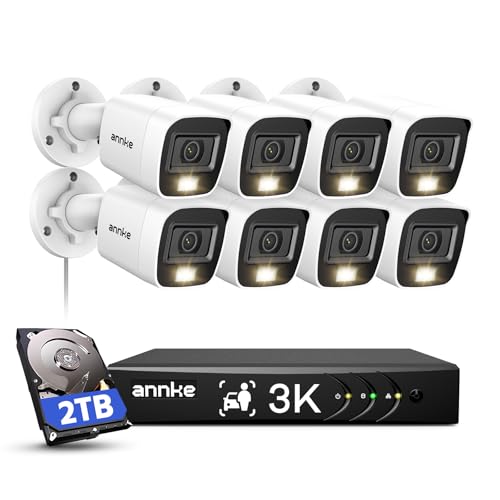
Pros
- Eight 3K cameras with integrated audio recording
- Smart dual-light switches to color upon detection
- Weatherproof IP67 rating from -40°F to 140°F
- Included 2TB hard drive expandable up to 10TB
Cons
- Wired analog installation requires running physical cables
- Frame rate is limited to 20fps at 3K resolution

Pros
- Crisp 4K 8MP resolution captures fine visual details
- Dedicated 2TB NVR enables continuous local recording
- Wired PoE connection bypasses Wi-Fi dropouts completely
- Built-in analytics flag people, vehicles, and glass breaks
Cons
- Requires running physical ethernet cables to every camera
- Includes only eight cameras for sixteen available channels

Pros
- Four 5MP cameras with 100-foot night vision
- Single-cable PoE connection handles power and video
- Pre-installed 2TB drive stores ten days of video
- Built-in microphones record ambient sound
Cons
- Physical Ethernet cable required for each camera run
- Firmware update required to enable smart motion filters
Signal Transmission and Cable Architecture
Closed systems isolate video data from the public internet by recording straight to an onsite hard drive. Choosing the hardware begins with understanding what is an NVR and how it differs from a DVR. Network video recorders handle digital IP streams, whereas digital video recorders process analog signals routed over coaxial cables.
Power over Ethernet remains the commercial benchmark for physical reliability. Running one Cat5e or Cat6 line delivers continuous electrical current and high-bandwidth video simultaneously. This eliminates the voltage drop common across cheap splitters and bypasses the radio congestion that degrades wireless cameras during peak household hours.
Check Exterior Conduit: Exposed cabling along low eaves invites tampering. Run all exterior wiring through metal conduit or drill directly through the mounting plate into the wall cavity so no wiring remains accessible to intruders.
Local Storage Capacity and Retention Realities
A closed circuit system depends on physical drive capacity to retain forensic video. Continuous twenty-four-hour recording across four or eight 5MP sensors consumes hundreds of gigabytes per week. The Federal Communications Commission oversees equipment frequencies, but storage mechanics depend entirely on local compression codecs.
Modern H.265 compression cuts storage overhead in half compared to older H.264 formats. Without modern compression, a four-camera array will overwrite crucial events within days. Understanding your daily recording volume ensures that essential events remain intact if you ever need to verify whether security camera footage is admissible in court after an incident.
| System Type | Transmission Path | Primary Placement |
|---|---|---|
| PoE NVR | Cat5e Ethernet | Attics and soffits |
| Analog DVR | RG59 Coaxial | Direct building retrofits |
| Wireless NVR | Dedicated Wi-Fi | Outbuildings and garages |
Night Illumination and Threat Verification
Night recording presents the most common failure point for budget cameras. Infrared illumination throws invisible light up to one hundred feet, but standard IR produces monochrome images that obscure clothing colors and vehicle finishes. Smart dual-light configurations use passive infrared to navigate in black and white until an object triggers bright white LEDs.
Expert Examined
From Marcus Bell

I frequently see property owners mount bullet cameras too high on second-story gutters, creating severe downward angles that capture only the tops of hats. Lower your mounting points to eight or nine feet above ground level to capture recognizable facial profiles.
Read more about Marcus BellWhen selecting positions along entry walkways, observe what the lights on a security camera mean before fastening brackets permanently. Visible indicator status lights warn visitors of recording status, but poorly shielded infrared arrays can reflect off rain gutters, completely blinding the sensor.
Plan for Heat Dissipation: NVR and DVR base units contain mechanical spinning hard drives that generate steady heat. Place the central recorder in a ventilated closet or lockbox rather than a sealed ceiling crawlspace to prevent premature drive failure.
Selecting Hardware for Your Property Layout
If you want a dependable, professional setup without monthly upkeep, I would point you toward the REOLINK 8CH 5MP PoE Security Camera System. It includes a pre-installed 2TB hard drive and uses streamlined Power over Ethernet connections that simplify pulling lines through an attic. The person and vehicle detection filters prevent false alarms caused by blowing shrubbery.
For detached structures where running network wiring through crawlspaces is impractical, I recommend the Hiseeu 5MP Home Security Camera System Outdoor. Its 3TB hard drive provides ample continuous recording space, and its independent wireless network connects outdoor cameras without consuming home internet bandwidth. For comprehensive installations requiring analog upgrades, the ANNKE 8CH 3K Wired Security Camera System delivers robust IP67 weather resistance across eight camera positions.
The Bottom Line
The single most frequent mistake buyers make is prioritizing high channel counts while underestimating cable management. Purchasing an eight-camera kit does little good if the physical layout of your home prevents you from pulling wiring to exterior corners. Match the physical infrastructure of your house to the wiring format before ordering hardware.
Map your exterior vulnerable points first and measure the exact cable distances needed to reach the central recorder. Once you confirm the pathway between your intended recorder location and the exterior perimeter, choose a system within our security cameras directory that matches those specific physical runs.
FAQs
Do closed circuit security camera systems require home internet?
No, closed circuit setups operate independently of an internet connection. The cameras route video directly to the local NVR or DVR hard drive. You only need an internet connection if you want to stream live video to a mobile phone application while away from the property.
What happens to recording when the hard drive fills up?
Standalone surveillance recorders utilize continuous circular recording loops. Once the storage capacity reaches its limit, the system automatically writes over the oldest recorded footage first. This process ensures you always retain the most recent video history without needing to format the drive manually.
How far can you run Ethernet cables for PoE security cameras?
Standard Power over Ethernet cables can transmit video data and electrical power reliably up to 328 feet per run. Exceeding this distance causes signal degradation and electrical voltage drop. For runs beyond this limit, you must introduce a powered PoE extender switch.
What is the difference between IP66 and IP67 weather ratings?
An IP66 rating certifies protection against powerful directed water jets and heavy downpours. An IP67 enclosure provides higher sealing integrity, preventing damage even during temporary submersion in shallow water. Both ratings are suitable for outdoor home perimeter security in all seasons.
Sources
- Federal Communications Commission Equipment Authorization www.fcc.gov
- UL Solutions Standards for Video Surveillance Systems www.ul.com