
Finding the best smoke detectors for home safety hinges on whether your ceilings already contain interconnect wiring or require wireless radio communication between rooms. Older residences without recessed junction boxes demand standalone wireless networks, while modern builds require 120-volt lines to satisfy local building codes.

Pros
- UL 217 10th Edition certified dual-beam photoelectric sensor
- 10-year CR123A lithium battery eliminates annual swaps
- Wirelessly interconnects up to 24 units locally
- Includes 2.4GHz gateway for mobile app alerts
- Tool-free magnetic mounting pads included
Cons
- Gateway incompatible with 5GHz Wi-Fi bands
- Lacks built-in carbon monoxide detection

Pros
- Built-in 10-year battery backup eliminates annual replacements
- Spoken voice alerts announce Fire alongside 85 dB horn
- Wired interconnect triggers all linked alarms together
- Meets UL 217 10th Edition safety standards
- Enhanced sensing cuts nuisance cooking and steam alerts
Cons
- Requires dedicated 120V AC electrical wiring
- Lacks carbon monoxide detection capabilities
- Interconnect limited to compatible Kidde alarms

Pros
- Hardwired interconnection links up to 12 units
- Photoelectric sensor reduces nuisance cooking alarms
- UL217 listed for residential fire safety
- Ten-hour do-not-disturb mode silences night chirps
- Single button tests all linked alarms at once
Cons
- Requires existing hardwired electrical ceiling boxes
- Backup 9V batteries require periodic replacements
- Lacks integrated carbon monoxide detection
Pros
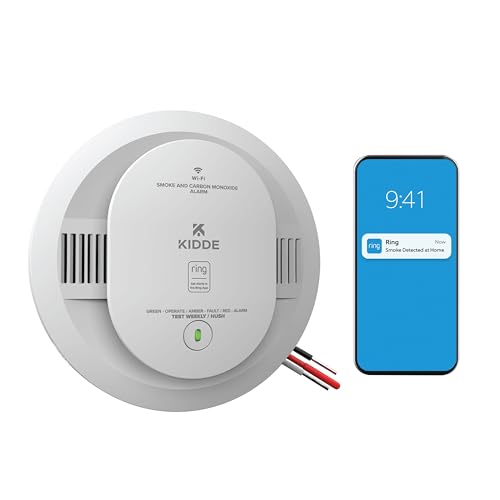
- Smoke and carbon monoxide double detection
- Free real-time Ring app notifications
- Spoken voice alerts and Alexa compatibility
- UL 217 and FCC safety certified
Cons
- Requires hardwired electrical installation
- 24/7 professional monitoring requires paid subscription
- Uses replaceable AA batteries instead of sealed cell

Pros
- Compact 2.7-inch diameter takes minimal ceiling space
- 915MHz wireless interconnect links units without running wire
- Dual-LED photoelectric sensor reduces cooking false alarms
- Certified to latest UL 217 10th Edition standard
Cons
- Lacks integrated carbon monoxide detection
- Single pack requires buying extra alarms to link

Pros
- Sealed 10-year battery eliminates annual swaps
- Photoelectric smoke and electrochemical CO sensors
- Wireless interconnection covers up to 820 feet
- Certified to UL 217 and UL 2034 standards
Cons
- Lacks Wi-Fi connectivity for phone notifications
- Battery operation only with no hardwired option
Hardwired Power Versus Sealed Lithium Batteries
Homes constructed after the late 1980s typically feature dedicated electrical boxes linked by a three-wire cable. In these setups, line-voltage alarms draw primary electricity from the house circuit while maintaining a secondary cell for outages, fitting into standard home safety and detection infrastructure. Replacing these requires matching the existing wiring harness or splicing in a new connector plug.
Properties built before modern electrical mandates often lack junction boxes across hallway ceilings. Sealed ten-year lithium units resolve this limitation without pulling conduit through wall framing. These self-contained devices provide uninterrupted operation for a decade, eliminating midnight battery chirps and annual ladder climbing.
Wiring Mismatches: Never connect high-voltage AC house wiring to low-voltage battery terminals. Mixing incompatible equipment brands on a single wired interconnect traveler line can also cause false alerts or equipment damage.
Whole-Home Interconnection Protocols
Safety agencies like the National Fire Protection Association emphasize that when one detector activates, every unit across the property must sound. Hardwired systems achieve this through an analog communication wire, while modern wireless units rely on dedicated radio-frequency signals operating around 915MHz. This wireless relay ensures a fire in an attached garage wakes occupants sleeping on the second floor.
Advanced systems add Wi-Fi gateways to relay sirens directly to your smartphone. While local alarms sound without internet, digital bridges notify family members who are away from home, integrating alongside comprehensive home security systems. You can read more safety strategies on our safety blog.
Expert Examined
From Jenna Castellano

The mistake I see most often in multi-level houses is isolated battery alarms placed in bedrooms that cannot be heard from the basement. If a fire starts near a furnace or clothes dryer, escape time drops dramatically unless units share an interconnected signal.
Read more about Jenna CastellanoPhotoelectric Sensing and Cooking Nuisance Resistance
Modern residential manufacturing standards from organizations like UL Solutions focus heavily on eliminating nuisance cooking alarms while detecting slow, smoldering fires. Optical chambers utilize light dispersion to spot smoldering furniture fabric rapidly while filtering out harmless kitchen steam and particulate dust.
| Detector Type | Detection Target | Ideal Placement |
|---|---|---|
| Single Photoelectric | Smoldering fabric | Living rooms and hallways |
| Dual-Beam Optical | Cooking vapor resistance | Dining rooms and kitchens |
| Combo Smoke CO | Smoke and toxic gas | Hallways outside bedrooms |
Dual-function hardware combines optical smoke chambers with electrochemical carbon monoxide sensors in a single chassis. This combination monitors both visible combustion hazards and colorless gas leaks from furnaces, water heaters, or wood stoves. Consolidating both functions reduces the overall number of devices mounted to your ceiling drywall.
Kitchen Spacing: Position ceiling alarms at least ten feet away from stationary cooking surfaces. This spacing prevents everyday meal preparation steam from triggering nuisance sirens while preserving rapid notification during an emergency.
Matching the Detector to Your Floor Plan
For multi-level properties lacking existing ceiling conduit, I would point you to the Heiman Smart Wireless Interconnected Smoke. It combines a decade-long battery lifespan with dedicated radio linking that sounds all sirens together, plus an included gateway for remote phone alerts without monthly fees.
If your home already features AC junction boxes with a communication traveler wire, I recommend installing the Kidde Smoke Detector, Hardwired & 10-Year Battery. This model draws continuous line power while providing a sealed ten-year backup battery, and its voice warning explicitly calls out hazard types to wake heavy sleepers.
For households burning heating oil, natural gas, or wood, carbon monoxide monitoring is just as critical as fire detection. In those spaces, I suggest mounting the X-Sense Interconnected Smoke and CO Detector outside sleeping quarters. It packages optical and electrochemical sensors into a sealed battery shell, linking up to eighteen units across separate rooms without running new wire.
The Bottom Line
The most common error homeowners make is buying standalone smoke alarms that operate in isolation from one another. In a multi-story home, a closed bedroom door can muffle the sound of an alarm ringing on the ground floor, costing occupants precious seconds during an active fire.
Before making any purchase, remove one of your existing ceiling alarms and inspect the junction box. Knowing whether you need a hardwired connection with a traveler wire or a battery-powered wireless network immediately narrows your selection to the correct hardware type.
FAQs
What is the difference between ionization and photoelectric smoke alarms?
Ionization sensors react fastest to open flaming fires, while photoelectric sensors detect slow-smoldering fires that produce heavy smoke. Most modern residential standards prioritize photoelectric chambers because smoldering fires from upholstery and mattresses pose the greatest residential risk, while photoelectric sensors also produce fewer false alarms from cooking.
Do wireless interconnected smoke alarms require home Wi-Fi to sound?
No, wireless interconnected alarms communicate with one another using local radio-frequency signals, typically around 915MHz. They sound simultaneously across all rooms even during power cuts or internet outages. Wi-Fi is only required if your specific system includes a gateway hub that sends alerts to your phone.
How often do smoke alarms need complete replacement?
All residential smoke alarms must be replaced ten years from their manufacture date, regardless of battery condition or power source. Over a decade of operation, airborne dust, insects, and sensor degradation reduce detection accuracy. Check the date stamp printed on the rear housing to verify age.
Can hardwired alarms connect with battery-powered alarms?
Standard hardwired alarms interconnect via a physical 120-volt signaling wire and cannot directly talk to standalone battery alarms. However, select manufacturers provide bridge alarms or wireless modules that wire into the AC circuit, allowing them to translate physical line signals into radio waves for battery-operated devices.
Sources
- National Fire Protection Association www.nfpa.org
- U.S. Consumer Product Safety Commission www.cpsc.gov
- UL Solutions www.ul.com