
Choosing the best smart thermostats for privacy starts with deciding where control should happen: locally through a Matter platform or remotely through a manufacturer app. That distinction matters most for households limiting accounts, cloud dependence, or unnecessary data sharing.

Pros
- Works with 120V to 240V electric heating
- Humidity sensor and touchscreen
- Scheduling and geofencing support
- Apple Home, Alexa, and Google compatible
Cons
- Requires a neutral or second live wire
- Limited to electric baseboards and fan-forced heaters

Pros
- Matter support across major smart-home platforms
- Flexible 24/7 heating and cooling schedules
- Remote app and voice control
- Alerts for filters and system malfunctions
Cons
- C-wire required for some wiring configurations
- Not compatible with electric baseboard heaters
- Compatibility check required before purchase

Pros
- Matter support across major smart-home platforms
- No new app or account required
- Local and remote control through existing app
- Supports conventional and heat-pump systems
Cons
- Matter controller required for outside-home connectivity
- Not compatible with 120V or 240V systems
Pros
- Matter support for major smart-home platforms
- Flexible 24/7 heating and cooling schedules
- Remote app and voice control
- Smart alerts for filters and malfunctions
Cons
- C-wire may be required and is not included
- Not compatible with electric baseboard heaters

Pros
- ENERGY STAR certified
- Customizable 4.3-inch touchscreen
- Humidity monitoring for indoor air quality
- Works with Alexa, Matter, Apple Home, Google
Cons
- C-wire required for installation
- Not compatible with 120-240V electric baseboard heat

Pros
- Works with over 20,000 AC models
- AI-based Comfy Max climate control
- Schedules continue during internet outages
- Alexa, Google, SmartThings, and IFTTT support
Cons
- 2.4 GHz Wi-Fi required
- IR remote compatible units only
Local Control Is the Privacy Divider
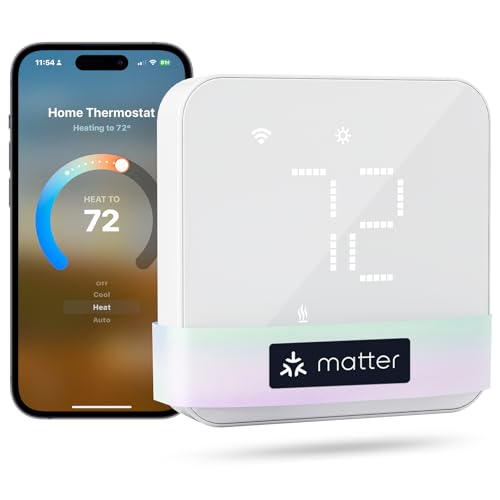
Matter is the clearest privacy-oriented feature in this group because compatible products can integrate with Apple Home, Alexa, Google Home, Home Assistant, or SmartThings. The meross and LUX options describe local Matter integration or device-level configuration, which can reduce the need for another dedicated thermostat account or app.
Local control does not mean every feature works without a network. The LUX thermostat requires a Matter controller or smart speaker for connectivity outside the home, while the meross models also offer app-based remote control and usage management. Check which smart-home platform you already use before choosing a device.
FYI: Matter is a smart-home interoperability standard, not a promise that every function is offline. Confirm the controller, app, and remote-access requirements for your preferred setup.
For broader smart-home context, the site’s Home Assistant device coverage shows why protocol compatibility deserves attention before adding another connected product.
Match the Thermostat to the HVAC System
Privacy features cannot compensate for incorrect wiring. Mysa is designed for 120 to 240V electric baseboards and electric fan-forced heaters, while the meross and Honeywell Home products are intended for conventional HVAC equipment, heat pumps, boilers, humidifiers, or related systems as specified in their compatibility details.
The Cielo Breez Max is a different category altogether. It controls mini-split, window, or portable air conditioners with an IR remote, connects over 2.4 GHz Wi-Fi, and needs to sit within six to twelve feet with a clear line of sight.
| Device type | Privacy-related control | Best-fit system |
|---|---|---|
| Matter thermostat | Local platform control | Conventional HVAC |
| Line-voltage thermostat | App and smart-home control | Electric baseboard |
| IR room controller | App with schedules | Mini-split or portable AC |
Before You Wire: A 120V, 240V, millivolt, or two-wire system can be incompatible with a conventional smart thermostat. Turn off power and verify the existing wiring and system type before installation.
The meross models require careful compatibility checks, including C-wire requirements in some configurations, and neither is suitable for electric baseboard heaters. Honeywell Home includes a path to obtain a C-wire adapter if the system lacks one, but it also does not support 120 to 240V electric baseboard heat.
For another connected-home category where protocol and wiring distinctions matter, see the Z-Wave smoke detector selection for a useful comparison of ecosystem choices.
Privacy Also Depends on Daily Features
A thermostat can expose more information through schedules, geofencing, usage history, and remote access than through temperature control alone. If you want fewer services involved, the LUX model keeps system configuration on the device and works through an existing Matter app, while Mysa offers control from an Android or iOS device without a subscription.
Other shoppers may prefer practical visibility over the smallest possible data footprint. Honeywell Home provides humidity monitoring, a customizable display, and remote control through the First Alert app, while Cielo Breez Max adds humidity sensing, usage history, filter status, geofencing, and schedules for compatible air conditioners.
Expert Examined
From Jenna Castellano

I keep the thermostat’s app and smart-home permissions as separate decisions. The mistake I see is granting every available integration during setup, so I would start with the one platform you actually use and leave optional services disconnected.
Read more about Jenna CastellanoWhen privacy is your priority, disable features you do not need and review which household members or services can change settings. A schedule that stays on the device or within your chosen platform may be preferable to adding several overlapping accounts.
Before selecting any connected climate device, you can also review the site’s Smart Energy and Climate Control category for related ecosystem considerations.
Which Model Fits Your Home
I would point you to the Mysa Smart Thermostat V2 for Electric Baseboard only when your home uses compatible 120 to 240V electric baseboards or electric fan-forced heaters. Its no-subscription positioning, touchscreen, humidity sensor, scheduling, geofencing, and Apple Home, Alexa, and Google support make it the most direct fit for a line-voltage household that still wants connected control.
For conventional HVAC, I would choose the meross Matter Smart Thermostats for Home when local Matter integration and broad platform support matter more than adding a separate ecosystem. Verify the C-wire and system requirements first, especially because it cannot operate electric baseboard, millivolt, or two-wire systems.
I would reserve the Breez Max Smart WiFi Thermostat for Mini-Split for a room with a compatible IR-controlled mini-split, window, or portable AC. Its schedules can continue during an internet outage, and its placement requirement is clear: keep it six to twelve feet away with line of sight.
The Bottom Line
The biggest privacy mistake is treating every smart thermostat as interchangeable. A Matter model may fit your preferred local platform, but it still has controller and remote-access requirements, while an IR controller or line-voltage model serves a completely different system.
If you do one thing first, identify the HVAC type and existing wiring. Then choose the smallest control path that meets your needs, limiting integrations and accounts to the platform you already trust.
FAQs
Matter models with local platform integration can reduce dependence on a separate manufacturer account or app. Privacy still depends on the controller, remote-access settings, and optional services you enable. Not necessarily. The meross and Honeywell Home models do not support 120V or 240V electric baseboard heat, while Mysa is specifically designed for compatible line-voltage systems. Some conventional HVAC installations require a C-wire, and the meross and Honeywell Home products specify wiring requirements that should be checked before purchase. C-wire needs vary by system and configuration. Matter indicates compatibility with supported smart-home platforms such as Apple Home, Alexa, Google Home, Home Assistant, or SmartThings. It does not guarantee that every feature works without Wi-Fi, a controller, or remote access. Place a Cielo Breez Max six to twelve feet from the compatible air conditioner with a clear line of sight. It connects to a 2.4 GHz Wi-Fi network and communicates with the unit through infrared control.Which thermostat type is most private?
Can a Matter thermostat replace an electric baseboard thermostat?
Does a smart thermostat need a C-wire?
What does Matter certification mean for a thermostat?
Where should an IR thermostat controller go?
Sources
- UL Solutions www.ul.com
- US Consumer Product Safety Commission www.cpsc.gov
- NFPA www.nfpa.org