
Choosing the best security cameras that work without internet starts with deciding whether you need recording to continue locally or want remote phone access too. This matters most for rural properties, unreliable connections, and anyone who wants footage kept inside the home.

Pros
- No subscription fees with 32GB local base storage
- Ultra-wide 166-degree viewing angle reduces blind spots
- Full-color night vision via built-in white spotlights
- Simultaneous live viewing across four camera feeds
Cons
- Requires direct sunlight for self-sustaining solar operation
- Base station capped at 32GB of loop storage
Pros
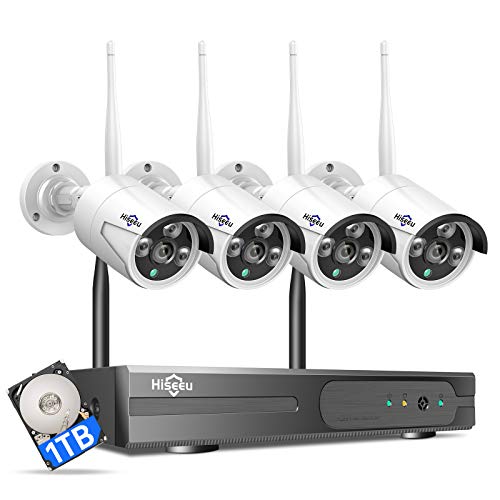
- Pre-installed 1TB hard drive with zero subscription fees
- Continuous 24/7 recording via corded plug-in power
- IP66 weather resistance rated from -13°F to 122°F
- AI human detection filters out pets and shadows
- Scalable 4K NVR system supports up to 10 channels
Cons
- Corded plug-in setup requires nearby power outlets
- One-way audio permits listening only without two-way talk

Pros
- Three lenses, simultaneous 3MP views
- 355° pan and 90° tilt coverage
- Human, vehicle, and pet AI detection
- 32GB SD card included, no subscription
Cons
- 2.4GHz Wi-Fi only
- Wired installation required

Pros
- 4K Ultra HD detail
- 360° PTZ surveillance
- Full-color night vision
- 32GB local storage, no subscription
Cons
- Requires H200 base station
- 2.4GHz WiFi only
Pros
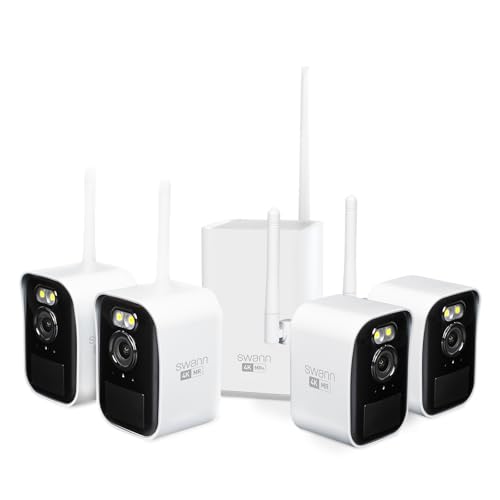
- Wi-Fi HaLow covers up to 1,000 feet line of sight
- 4K video capture with 50-foot color night vision
- Solar panels provide continuous outdoor power
- Free local storage on included 32GB microSD card
- True Detect plus senses heat, motion, and people
Cons
- Wireless reach drops to 330 feet through obstacles
- System expansion limited to 8 total cameras
Local Recording Versus Remote Access
A camera can keep recording without an internet connection, but remote viewing and phone alerts generally depend on a network path. The Hiseeu system is the clearest fit for local operation because its cameras and NVR support local view and control without Wi-Fi, while remote control uses dual-band Wi-Fi.
Local storage also changes how you retrieve evidence. The aosu 2K QHD Solar Security Cameras use a base with 32GB of encrypted storage and support viewing up to four feeds together, while Hiseeu uses a 1TB hard drive with continuous recording and several recording modes.
If you want background on the recorder itself, the explanation of how an NVR differs from a DVR can help you understand why a recorder-based system suits offline operation.
Pro Tip: Choose local viewing first if your main concern is a weak or absent internet connection. Treat remote alerts as an additional feature, not the foundation of the system.
Power Determines Whether Offline Recording Continues
Internet independence does not remove the need for dependable power. Hiseeu uses wired plug-in cameras and an NVR for continuous recording, while aosu, BOTSLAB, and Swann use solar-oriented designs that reduce routine cable work outdoors.
The solar options are not identical. aosu states that as little as two hours of direct sunlight per day can support operation, and BOTSLAB pairs a 10,000mAh battery with a 5W external panel. Swann adds Wi-Fi HaLow for long-range connections between cameras and its base station, with local recording on a 32GB MicroSD card.
Before You Mount It: A camera that loses power cannot record during an outage, even if its storage is completely local. Check the outlet, panel exposure, and base-station location before fixing outdoor hardware in place.
Coverage, Detection, and Night Detail
Wide coverage can reduce the number of cameras required, but movement and lighting still matter. aosu offers a 166-degree view, BOTSLAB adds 360-degree surveillance with AI recognition, and Anssipo combines fixed lenses with a rotating pan-and-tilt lens.
Detection features are useful when local storage contains many hours of footage. Hiseeu identifies people, Anssipo distinguishes humans, vehicles, and pets, and Swann’s True Detect responds to heat, motion, people, and vehicles. Night visibility also varies, from color night vision on several models to infrared black-and-white viewing on Swann.
Mounting height and viewing angle should limit blind spots without placing the lens behind branches, glare, or reflective surfaces. For more help interpreting status lights during setup, see the explanation of what security camera lights mean.
Expert Examined
From Jenna Castellano

I keep the recorder or base station in a protected indoor location, rather than treating the outdoor camera as the whole system. The mistake I see is mounting cameras first and discovering later that storage access, power, or the wireless path is inconvenient.
Read more about Jenna CastellanoMatching the System to Your Property
I would put an NVR-style system such as Hiseeu [24/7 Recording Home Security Camera in a home where uninterrupted recording and local control matter more than quick installation. Its 1TB drive, wired power, and local view make it the most direct match for internet outages.
For a sunny property where running cables is difficult, I would point you to the aosu 2K QHD Solar Security Cameras. Its four-camera view, encrypted 32GB base storage, solar panel flexibility, and connected event timeline suit someone covering several exterior areas without a subscription.
I would reserve BOTSLAB 4K Security Camera Wireless Outdoor for a larger outdoor property where sharper 4K detail, 360-degree coverage, cross-camera tracking, and expandable local storage justify choosing a more feature-heavy system.
The Bottom Line
The mistake most buyers make is treating “without internet” as meaning every feature works remotely with no connection. Local recording and local viewing can continue, but phone access and remote notifications may require the network features described by the manufacturer.
If you only do one thing first, identify where recording must continue during an outage and choose the power and storage format that supports that location. Then confirm whether you need solar operation, continuous NVR recording, or simple local card storage.
FAQs
A system with local storage and local viewing is the most direct choice. Hiseeu supports local view and control without Wi-Fi, while several other options store footage locally through a base station or memory card. Solar power and internet access are separate concerns. The aosu, BOTSLAB, and Swann systems list local storage, so recording can be stored locally, while remote app features may depend on connectivity. Keep the base station or NVR in a protected indoor location with dependable power. Outdoor cameras should have a clear view, and solar panels need suitable direct sunlight for continued operation. IP66 is an ingress-protection rating associated with resistance to dust and powerful water jets. It does not describe image quality, storage, internet independence, or protection from every installation condition.Which type of security camera works best without internet?
Can solar security cameras record without internet?
Where should I place the recorder or storage device?
What does IP66 mean on an outdoor camera?
Sources
- UL Solutions and Ingress Protection Ratings. www.ul.com
- US Consumer Product Safety Commission and Home Safety. www.cpsc.gov