
Choosing the best security cameras for offices starts with the wiring already in your building, since coaxial DVR cameras and PoE network models require different equipment. You also need to match the lens and recording method to rooms, entrances, and outdoor approaches, so this selection suits office managers comparing those specific trade-offs.

Pros
- 180-degree wide-angle 1.7mm fisheye lens
- Super hybrid 4-in-1 output for TVI, AHD, CVI, and CVBS
- 5MP CMOS sensor for high-resolution capture
- IR day and night vision for indoor or outdoor mounting
Cons
- Requires a standalone DVR for video recording
- Defaults to low-definition 1200TVL analog output
- No PTZ controls or native remote viewing

Pros
- Hybrid 4-in-1 output matches TVI, AHD, CVI, and CVBS
- Night vision reaches 80 feet with auto IR-cut filter
- IP66 weatherproof and rust-resistant exterior
- Built-in OSD menu changes signal formats in seconds
Cons
- Requires a compatible analog DVR system to function
- Power adapter, DVR, and video cables sold separately
Pros
- Ultra wide 180 degree coverage
- 4 in 1 hybrid compatibility
- Weather resistant metal housing
- Night vision up to 30 feet
Cons
- No PTZ movement capability
- Requires manual mode switching

Pros
- High 3840 x 2160 4K resolution
- Wide 102-degree viewing angle
- Starlight night vision up to 98 feet
- Weatherproof IP67 rated metal housing
- Built-in microphone captures ambient sound
Cons
- Requires wired PoE Ethernet cabling
- Micro SD card not included
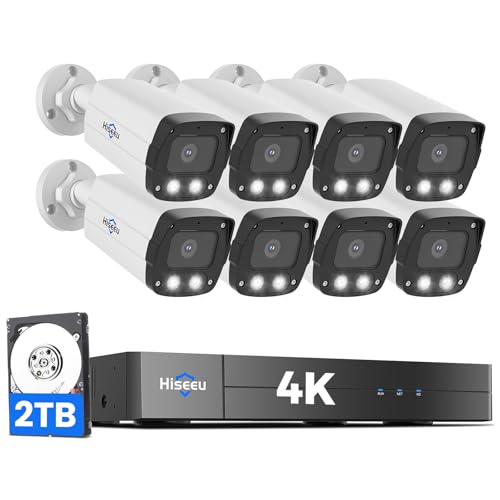
Pros
- Sharp 4K 8MP resolution with 121-degree wide view
- Preinstalled 2TB hard drive for continuous recording
- AI human and vehicle detection with active warnings
- Three selectable night modes including full color
Cons
- Requires wired router connection for remote app access
- Extra PoE switch needed to expand past eight cameras
- Synchronized playback limited to four cameras at once

Pros
- 100-foot full-color night vision with dual illumination LEDs
- AI event filtering for humans, faces, and vehicles
- Weatherproof IP67-rated heavy-duty metal housing
- Super-wide 132-degree viewing angle at 5MP resolution
- Full NDAA compliance with no FCC Covered List parts
Cons
- PoE injector or power switch is not included
- Maximum video frame rate capped at 20fps
- Off-site cloud storage requires an optional subscription
Match the Camera to Existing Infrastructure
Analog models such as the DCSEC and ZOSI options connect to a compatible DVR through coaxial cabling. They can be useful when an office already has that wiring in place, but the default video mode may need to be changed through the camera controls before a high-definition DVR displays the intended picture.
PoE models use one Ethernet cable for power and data, which can simplify new installations when your network supports PoE. The Hiseeu system includes an NVR and storage, while the VIKYLIN and AMLINK cameras are individual network cameras that need compatible recording or storage arrangements.
Before buying, identify whether your recorder is a DVR or NVR. The difference affects compatibility, expansion, remote access, and the cables running to every camera. This explanation of NVR and DVR differences can help clarify the choice.
Pro Tip: Confirm the recorder type, cable route, and available PoE ports before ordering a camera.
Cover Open Rooms Without Blind Spots
Wide-angle cameras are especially useful in reception areas, open-plan workspaces, and small offices where one viewpoint can cover several directions. The DCSEC 180-degree models use a fisheye lens, while the AMLINK offers a 132-degree view and the Hiseeu system lists a 121-degree view.
A wide view does not automatically provide close detail everywhere in the frame. Mount the camera where desks, doors, and corridors remain visible without shelving or partitions blocking the lower part of the image. For a narrow doorway or exterior approach, a conventional view may be easier to aim precisely.
| Camera type | Main distinction | Suitable location |
|---|---|---|
| Analog fisheye | 180-degree coverage | Open rooms |
| PoE turret | Ethernet power | Entrances and corridors |
| PoE system | NVR recording | Multi-room offices |
Night coverage also differs. ZOSI lists up to 80 feet of infrared visibility, the DCSEC 2MP model lists up to 30 feet, and VIKYLIN lists infrared coverage up to 98 feet. AMLINK and Hiseeu add color night options, which may help identify activity when the scene has enough usable light.
Plan Recording, Alerts, and Privacy
Some office buyers need continuous local recording, while others mainly want event notifications. Hiseeu includes a 2TB hard drive and supports continuous recording, while VIKYLIN supports a microSD card up to 256GB, NVR, or FTP storage. AMLINK supports microSD, PC, NVR, FTP, SFTP, and optional cloud storage.
AI features can reduce the number of irrelevant alerts. Hiseeu lists human and vehicle detection, AMLINK lists human, face, and vehicle detection, and VIKYLIN lists tripwire and intrusion functions. Set activity zones carefully so routine movement in a lobby does not create constant notifications.
For offices, camera placement should respect employee privacy and company policy. Avoid aiming cameras into private areas, limit access to recordings, and explain retention rules before installation. The rules surrounding camera footage in court are another reason to preserve recordings carefully and restrict who can retrieve them.
Before You Mount It: A camera that records sound or sends cloud footage may create separate workplace privacy obligations. Confirm your policy and local requirements before enabling microphones, audio storage, or remote sharing.
Expert Examined
From Ray Okafor

I keep seeing office owners focus on resolution while overlooking the recorder and cable path. The practical fix is to map every camera location, confirm its power source, and decide where footage will be stored before choosing the lens.
Read more about Ray OkaforWhich Camera Fits Your Office
I would point you to the DCSEC 5MP 4MP 180 Degree Wide Angle Dome Security when one camera must watch a broad room and the office already uses a compatible analog DVR. Its 180-degree view can reduce the number of cable runs, but you must select the correct high-definition mode and provide the DVR because the camera does not record by itself.
I would choose the Hiseeu 8MP PoE Security Camera System for a multi-room office that wants a complete PoE setup with an NVR, a 2TB hard drive, 4K image resolution, and continuous recording. Its human and vehicle detection plus app alerts suit managers who need event notifications as well as local playback.
For a single network camera with flexible storage, I would consider the VIKYLIN 4K 8MP IP POE Security. It combines 4K video, a 102-degree view, a built-in microphone, microSD support up to 256GB, IP67 weather protection, and smart detection features, making it a practical fit for an entrance or exterior office wall.
The Bottom Line
The biggest mistake office buyers make is treating every camera as interchangeable. Analog cameras need compatible DVR equipment, while PoE cameras need network power and a suitable recording plan, and wide-angle coverage changes how you position each unit.
If you do only one thing first, trace the cable and recording path from each proposed camera location to the recorder or network switch. That single check will eliminate incompatible models before you spend time comparing resolution, night vision, or alert features.
FAQs
Analog cameras suit offices with compatible coaxial DVR wiring already installed. PoE cameras are better suited to a network-based installation where Ethernet cabling, PoE power, and an NVR or other storage method are available. Mount cameras to show entrances, reception areas, corridors, and open workspaces without obstructions. Keep them away from private areas, and aim wide-angle models carefully because the edges of a broad image may show less detail. Analog cameras require a power source plus video and power cabling, while PoE cameras can carry power and data through one Ethernet cable when the switch or injector supports PoE. Check connections, storage capacity, firmware, and camera views on a regular schedule. IP67 describes protection against dust and temporary water immersion under defined conditions. It does not replace careful mounting, sealed cable connections, or a location that protects the camera from avoidable impact and tampering.Should an office use analog or PoE cameras?
Where should office security cameras be mounted?
What power and maintenance do office cameras need?
What does IP67 mean on an office camera?
Sources
- National Institute of Standards and Technology www.nist.gov
- Federal Trade Commission www.ftc.gov