
Finding the best security camera systems under $500 means choosing between running structured Ethernet lines or relying on local power outlets paired with wireless video transmission. Property size dictates this divide, separating owners who need stable footage across expansive outbuildings from those wanting simple perimeter surveillance around a compact suburban lot.
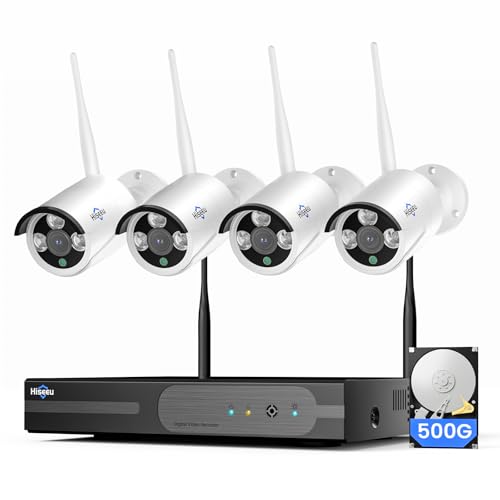
Pros
- Pre-installed 500GB hard drive without subscription fees
- Dual-band WiFi connectivity plus standalone local monitoring
- Expandable 16-channel NVR with 4K color night vision
- Weatherproof IP66 housings rated from minus 13 degrees
Cons
- Plug-in wired power requires nearby outdoor outlets
- Comes with four cameras despite sixteen channel capacity

Pros
- Pre-installed 2TB HDD for local continuous recording
- True 4K 8MP resolution with 132-degree viewing angle
- Single-cable PoE setup with no monthly subscription
- IP67 weatherproofing for outdoor rain and snow
- AI human and vehicle detection with custom zones
Cons
- Includes only four cameras for an eight-channel NVR
- Requires running physical Ethernet cables to each spot
Power Architecture and Transmission Reliability
Surveillance stability depends directly on how each camera receives operating current and delivers its video stream back to the recorder. Understanding what is an NVR and how is it different from a DVR helps clarify why IP camera systems manage modern data loads so much more effectively than older coaxial hardware.
Power over Ethernet relies on a single Cat5e or Cat6 line to transmit low-voltage electrical current alongside high-bitrate video signals. Running dedicated cabling through attic spaces or soffits requires initial effort, but it completely eliminates Wi-Fi congestion and radio frequency interference. Dedicated networking guidelines maintained by organizations like FCC emphasize keeping heavy local data streams isolated to avoid choking domestic wireless traffic.
Plug-in Wi-Fi systems reduce installation time by transmitting video data through 2.4 GHz or 5 GHz bands while relying on standard outdoor electrical outlets. This design avoids pulling cable through interior walls, but exterior power supplies must be shielded from moisture and physical tampering.
| System Architecture | Wiring Requirement | Primary Advantage |
|---|---|---|
| PoE Wired | Single Cat6 Ethernet | Zero RF interference |
| Plug-in Wireless | Outlet power only | Faster camera mounting |
| Dual-Band NVR | Outlet plus antenna | Flexible placement radius |
Outlet Exposure Trap: Outdoor AC adapters plugged into standard ground-level receptacles invite simple sabotage and water intrusion. Always secure exterior power connections inside weather-resistant, locked junction boxes.
Local Hard Drives Versus Continuous Bandwidth Loads
Continuous around-the-clock recording demands dedicated onboard mechanical storage rather than reliance on internet uplinks. High-efficiency video encoding formats like H.265 compress 8-megapixel video frames, keeping storage footprints manageable across multi-terabyte drives. Having dedicated local disks ensures that recording never stops if your neighborhood internet service goes down.
Expert Examined
From Jenna Castellano

The mistake I see most often is placing a recorder inside an unventilated closet where ambient heat degrades the mechanical hard drive within two summers. Keep the base station in a conditioned, dust-free space with decent airflow to preserve the drive bearings.
Read more about Jenna CastellanoHomeowners often evaluate how surveillance integrates into future property transactions, which is why checking whether are security cameras included when you sell a house is worth reviewing before permanently mounting hardware. A properly installed local storage system adds tangible security value without burdening subsequent residents with mandatory subscription charges.
Motion Differentiation and Night Video Clarity
Modern surveillance processing uses edge detection algorithms to differentiate pedestrian profiles and vehicle outlines from blowing tree limbs or wandering nocturnal pests. Reducing false alert notifications prevents notification fatigue, ensuring you react immediately when an actual perimeter breach occurs. Visible deterrent spotlights integrated directly into camera housings can also clarify nocturnal footage.
Interpreting equipment status lights during nighttime operation is straightforward once you discover what do the lights on a security camera mean during active recording cycles. Integrated supplementary lighting enables true full-color imaging at night, which captures vital vehicle colors and clothing details that traditional black-and-white infrared illuminators miss entirely.
Pro Tip: Position outdoor cameras at roughly nine feet high to balance clear facial identification angles against physical reach from ground level intruders.
Matching the Hardware to Your Layout
For detached structures, sprawling acreage, or scenarios where running buried conduit is simple, I would point you to the 4K PoE Security Camera System. Its true single-cable Power over Ethernet connection delivers absolute network reliability, while the massive pre-installed 2TB drive accommodates extended retention spans for up to eight total cameras without subscription overhead.
If you lack attic crawlspaces or manage a finished home where snaking Ethernet cables through finished drywall is impossible, I would choose the Hiseeu 4K 8MP Home Security Camera System Outdoor. It utilizes convenient localized AC power outlets paired with dual-band wireless transmission back to a dedicated 16-channel base unit, letting you cover perimeter doors quickly without professional fishing tools.
The Bottom Line
The single thing most buyers get wrong in this category is underestimating the labor of running physical lines versus the operational stability of a closed-loop network. Opting for wireless camera convenience often trades off long-range signal reliability across thick masonry walls, leading to dropped frames when an incident occurs.
If you only do one thing before purchasing, trace your prospective cable routes from each mounting corner directly back to where your recorder will live. Knowing exactly how you will supply power and retrieve data guarantees you choose a system you can mount smoothly in a single afternoon.
FAQs
Do these security camera systems require an internet connection to record?
No, continuous local recording systems save video directly from the cameras to the pre-installed internal hard drive over your local private network. An active internet connection is only necessary if you want to stream live footage, check playback, or receive push notifications on a smartphone app while away from the property.
What happens to the camera footage during a power outage?
Unless your recorder and cameras are plugged into an uninterruptible power supply battery backup, the system will shut down and halt recording during a power outage. Once household electricity is restored, the hardware automatically reboots and resumes scheduled recording without requiring manual reconfiguration or loss of prior footage.
Can these multi-camera kits be expanded with additional cameras later?
Both systems feature multi-channel recorders that support additional cameras beyond the four included in the box. You can attach compatible matching-protocol cameras up to the channel limit of the recorder as your perimeter coverage needs expand, provided your storage drive accommodates the added data stream.
How does weatherproofing protect exterior bullet cameras in severe winter conditions?
Units rated at IP66 or IP67 are fully sealed against blowing dust, torrential rain, and driving snow accumulation. Operating temperature specifications allow these housings to function in sub-zero winter environments as well as summer heat, provided cable entry points are sealed with silicone or drip loops.
Sources
- Federal Communications Commission Equipment Authorization www.fcc.gov
- UL Solutions Safety Standards for Audio/Video and Security Systems www.ul.com