
Shopping for the best residential water leak detectors starts with one practical split: do you need alerts away from home, or only a loud local alarm? That choice matters most for landlords, vacation-home owners, and anyone placing sensors in a basement or utility room.

Pros
- Three pre-paired sensors included
- App, email, and SMS leak alerts
- Adjustable 100dB alarm volume
- IP66 waterproof sensor housing
Cons
- Requires hub and mobile app setup
- Supports only 2.4G WiFi

Pros
- Dual probe sets for early leak detection
- 105dB alarm with four volume settings
- Five-year built-in battery
- IP67 waterproof design
Cons
- Cannot connect to WiFi directly
- H5044 gateway required for app monitoring

Pros
- No hub required for app and email alerts
- Detects water levels as low as 0.5mm
- Loud 100dB alarm
- IP67 waterproof shell
- Up to two-year battery life
Cons
- 2.4GHz WiFi required for remote alerts
- Uses two AAA batteries per detector

Pros
- Six probes detect drips and pooling water
- Loud 120dB local alarm
- IP66 waterproof ABS housing
- Four volume modes plus mute
- Replaceable AAA batteries
Cons
- No WiFi, app, or hub alerts
- Requires two AAA batteries

Pros
- Three sensors included with one Wi-Fi gateway
- Top and bottom probes detect drips and pooling
- 120dB adjustable sensor alarm
- IP66 waterproof design
- Up to two-year AAA battery life
Cons
- 2.4GHz Wi-Fi only, not 5GHz compatible
- App alerts require the gateway and Wi-Fi
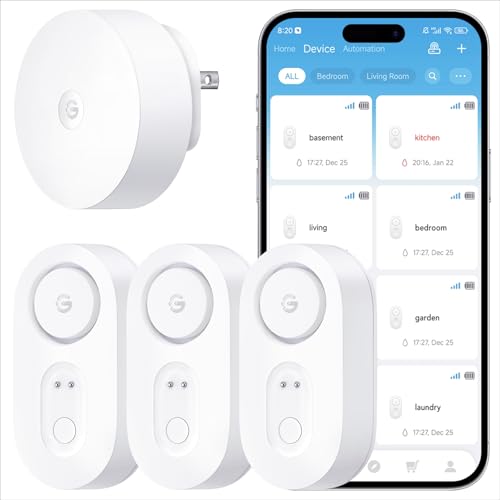
Pros
- 1,804-foot range through up to five walls
- SMS, email, and app push alerts
- 105 dB alarm with four volume levels
- IP67 waterproofing and five-year battery life
Cons
- Gateway supports 2.4 GHz Wi-Fi only
- Gateway pairs only with select GoveeLife sensors
Remote Alerts or Local Warning
A local alarm can warn someone nearby, but it cannot tell you about a burst pipe while you are away. Connected models add app notifications, and some also send email or SMS alerts. That makes them more suitable for vacation properties, basements, and homes where nobody may hear a siren.
Hub requirements deserve close attention. Winees includes a hub and arrives with its sensors pre-paired, while SwitchBot connects to Wi-Fi without an additional hub. The GoveeLife 105dB five-pack cannot connect directly to Wi-Fi and requires the H5044 gateway, whereas the smart GoveeLife kit includes that gateway.
For broader home planning, review where water leaks start in a house before deciding how many rooms need coverage. A sensor near a water heater does a different job from one under a kitchen sink or beside a sump pump.
Pro Tip: Place one sensor at the lowest reachable point beneath each likely leak source, then confirm that its alarm can be heard from the rooms people occupy.
Sensor Coverage and Placement
Top and bottom probes help detect different events. A top probe can respond to dripping from a pipe, while bottom probes react when water pools on the floor. The SwitchBot detects water levels as low as 0.5mm, and the RUIKORING uses top and bottom sensing with a requirement that at least two bottom probes trigger to reduce false alarms.
Use a waterproof housing in damp locations, but do not treat an IP rating as permission to leave electronics submerged indefinitely. IP66 and IP67 designs resist different levels of water exposure, so place the unit where it can sense the first water without sitting in routine splashes.
| Sensor approach | Key distinction | Suitable location |
|---|---|---|
| Top and bottom probes | Detect drips and pooling | Under sinks |
| Connected sensor | Remote app alerts | Vacation homes |
| Local-only sensor | No hub or Wi-Fi | Occupied utility rooms |
Mounting position also affects signal quality. Keep a connected sensor accessible enough to replace batteries and reach its wireless network, rather than hiding it behind a sealed appliance. If your concern is a sump pump, pair leak detection with advice on what a sump pump alarm does.
Battery Life, Range, and Maintenance
Battery claims vary by design and use. SwitchBot lists up to two years from two AAA batteries, RUIKORING lists up to two years, and the GoveeLife models use built-in batteries rated for five years. The EZ2LOCATE model uses replaceable AAA batteries and has a low-battery beep every 60 seconds.
Long range is useful only when the receiving equipment is placed correctly. Winees lists a 200-meter hub-to-sensor distance, RUIKORING lists up to 328 feet in open areas, and GoveeLife lists up to 1,804 feet for its Sub-1G system. Walls, appliances, and basement construction can reduce practical coverage.
Expert Examined
From Jenna Castellano

I keep leak sensors visible enough to inspect, because the common failure is forgetting that a hidden device still needs battery attention. I also prefer a quick alarm check after moving a sensor, changing network equipment, or replacing batteries.
Read more about Jenna CastellanoUse the manufacturer’s app or physical button to confirm the alarm and review low-battery notices where available. For water shutoff planning, see whether water sensors shut the water off; detection alone does not stop a leak.
Before You Mount It: Do not place a sensor where a normal splash repeatedly triggers it, and never assume a detector can close a water valve unless a separate shutoff system specifically provides that function.
Which Detector Fits Your Home
I would point you to the SwitchBot 3 Pack Water Leak Detector for Home when you want three connected sensors without buying a separate hub. Its app and email alerts work remotely after Wi-Fi setup, while its 100dB alarm, IP67 housing, and up to two-year AAA battery life suit laundry rooms, sinks, and water heaters.
For a larger property with a detached garage, deep basement, or distant outbuilding, I would choose the GoveeLife Upgraded Smart Water Leak Detector 1s. Its included H5044 gateway supports SMS, email, and app push notifications, while the listed 1,804-foot Sub-1G range and five-year battery rating target challenging layouts.
If you only need a loud warning near a washer, toilet, or water heater, I would put the 3 Pack Water Leak Detector 120dB 6 Probe IP66 on the shortlist. It needs no Wi-Fi, app, hub, or subscription, uses six probes, and offers four volume modes with replaceable AAA batteries.
The Bottom Line
The biggest mistake buyers make is treating every water detector as interchangeable. A local-only alarm cannot notify you at work, and a connected sensor may need a gateway, compatible Wi-Fi, or ongoing battery attention.
Start by listing the rooms and deciding whether someone will always be close enough to hear an alarm. Then choose the simplest model that covers those locations, verify its network or hub requirements, and place it at the lowest practical point near each water source.
FAQs
Choose a connected model if you need app, email, or SMS alerts while away from home. A local-only detector is suitable when people are usually nearby and you want a simple alarm without Wi-Fi, an app, or a hub. Place them beneath sinks, near washing machines, water heaters, dishwashers, toilets, pipes, and sump pumps. Keep the probes at the lowest practical point, but avoid locations that receive routine splashes or condensation. Battery life depends on the model and usage. Check low-battery alerts, inspect the sensor periodically, and remember that replaceable AAA batteries and built-in five-year batteries have different maintenance needs. An IP rating describes protection against dust and water under defined conditions; it does not make every placement suitable for continuous immersion. Use the housing rating as guidance, while keeping the sensor positioned to detect water early.Should I choose a connected or local water leak detector?
Where should water leak sensors be placed?
How often do water leak detector batteries need attention?
What does an IP66 or IP67 rating mean?
Sources
- UL Solutions and Water Safety Information. www.ul.com
- US Consumer Product Safety Commission and Home Safety. www.cpsc.gov
- NFPA and Water Damage Prevention Guidance. www.nfpa.org