
Finding the best residential smoke detectors hinges on whether your home already has interconnected wiring behind the drywall. Modern building codes require alarms that communicate across rooms, but older properties often force homeowners to choose between running new copper lines or setting up wireless networks.

Pros
- UL 217 10th Edition certified photoelectric sensor
- Open-air interlink range reaching up to 2,034 feet
- Local device-to-device alerts continue during Wi-Fi outages
- Monitors rapid temperature shifts within two minutes
- App-based scheduling for remote self-tests and silence
Cons
- YoLink Hub required separately for app connectivity
- Battery life limited to five years maximum
- Compatible accessories and sirens sold separately
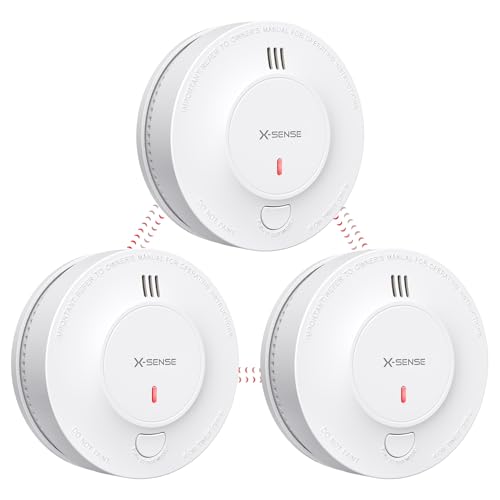
Pros
- Wireless interconnect for up to 18 Link+ units
- Sealed 10-year lithium battery eliminates replacements
- ETL listed to UL 217 safety standard
- Photoelectric sensor helps reduce false alarms
Cons
- Lacks built-in carbon monoxide detection
- Silencing remote control sold separately

Pros
- Compact 2.7-inch diameter takes minimal ceiling space
- 915MHz wireless interconnect links units without running wire
- Dual-LED photoelectric sensor reduces cooking false alarms
- Certified to latest UL 217 10th Edition standard
Cons
- Lacks integrated carbon monoxide detection
- Single pack requires buying extra alarms to link

Pros
- UL 217 9th edition certified photoelectric sensor
- Hardwired interconnect links up to 12 alarms
- 9V battery backup maintains power during outages
- Ten-hour silence mode mutes nuisance alerts
Cons
- Requires 120V AC wiring for primary operation
- Uses standard 9V batteries instead of sealed cells
- No integrated carbon monoxide sensing

Pros
- Sealed 10-year lithium battery prevents routine replacements
- Photoelectric sensor reduces nuisance alarms from cooking
- ETL listed to the UL 217 safety standard
- Wire-free installation with mounting hardware included
Cons
- No wireless interconnection to link multiple units
- Lacks Wi-Fi connectivity and mobile app notifications

Pros
- Certified to the UL 217 10th Edition standard
- Dual-wavelength photoelectric sensing limits nuisance alarms
- Tool-free magnetic adhesive pad mounting included
- Compact frame under three inches across
Cons
- No built-in carbon monoxide detection
- Requires CR123A battery replacements over its life
Wiring Infrastructure and Communication Types
Homes built after 1989 typically feature dedicated 120-volt wiring tying every alarm together. When one sensor detects smoke, that line carries a signal that triggers every horn across bedrooms simultaneously. Replacing units in these structures requires matching the voltage harness, while unlinked homes require radio-frequency links.
Wireless interlinked detectors bridge this gap without cutting drywall. These battery-powered units communicate on proprietary sub-gigahertz frequencies to mirror hardwired systems. You can integrate individual detectors into broader home security systems to monitor entry points alongside fire alerts.
Standalone battery units remain useful for small rental units, but larger residences leave occupants vulnerable when an alarm sounds behind closed doors. If an isolated unit triggers in a basement, sleeping occupants on upper floors may never hear it.
| Alarm Type | Power Format | Best Placement |
|---|---|---|
| Hardwired Interconnect | 120V AC with backup | Pre-wired residences |
| Wireless Interconnect | Sealed lithium battery | Multi-story older homes |
| Standalone Unit | 10-year sealed lithium | Studio apartments and rentals |
The Impact of UL 217 Standards on Nuisance Alarms
Nuisance triggers from kitchen steam cause people to disable detectors, creating hazardous coverage gaps. The National Fire Protection Association warns that false alarms directly contribute to fire injuries when occupants remove batteries. The revised UL 217 criteria mandate sensors that distinguish common cooking vapors from polyurethane foam fires.
Nuisance Alarm Trap: Never remove the battery or unscrew an active detector when cooking creates smoke. Use the integrated silence button instead, as disabled units are responsible for a large share of residential fire fatalities.
Dual-wavelength optical sensors satisfy these stricter benchmarks by measuring both infrared and red-light refraction. This analysis ensures prompt notification for slow-smoldering fires while ignoring kitchen humidity. Following standard home safety and detection guidelines means replacing detectors that lack updated smoke chamber certifications.
Expert Examined
From Jenna Castellano

I frequently find homeowners disabling smoke units near kitchens simply because older sensors could not distinguish cooking steam from a flaming grease pan. Switching to a dual-wavelength photoelectric model eliminates those nuisance interruptions while keeping the warning network active when someone burns dinner.
Read more about Jenna CastellanoStrategic Placement and Sensor Maintenance
Proper placement dictates whether smoke reaches the sensing chamber before flames compromise an escape route. Mount detectors on flat ceilings at least four inches from walls, or on walls four to twelve inches below ceilings. Placing alarms within dead air pockets at ceiling peaks prevents smoke circulation.
Kitchen Clearance Rule: Install your alarms at least ten feet away from fixed cooking appliances to prevent cooking vapors from triggering nuisance alerts during routine meal preparation.
Sealed lithium cells run uninterrupted for ten years, eliminating irritating midnight battery chirps. However, a ten-year battery does not mean zero upkeep. Airborne dust collects in photoelectric chambers over time, requiring periodic cleaning with a soft brush to preserve sensitivity. For other practical residential updates, check our blog for maintenance routines.
Matching Alarms to Your Living Space
For houses with existing junction boxes and 120V wiring, I would choose the Siterlink Hardwired Interconnected Smoke. Its 9V battery backup keeps the interlinked network operational during power outages, and the multi-pack format simplifies whole-house updates across multiple hallways and bedrooms.
If you want connected safety without pulling electrical lines through drywall, I would point you to the X-Sense Interconnected Smoke Detector. Its sealed ten-year lithium battery eliminates battery replacement routines, and linking up to 18 units wirelessly ensures that a basement fire alerts every bedroom occupant instantly.
For larger properties with detached workshops, garages, or sprawling outbuildings, I would install the YoLink Photoelectric Smoke Detector. Its long-range LoRa protocol bridges up to 2,034 feet, and its local device-to-device automation allows the detector to sound sirens and control lighting even if your internet connection drops. You can also explore options for best home security systems to see how wireless protocols protect your entire perimeter.
The Bottom Line
Most homeowners mistakenly assume that any loud buzzer will protect a multi-story home, overlooking how closed bedroom doors muffle isolated alarms. Relying on disconnected units means that by the time an upstairs occupant wakes to a basement fire, the hallway may already be impassable.
Start by surveying your ceilings to determine whether you have hardwired wiring harnesses or need wireless interconnectivity. Once you identify that power format, purchase linked units that sound simultaneously throughout the entire floor plan to give your family crucial evacuation time.
FAQs
What is the difference between ionization and photoelectric smoke alarms?
Ionization sensors react quickly to fast-flaming fires using radioactive material, whereas photoelectric sensors use light scattering to detect slow-smoldering fires. Modern residences favor photoelectric sensors because they provide earlier warnings for smoldering upholstery while generating significantly fewer false alarms near kitchens.
Why is the UL 217 10th Edition certification significant?
This standard requires smoke alarms to differentiate between actual fire smoke and nuisance particles from routine cooking. It also introduces stricter requirements for detecting smoke generated by synthetic materials like polyurethane foam, which burn faster and hotter than natural wood or cotton.
How often should residential smoke alarms be replaced?
Smoke detectors must be replaced every ten years from their manufacture date, regardless of battery type. Sensor degradation and dust accumulation over a decade reduce operational reliability, making complete hardware replacement essential for ongoing household safety.
Can hardwired and wireless smoke alarms interconnect with each other?
Traditional hardwired alarms cannot communicate directly with standalone wireless models unless you introduce a dedicated bridge module from the same brand. Homeowners without interconnected wiring across every room often find it simpler to install a complete set of wireless interlinked detectors.
Sources
- National Fire Protection Association www.nfpa.org
- US Fire Administration www.usfa.fema.gov
- UL Solutions Standards www.ul.com