
Installing the best home security systems with cameras protects entry points while giving you instant visual proof of an intrusion. The real divide in these packages is between continuous local video storage and sensor-triggered alarm verification. Knowing which layout matches your property prevents false dispatches and costly gaps in coverage.
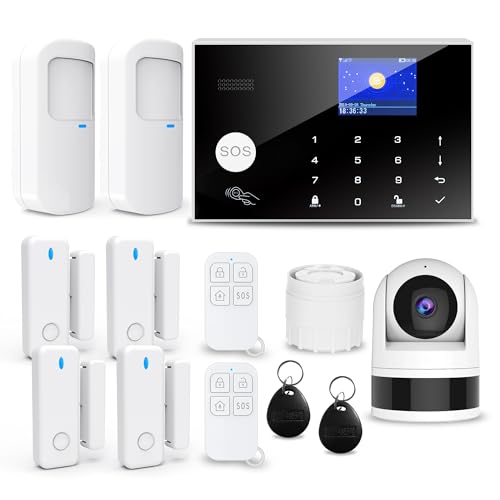
Pros
- Extensive 13-piece security kit
- Supports up to 100 sensors
- Dual WiFi and 2G connectivity
- Includes remote control and camera
Cons
- Requires legacy 2G network support
- Extensive initial installation time

Pros
- PIR motion and door/window sensors
- 120dB real-time alarm siren
- 2K camera with remote monitoring
- WiFi and 4G dual connectivity
Cons
- No 5G network support
- MicroSD card sold separately

Pros
- Zero monthly monitoring subscription fees
- Loud 120dB alarm siren included
- Includes 1080P auto-tracking night vision camera
- Expandable up to 100 wireless sensors
Cons
- Incompatible with 5GHz Wi-Fi bands
- Cellular backup limited to 2G networks

Pros
- Sensor spotlight with color night vision up to 32ft
- Standard black and white night vision reaches 100ft
- True Detect heat and motion sensing
- Works with Hey Google and Alexa voice commands
Cons
- Requires a separate DVR system to operate
- Wired DIY setup requires routing physical cable

Pros
- Hub supports up to 100 wireless sensors
- Peel-and-stick wireless sensor setup
- Includes keypad, motion sensor, and two entry sensors
- Five-second alert response from professional monitoring agents
Cons
- Ongoing paid subscription required for professional monitoring
- Monitoring service restricted to the 50 US states

Pros
- Local 1TB hard drive without monthly subscription fees
- PIR sensors detect human and vehicle heat signatures
- Motion-activated spotlights enable color night vision
- Wired DVR connection avoids Wi-Fi interference
Cons
- Requires running physical cables for installation
- Color night vision distance capped at 32 feet
Continuous Recording Versus Event-Triggered Video
Most buyers expect every system to save hours of ambient footage, but standard alarm bundles operate differently than standalone recorder setups. A hub-driven alarm uses contact sensors and passive infrared motion detectors to catch movement first, turning on the camera only to capture the immediate incident.
Dedicated multi-channel systems record constantly to a local hard drive regardless of whether a door opened. Understanding what is an NVR and how is it different from a DVR helps determine if you need continuous footage for vehicle tracking or simple snapshot clips for unexpected entry.
| System Architecture | Storage Medium | Primary Benefit |
|---|---|---|
| Wired DVR Package | Internal 1TB Hard Drive | Uninterrupted 24/7 video |
| Wireless Alarm Hub | Local MicroSD Card | Fast sensor verification |
| Monitored Base Station | Cloud or App Clips | Rapid emergency dispatch |
Dual-Network Connections and Power Interruptions
Wi-Fi works well for transmitting live camera feeds, yet wireless signals remain vulnerable to broadband outages and physical line cuts. Equipment that features a backup cellular slot maintains communication with your phone or dispatch center even if your home router drops offline.
The Federal Communications Commission regulates consumer wireless standards, and dual-band setups ensure security data transmits across clear frequencies according to FCC guidelines. If your perimeter cameras feature status indicators, understanding what do the lights on a security camera mean helps you quickly confirm connection health during a power failure.
Network Vulnerability: Never rely on Wi-Fi alone if your neighborhood experiences frequent broadband dropouts. An intruder cutting your exterior internet line disables remote alerts entirely unless your base hub supports a secondary cellular channel.
Sensor Integration and False Alarm Prevention
Basic video motion detection often triggers on blowing tree branches or passing headlights, creating notification fatigue. Pairing exterior cameras with physical perimeter sensors reduces erratic alerts by verifying real physical entry before sounding a siren.
Heat-detecting sensors identify body signatures rather than pixel changes across the frame. When an incident does occur, knowing whether is security camera footage admissible in court reinforces the value of clear timestamps, high-decibel deterrence, and verifiable sensor logs.
Expert Examined
From Jenna Castellano

The mistake I see most often is placing wide-angle cameras facing south into direct sun glare, which blinds the sensor and causes constant false motion events. I mount exterior lenses under shaded eaves angled downward across entry walkways rather than pointing them into open sky.
Read more about Jenna CastellanoPro Tip: Position your high-decibel siren central to the living space rather than tucked in an entryway closet. Sound carries much faster through open hallways, waking sleeping occupants before an intruder crosses deep into the home.
Selecting the Right Kit for Your Layout
For large perimeter monitoring and constant vehicle tracking, I would point you to the Swann Home/Business Wired DVR. Its eight wired cameras deliver 1080p resolution with color night vision, while the 1TB hard drive handles continuous recording without internet dependencies.
If you live in a multi-story house and want simple DIY protection without drilling holes through wall studs, the Alarm System for Home Security,22Piece WiFi+4G offers excellent coverage. It includes an HD camera, motion detectors, and a loud 120dB siren backed by dual Wi-Fi and 4G connectivity.
For apartments or smaller layouts where monitored response is the priority, the Wyze Home Security Core Kit: Hub, Keypad handles entry detection and connects with optional cameras, giving you fast dispatch capability inside broader home security systems without complex wiring.
The Bottom Line
The single thing most buyers get wrong is choosing an alarm based purely on camera resolution while ignoring how footage gets stored and accessed. High-resolution sensors are useless during an intrusion if your Wi-Fi drops and the hub lacks cellular fallback or local drive backups.
Audit your entry points first to see where hardwired lines or wireless sensors can actually reach. Map out high-traffic doors and vulnerable windows, then choose the system that secures those physical boundaries before adding supplementary cameras.
FAQs
Do security systems with cameras require a monthly fee?
Many systems operate entirely without subscriptions by saving video to an internal hard drive or local microSD card. Subscription fees usually apply only if you select professional emergency dispatch or off-site cloud video storage.
What happens if the internet goes down?
Wired DVR systems continue recording footage directly to their internal hard drives without any internet connection. Wireless hubs equipped with cellular SIM backup can still send alarm alerts and trigger local sirens during an outage.
How far away can cameras detect motion effectively?
Most consumer security cameras and integrated heat sensors detect human motion reliably up to thirty feet away. Sensor spotlights also illuminate movement within that range to maintain clear night recording.
Can I add more sensors to an existing security hub?
Most modern wireless alarm hubs support up to one hundred individual components. You can add extra door contacts, PIR motion detectors, and water sensors as your home security needs expand.
Sources
- Federal Communications Commission www.fcc.gov
- UL Solutions Safety Standards www.ul.com