
For the best govee water leak detectors, the key split is local alarm versus remote notification. Choose based on whether someone can hear a sensor at home, or whether a distant basement, cabin, or garage needs to reach your phone.

Pros
- 100dB adjustable alarm with mute button
- Five-year battery life
- IP66 water-resistant construction
- Five wireless detectors in one pack
Cons
- Gateway required for mobile alerts
- Gateway device not included

Pros
- 4.92-foot cable reaches hidden leak-prone areas
- Three contact points monitor two areas
- 105dB alarm with four volume levels
- Five-year battery life
Cons
- No app or Wi-Fi when used alone
- Only compatible with H5044 gateway

Pros
- Dual probe sets for early leak detection
- 105dB alarm with four volume settings
- Five-year built-in battery
- IP67 waterproof design
Cons
- Cannot connect to WiFi directly
- H5044 gateway required for app monitoring
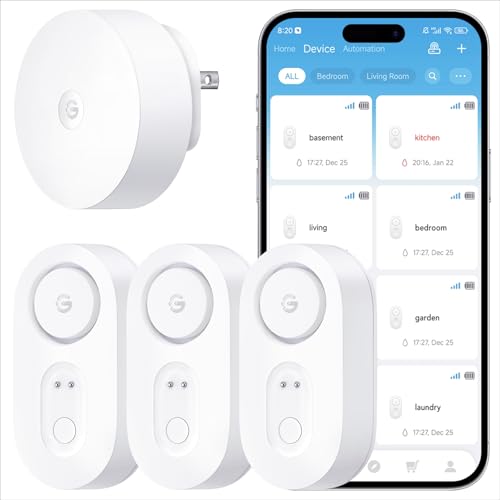
Pros
- 1,804-foot range through up to five walls
- SMS, email, and app push alerts
- 105 dB alarm with four volume levels
- IP67 waterproofing and five-year battery life
Cons
- Gateway supports 2.4 GHz Wi-Fi only
- Gateway pairs only with select GoveeLife sensors

Pros
- 1968-foot LoRa receiving range
- SMS, email, and app push alerts
- Up to 100dB leak alarm
- IP66 rating for damp areas
Cons
- Gateway supports 2.4GHz Wi-Fi only
- Alerts depend on gateway and app connection
Match the Sensor to the Leak Risk
Basic audible units suit kitchens, bathrooms, laundry rooms, and other places where a 100dB or 105dB alarm can be heard quickly. They do not provide remote alerts by themselves. The second GoveeLife option requires the H5044 gateway for phone monitoring, while the first requires its compatible H5043 gateway.
A cable sensor is more useful when the likely wet spot is hidden behind an appliance or inside a sump pit. The GoveeLife Upgraded Water Leak Detector 1s has a 4.92-foot cable and three contact points, allowing one sensor to monitor two areas when the probes are positioned separately.
Pro Tip: Place the sensing points at the lowest practical part of the risk area, but keep the alarm body accessible for silencing and battery checks.
Remote Alerts Need the Right Gateway
Remote monitoring is a separate feature, not a default property of every GoveeLife sensor. The smart three-pack includes an H5044 gateway and supports SMS, email, and app push notifications. The six-pack also sends remote alerts through its gateway and adds Alexa voice assistant reminders.
Gateway compatibility deserves attention before you buy additional sensors. H5059 and H5830 sensors pair with H5044, while the H5058 sensor pairs with H5043 and is not compatible with several other gateways. If you need help deciding where sensors belong, review common leak starting points in a house.
| Sensor style | Main strength | Suitable location |
|---|---|---|
| Audible unit | Simple local warning | Kitchen or bathroom |
| Cable sensor | Reaches hidden areas | Behind appliances |
| Smart gateway | Remote notifications | Vacation property |
A gateway also adds another dependency: Wi-Fi. The H5044 gateway supports 2.4G Wi-Fi, so confirm that your home network can provide that connection near the planned gateway location.
Water Resistance, Battery, and Placement
All five options specify a five-year battery life, though the stated protection ratings differ. IP67 models are suited to damp locations and accidental submersion, while IP66 models protect against water exposure without offering the same submersion rating.
Use sensors near water heaters, washing machines, dishwashers, sinks, toilets, sump pumps, and fish tanks. A detector only reports water after its probes contact it, so placement matters more than adding a unit in a dry, elevated corner. For sump-related planning, learn how sump pump alarms work.
The US Consumer Product Safety Commission provides broader household safety information at CPSC.gov. Its guidance cannot replace the sensor maker’s pairing instructions or the product’s stated protection rating.
Before You Mount It: Do not assume a water sensor shuts off the supply. Keep the main shutoff accessible and learn how to shut off the water main before a leak occurs.
Expert Examined
From Ray Okafor

I keep sensors slightly away from stored items that could hide a puddle or block the alarm sound. The mistake I see is placing every unit beside the appliance instead of at the lowest point where water will spread first.
Read more about Ray OkaforWhich GoveeLife Model Fits Your Home
I would point you to GoveeLife Upgraded Smart Water Leak Detector 1s for a home where missed alerts matter, such as a vacation property or a basement separated from living areas. It includes the H5044 gateway and supports SMS, email, app push notifications, a 1804-foot stated range, and a 105dB alarm.
I would choose GoveeLife Upgraded Water Leak Detector 1s for a hidden appliance connection or sump pit. Its 4.92-foot cable, independent probe operation, IP67 rating, adjustable 105dB alarm, and five-year battery make it the most flexible placement option, but remote monitoring requires the H5044 gateway.
For broad coverage across several rooms, I would consider GoveeLife Smart Water Leak Detector 2 with 1968ft. Its six sensors, 1968-foot stated range, six sensing probes per detector, and support for SMS, email, app alerts, and Alexa suit a larger property. Choose it only if the 2.4G gateway setup fits your network.
The Bottom Line
The mistake most buyers make is treating every GoveeLife detector as a standalone Wi-Fi product. Several models need a specific gateway, and gateway generations are not interchangeable, so pairing requirements should be checked before deciding on sensor placement.
If you do one thing first, map the likely leak points and mark which areas need a phone alert. Then select local audible sensors for occupied rooms, a cable model for concealed spaces, or a gateway kit for property-wide notifications.
FAQs
The GoveeLife Upgraded Water Leak Detector 1s has a 4.92-foot cable and three contact points. Its cable can reach behind appliances or into sump pits while the main alarm remains accessible. Not all of them. The upgraded five-pack and cable sensor require the H5044 gateway for app monitoring, while the smart kits include a gateway and provide remote alerts through it. Each listed model specifies a five-year battery life. The sensors also provide low-battery information through an alarm or flashing indicator, depending on the model’s features. The ratings describe resistance to water and dust under defined conditions. IP67 models are specified for temporary submersion, while IP66 models are suited to powerful water exposure without the same submersion claim.Which GoveeLife water sensor suits a hard-to-reach area?
Can these GoveeLife sensors connect to Wi-Fi directly?
How often do the batteries need replacement?
What does IP66 or IP67 mean for a leak detector?
Sources
- US Consumer Product Safety Commission www.cpsc.gov
- UL Solutions www.ul.com