
Finding the best eufy security cameras requires deciding whether you need uninterrupted floodlight power or the freedom of solar-powered mounts. The lineup avoids recurring subscription fees by relying on onboard or hub-based memory, making hardware placement the primary variable for homeowners. Driveway choke points demand active illumination and wide pans, while property lines benefit from independent solar harvesting.
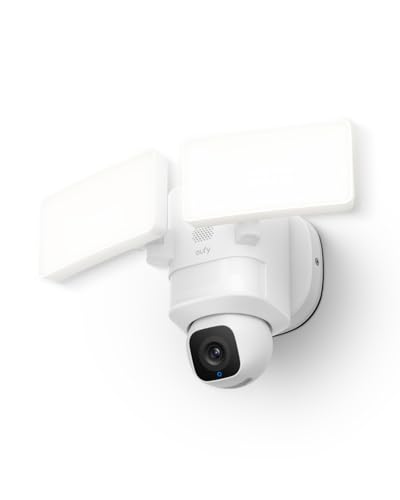
Pros
- 360-degree pan and tilt with auto-tracking
- Bright 2,000-lumen motion-activated floodlights
- Continuous 24/7 recording in 2K resolution
- IP65 weatherproof rating for outdoor exposure
- No monthly subscription fees required
Cons
- Hardwired installation required, no battery option
- Limited to 2.4GHz Wi-Fi networks only

Pros
- Solar-powered setup with removable panel
- Dual lenses with 3K resolution and 8x zoom
- Full 360-degree pan and tilt surveillance
- Built-in 8GB local storage with no monthly fees
Cons
- Requires vertical mounting to eliminate blind spots
- Onboard video storage limited to 8GB

Pros
- Triple-lens setup with 4K wide-angle and 2K tracking PTZ
- Detachable 5.5W solar panel needs 1 hour of daily sunlight
- Radar and PIR motion detection reduces false triggers
- Built-in 32GB local storage with no monthly subscription
- Built-in 105 dB siren with red and blue warning lights
Cons
- Continuous 24/7 recording requires a separate HomeBase S380
- Incompatible with older HomeBase models and eufy NVRs

Pros
- Integrated solar panel with 13,000 mAh battery
- 2K color night footage with F/1.0 aperture
- Built-in 16GB local storage on HomeBase 2
- PIR and AI detection for people, pets, vehicles
Cons
- Requires separate HomeBase 2 hub
- Relies on eufy Security app for alerts

Pros
- Dual-lens 3K video with 8x zoom up to 40 feet
- Removable solar panel provides continuous wire-free power
- HomeBase S380 hub with expandable local storage to 16TB
- Full 360-degree pan and tilt with AI motion tracking
Cons
- Must be mounted vertically to achieve complete coverage
- Dual-lens visual clarity capped at 40 feet of range

Pros
- Integrated solar panel needs two hours daily sunlight
- Detailed 4K video recording with color night vision
- Built-in 16GB local storage with no monthly fees
- BionicMind AI facial recognition identifies family and strangers
Cons
- Sold strictly as an add-on unit
- Expansion hard drive not included for larger storage
Solar Charging Against Continuous Wiring
Solar options like integrated photovoltaic panels simplify mounting because you avoid drilling electrical junction boxes. Units equipped with high-capacity batteries and high-efficiency solar cells require only one to two hours of direct sun daily to maintain a full reserve. Shaded eaves or north-facing walls, however, can starve solar collectors, causing intermittent dropouts during extended winter storms.
Hardwired fixtures solve power starvation entirely. A wired floodlight unit connects directly to standard home wiring, allowing it to sustain 24/7 video capture without draining a battery cell. For perimeter areas where power lines are unavailable, pairing battery hardware with external mounting brackets lets you angle the collector toward open southern skies. The Federal Communications Commission regulates the wireless transmission equipment inside these outdoor devices to ensure signal stability through exterior walls.
Resolution and Dual-Lens Optical Tracking
Resolution dictates whether distant license plates and facial features remain legible after digital magnification. A standard 2K sensor captures broad yard movement, but 4K sensors preserve fine details at extended distances. Knowing if security cameras have facial recognition helps you decide between a basic motion trigger and smart identity filtering that ignores neighborhood wildlife.
| Camera Style | Primary Advantage | Best Placement |
|---|---|---|
| Hardwired Floodlight | Continuous 24/7 recording | Garages and driveways |
| Dual-Lens Solar PTZ | 360-degree auto tracking | Open yard corners |
| Fixed Solar Bullet | Compact set-and-forget power | Side alleys and gates |
Multi-lens units solve the traditional compromise between wide coverage and sharp focus. By combining a fixed wide-angle lens with an independent pan-and-tilt module, a single fixture monitors an entire zone while zooming into moving targets. This tracking eliminates the blind zones common to static bullet cameras mounted flat against a wall.
Pro Tip: Position pan-and-tilt cameras at corner rooflines to give the rotating lenses an unobstructed view across two property sides simultaneously.
Local Storage Hubs and Home Network Demands
Unlike cloud cameras that push massive upload streams across your broadband plan, eufy hardware stores video locally on embedded memory or an indoor base station. Understanding what an NVR is and how it functions clarifies why centralized hubs with expandable hard drives are better suited for multiple camera setups than standalone cards. A base station keeps video safe inside the house even if an outdoor camera suffers physical damage.
Signal reach remains essential because high-resolution feeds drop frames over weak Wi-Fi links. Cameras equipped with signal power amplifiers can reach access points through brick or stucco sidings without requiring repeaters. Checking what the lights on a security camera mean during initial pairing confirms whether the camera is locked to a solid 2.4GHz link before you finish bolting the mount.
Mounting Caution: Never install solar security units beneath deep roof overhangs or dense tree canopies, as partial shade drastically reduces panel current output and leads to dead batteries.
Expert Examined
From Dana Whitfield

The mistake I see most often is mounting cameras too high on second-story gutters to capture wide views, which leaves faces obscured by hat brims and foliage. I keep cameras mounted eight to nine feet above grade so the optical path meets subjects at chest and head level.
Read more about Dana WhitfieldSelecting Hardware for Your Property
For broad front yards and complex driveways, I point buyers toward the eufy Security eufyCam S4, 4K Solar Camera. Its combination of a 4K fixed wide lens and an optical pan-and-tilt tracking mechanism covers expansive areas without missing close-up details. The 5.5-watt solar panel keeps it operational with minimal daylight, while the built-in siren and deterrent lights add immediate defense.
If you have an existing electrical junction box over a garage door, I would put the eufy Security Floodlight Camera E30, 2K in place. The 2,000-lumen floodlights illuminate dark approaches instantly, and the continuous hardwired power allows genuine round-the-clock recording that battery models cannot match.
For detached outbuildings or garden perimeters lacking utility wiring, the eufy Security SoloCam S340 delivers comprehensive 360-degree surveillance with zero wiring hassles. Its dual lenses eliminate blind spots effectively, and the removable solar collector makes bracket positioning straightforward on nearly any fence post or shed wall.
The Bottom Line
The single thing most buyers get wrong is assuming battery-powered solar cameras can record video continuously like commercial security rigs. Solar hardware relies on motion activation to preserve power, making continuous capture impossible without an uninterrupted wired electrical connection.
Audit your intended mounting locations before ordering any hardware. Determine whether sunlight reaches the exact bracket position for at least two hours daily, or choose hardwired floodlight fixtures for high-traffic entryways where non-stop recording is mandatory.
FAQs
Do eufy security cameras require a paid monthly subscription?
No, eufy cameras store your video clips locally on built-in flash storage or an indoor HomeBase unit. You get full access to live streaming, push notifications, and recorded event playback through the mobile app without ongoing fees.
Can solar-powered eufy cameras record continuously 24/7?
Most battery and solar models only record when their sensors detect motion, which prevents premature battery drain. Certain models like the S4 can support 24/7 recording only when connected to a compatible powered HomeBase setup, whereas hardwired floodlights run continuously.
How much sunlight do solar eufy cameras need each day?
Most integrated solar cameras need one to two hours of direct, unobstructed sunlight daily to remain perpetually charged. Shaded placements under deep eaves or heavy tree limbs require periodic manual recharging through a USB cable.
What happens to my video recordings if a camera is stolen?
Standalone cameras hold footage on their internal memory chips, meaning local files vanish if the unit is taken. Pairing cameras with an indoor HomeBase stores all encrypted footage safely inside your home regardless of what happens outside.
Sources
- Federal Communications Commission Equipment Authorization www.fcc.gov
- UL Solutions Safety Standards for Household Surveillance Equipment www.ul.com