
Shopping for the best cheap smart thermostats gets easier once you identify the system and wiring behind the wall. The decisive split is between battery-powered basic scheduling and C-wire-powered models with app access, voice control, or Matter integration.

Pros
- Remote app control and real-time monitoring
- 7-day programmable temperature scheduling
- Backlit LCD for dark rooms
- Temperature control within 2°F
Cons
- Requires a 24V C-wire and no batteries
- Works only with 2.4GHz Wi-Fi

Pros
- 7-day schedules with 8 periods
- Alexa and Google Assistant compatible
- Energy Star certified
- Temperature alerts and filter reminders
Cons
- C-wire required for installation
- Compatibility check needed before purchase

Pros
- Matter support across major smart-home platforms
- Flexible 24/7 heating and cooling schedules
- Remote app and voice control
- Alerts for filters and system malfunctions
Cons
- C-wire required for some wiring configurations
- Not compatible with electric baseboard heaters
- Compatibility check required before purchase

Pros
- Remote control through Smart Life App
- Alexa and Google Home compatible
- 7-day or 5-1-1 scheduling
- Supports non-programmable mode
Cons
- Requires C-wire, cannot use batteries
- Not compatible with multi-stage systems
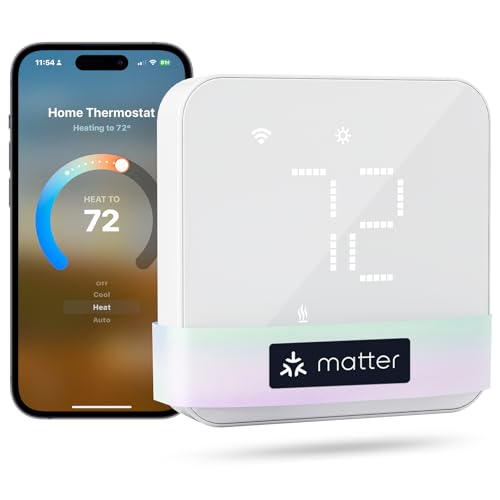
Pros
- Matter support for major smart-home platforms
- Flexible 24/7 heating and cooling schedules
- Remote app and voice control
- Smart alerts for filters and malfunctions
Cons
- C-wire may be required and is not included
- Not compatible with electric baseboard heaters

Pros
- 5-2 day scheduling
- Large backlit display with clear font
- Battery powered, no C-wire required
- UWP wall plate simplifies installation
Cons
- Not compatible with electric baseboard heat
- Two AA batteries not included
Start With Your HVAC Compatibility
A thermostat is only a bargain if it supports your equipment. Riseem’s WiFi Thermostats for Home is limited to conventional single-stage systems with one heat and one cool stage, while it excludes heat pumps, multi-stage systems, heat-only setups, and cool-only setups. It also needs RH, RC, W, Y, G, and C wiring with a 24V C-wire supply.
The vine Smart Thermostat for House is more flexible on paper, supporting conventional systems, boilers, heat pumps, and heat-or-cool-only systems. Meross models cover a broad range that includes heat pumps, furnaces, boilers, humidifiers, and dehumidifiers, but they do not support millivolt systems, two-wire systems, or 110V, 120V, or 240V electric baseboard heaters.
Check Before Wiring: Do not connect a thermostat until the equipment and terminal labels match the product requirements. A wrong system match can cause abnormal operation or leave heating and cooling unavailable.
XuLuaba supports several conventional arrangements, heat-only systems, and some heat pumps, but excludes heat pumps with auxiliary or emergency heat and multi-stage systems. Honeywell Home X2P is a simpler single-stage option for forced air, hot water heat, and 750 mV systems, with battery power instead of a C-wire.
Power, Scheduling, and Remote Access
Four of these choices require a C-wire, so inspect the existing thermostat cable before ordering. Riseem, vine, and XuLuaba cannot run on batteries. The Honeywell Home X2P uses two AA batteries, which are not included, and does not require a C-wire.
Remote control is available through an app on Riseem, vine, XuLuaba, and meross models. Riseem works only on 2.4GHz Wi-Fi. Vine adds Alexa and Google Home support, while XuLuaba works with Alexa and Google Home through Smart Life.
Scheduling varies meaningfully. Riseem offers seven-day or zero-day programming, Honeywell Home provides a five-two schedule or non-programmable mode, and XuLuaba supports five-one-one or seven-day schedules. Meross uses flexible 24/7 plans for home, away, and sleep periods.
| Power style | Schedule type | Smart control |
|---|---|---|
| C-wire powered | Seven-day options | App and Wi-Fi |
| Battery powered | Five-two options | Local thermostat |
| Matter enabled | Flexible 24/7 | Voice and app |
Choose the Smart-Home Fit
Matter is the clearest differentiator between the two meross products and the other choices. Both meross thermostats connect locally with Matter-certified platforms including Apple Home, Amazon Alexa, Google Home, Home Assistant, and Samsung SmartThings. That can reduce the number of separate apps needed for household control.
Vine is a practical alternative if Alexa or Google Home is your priority without needing Matter. Its features include temperature alerts, filter-change reminders, automatic time and date synchronization, child lock functionality, and an Auto Home/Away mode.
For broader smart-home planning, the Smart Energy and Climate Control category provides related home automation context. I keep the thermostat choice tied to the platform you already use rather than selecting features you will not operate.
Pro Tip: Photograph the existing terminal labels before removing the old thermostat, then confirm the C-wire and system type in the selected model’s compatibility information.
Expert Examined
From Dana Whitfield

I keep seeing buyers focus on app features before checking the equipment labels. The practical fix is to identify the HVAC type and available wires first, then narrow the smart-home features to models that can actually power and control that system.
Read more about Dana WhitfieldEnergy scheduling can also work alongside other household automation. If you use Apple Home, you may want to pair thermostat planning with compatible devices discussed in HomeKit doorbell camera recommendations, but the thermostat still needs its own HVAC compatibility check.
Which Thermostat Fits Your Home
I would point you to the Smart Thermostats category when you want to compare the broad product type, but my specific choice depends on the wiring and system. For a conventional single-stage furnace or air conditioner with a confirmed C-wire, I would consider the WiFi Thermostats for Home Smart Thermostat because its seven-day scheduling and app control are straightforward, provided the system has no heat pump or extra stages.
For a home with a heat pump, boiler, or more varied 24V equipment, I would point you to the vine Smart Thermostat for House. Its compatibility range, Alexa and Google Home support, alerts, filter reminders, and Auto Home/Away mode make it the more adaptable choice among the listed options, though a C-wire is still required.
If your priority is platform flexibility, I would choose the meross Matter Smart Thermostats for Home. It suits many HVAC types and works with Apple Home, Alexa, Google Home, Home Assistant, and SmartThings through Matter, subject to the exclusions for baseboard, millivolt, and two-wire systems.
The Bottom Line
The mistake most buyers make is treating a smart thermostat as universally compatible. C-wire requirements, heat-pump limitations, stage counts, and voltage exclusions matter more than app features.
If you only do one thing first, identify the HVAC system and photograph every existing thermostat wire terminal. Then select a model whose compatibility list explicitly matches those details.
FAQs
A single-stage system needs a thermostat that supports one heat and one cool stage. Riseem and Honeywell Home X2P are specifically described for single-stage compatibility, while you should still confirm the available terminals and power method before installation. Most of the app-connected models listed require a C-wire, including Riseem, vine, XuLuaba, and the meross options in specified configurations. Honeywell Home X2P is battery powered with two AA batteries and does not require a C-wire. Some listed models support heat pumps, including vine and meross. Riseem does not, and XuLuaba excludes heat pumps with auxiliary or emergency heat, so match the exact equipment type before buying. Matter allows compatible smart-home platforms to communicate with the thermostat locally. The meross models list Apple Home, Alexa, Google Home, Home Assistant, and Samsung SmartThings among their Matter-certified platform integrations. Schedules let you set different temperature periods around home, away, and sleep routines. The listed models offer different formats, including seven-day, five-two, five-one-one, and flexible 24/7 plans.Which thermostat type suits a single-stage HVAC system?
Do these smart thermostats need a C-wire?
Can I use a smart thermostat with a heat pump?
What does Matter support mean on a thermostat?
How do thermostat schedules help at home?
Sources
- U.S. Department of Energy, Energy Saver. www.energy.gov
- U.S. Consumer Product Safety Commission, Home Safety. www.cpsc.gov