
Replacing old fire units with the best 9V smoke detectors protects your household whether the electrical grid stays live or shuts down. Most buyers need to decide whether their ceiling already has line-voltage harness wiring or requires pure battery operation. Matching that physical wiring prevents installation delays and keeps your living spaces secured immediately.

Pros
- Photoelectric sensor limits nuisance cooking alerts
- Operates on 120V AC with 9V battery backup
- Interconnected design triggers all alarms simultaneously
- Soft hidden LED preserves dark sleeping spaces
Cons
- Requires existing 120V AC home wiring
- Backup 9V battery requires periodic manual replacement

Pros
- Precision Detection reduces nuisance cooking alarms
- Quick Connect plug simplifies hardwired installation
- Early warning interconnect triggers all compatible units
- Visual indicator pinpoints the initiating alarm
- 9V battery backup maintains protection during blackouts
Cons
- Requires existing AC hardwiring in the ceiling
- Replaceable 9V battery backup requires periodic swaps

Pros
- Hardwired interconnection links up to 12 units
- Photoelectric sensor reduces nuisance cooking alarms
- Ten-hour silence mode pauses nighttime low-battery chirps
- UL217 listed with a 10-year product lifespan
Cons
- Requires existing line wiring for installation
- Standard 9V backup battery needs periodic replacement
- Does not include carbon monoxide detection

Pros
- Front-loading door for easy battery replacement
- Nine-volt battery backup sustains power during outages
- Pre-stripped harness wiring speeds up installation
- Hush control button silences nuisance alarms
- Rotatable 360-degree bracket aids ceiling alignment
Cons
- Requires an existing hardwired electrical connection
- Standard 9V battery requires periodic replacement
- Lacks integrated carbon monoxide detection

Pros
- UL 217 10th Edition safety certified
- Drill-free magnetic mounting base
- Photoelectric sensor catches slow smoldering fires
- Loud 85 dB horn with silence button
Cons
- Standard 9V battery needs annual replacement
- No built-in carbon monoxide detection
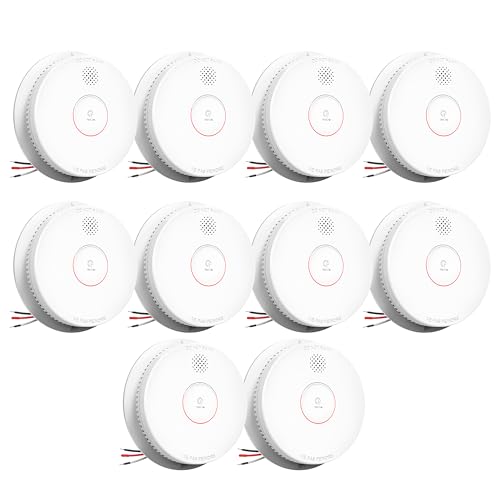
Pros
- Hardwired interconnect links up to 12 alarms
- Photoelectric sensor reduces cooking false alarms
- UL217-10th listed fire detection standard
- Ten-hour hush mode silences low-voltage chirps
Cons
- Requires existing AC electrical wiring to install
- Relies on replaceable 9V backup batteries
- Lacks integrated carbon monoxide monitoring
Hardwire Power Versus Standalone Battery Operation
Ceiling junction boxes in newer properties carry 120-volt alternating current directly to the mounting plate. A hardwired unit draws utility power constantly, relying on the nine-volt cell only when storms or grid failures sever electricity. Standalone battery alarms dispense with wiring harnesses entirely, drawing operating current exclusively from the replaceable nine-volt cell.
Renters and older households lacking pre-run cabling gain fire protection without opening drywall for electricians. However, dedicated battery alarms require disciplined annual cell replacements, whereas hardwired units keep monitoring if a homeowner forgets the backup cell. You can review additional baseline equipment within our home safety and detection section.
| Power Type | Backup Source | Ideal Placement |
|---|---|---|
| Hardwired 120V | 9V battery cell | Existing junction boxes |
| Battery Standalone | Primary 9V cell | Rentals without wiring |
Sensor Response and Kitchen Nuisance Triggers
Photoelectric sensors recognize visible particles from smoldering fires far faster than legacy ionization models. These optical chambers bounce internal light beams, detecting obscuration when dense smoke enters the housing. Modern standards established by UL Solutions require newer detectors to differentiate between nuisance cooking steam and genuine structural fire hazards.
Do Not Disable Nuisance Units: Never remove a battery or twist an alarm down to silence cooking vapor. If an alarm repeatedly activates near a kitchen, relocate the base at least ten feet away from cooking appliances rather than leaving the room unprotected.
Nuisance alerts often prompt frustrated residents to dismantle units, creating severe vulnerabilities during genuine emergencies. Modern nine-volt units incorporate silence functions that quiet the horn for up to ten hours during meal preparation. Pairing these alarms with broader whole home security systems ensures reliable hazard awareness without false alarms.
Expert Examined
From Dana Whitfield

In my consulting work, the most common hazard I see is a smoke alarm left unplugged in a hallway drawer after a false alert. Swapping an older sensor for a unit with a dedicated silence latch eliminates the frustration that causes people to dismantle their warning systems.
Read more about Dana WhitfieldEarly Warning and Whole-House Interconnection
A closed bedroom door muffles high-frequency alarm tones significantly, especially for young children or heavy sleepers. Hardwired units feature interconnect traveler wires that signal every linked detector across hallways and basements simultaneously. Guidance from the National Fire Protection Association highlights that interconnected alarms provide crucial escape time by sounding everywhere at once.
Battery-operated units lacking physical signal wires remain localized to the single room where smoke gathers. Standalone alarms provide critical point-of-origin alerts for apartments, but multi-story homes benefit heavily from hardwired clusters that trigger an 85-decibel alert everywhere at once. Expanding protective coverage can also involve wider home security systems that notify emergency responders.
Pro Tip: Check interconnected alarms using the central hush button once every month to confirm the traveler wire transmits the alert signal across the entire home.
Matching Detectors to Your Floor Plan
For homes already equipped with standard 120-volt wiring harnesses, I would point you to the First Alert Hardwire Smoke Alarm | SMI100-AC. Its quick connect plug slides onto existing wiring without tools, and the precision detection tech screens out nuisance cooking steam while maintaining whole-house interconnectivity. An indicator light visually flags which unit initiated the alarm, helping you locate smoke origins quickly.
If your ceilings feature tight junction boxes that make annual maintenance awkward, the Kidde Hardwire Smoke Detector with 9V Battery offers a distinct advantage. Its front-loading compartment lets you swap the nine-volt backup cell without detaching the mounting bracket. The pre-stripped wiring harness and 360-degree bracket simplify overhead positioning during replacement.
For rental apartments or older homes without pre-wired ceiling boxes, I suggest the SITERWELL Smoke Detector 9V Battery Operated. The magnetic mounting base fixes securely to drywall without drill holes, operating independently on its nine-volt cell. Its internal microprocessor handles automatic calibration while producing an 85-decibel horn loud enough to penetrate closed doors. You can discover additional maintenance advice on our safety blog.
The Bottom Line
Many homeowners mistakenly assume all smoke alarms function identically as long as a 9V battery snaps inside. In reality, purchasing a hardwired unit for an unwired ceiling leaves you with an unmountable shell, while installing standalone battery alarms in homes with existing harness wiring forfeits the lifesaving benefits of whole-house interconnected alarms.
Before purchasing replacement hardware, unclip a single existing alarm to check whether electrical wires emerge from the junction box. If wiring is present, select hardwired models with matching interconnect support; if the ceiling is bare, buy dedicated battery-operated detectors and install them outside every sleeping area immediately.
FAQs
How often must I replace the 9V battery in a smoke detector?
Replace standard 9V alkaline batteries once every twelve months, or immediately when the alarm emits a low-battery chirp. Hardwired alarms also require annual 9V battery replacements to guarantee backup power remains functional during grid failures.
Can I replace a hardwired smoke alarm with a battery-only model?
While a battery alarm mounts physically over the ceiling hole, doing so disconnects the interconnect line that warns other rooms. Building codes in most jurisdictions require maintaining hardwired interconnected alarms if the home was originally wired for them.
What is the difference between photoelectric and ionization smoke alarms?
Photoelectric alarms use optical light scattering to identify slow, smoldering fires rapidly while resisting cooking smoke triggers. Ionization units react faster to open flaming fires but trigger more nuisance alarms near kitchens.
How long does a 9V smoke detector last before total replacement?
All smoke detectors must be replaced entirely ten years from their manufacture date, regardless of battery health. Internal sensor components degrade over time, making decennial replacement essential for residential safety.
Sources
- National Fire Protection Association (NFPA) Standard 72 www.nfpa.org
- U.S. Fire Administration www.usfa.fema.gov
- Consumer Product Safety Commission www.cpsc.gov