
Mounting the best 180 degree security cameras solves the persistent blind spots created by standard narrow-angle lenses across wide property lines. Hardware choices divide sharply between unified dual-sensor enclosures and traditional multi-camera arrays running separate feeds. Homeowners monitoring expansive driveways or fence lines need smooth image stitching without network congestion.

Pros
- 180-degree field of view via dual lenses
- Dual-band 2.4 GHz and 5 GHz Wi-Fi connectivity
- Color night vision illuminating up to 30 meters
- Motion-triggered siren alert and two-way talk
Cons
- Non-PoE design requires an outlet nearby
- Large body measures over ten inches long

Pros
- 180-degree panoramic coverage with dual lenses
- Sharp 4K video at 20 frames per second
- Dual warm lights activate color night vision
- Human and vehicle shape detection alerts
- Local storage slot supports up to 512GB SD
Cons
- Two-way talk requires an Anpviz U Series NVR
- Frame rate caps out at 20fps in 4K

Pros
- Dual-lens setup delivers a 180-degree panoramic view
- Sharp 4K 8MP video with 98-foot infrared reach
- Power over Ethernet feeds data and power together
- Efficient H.265 compression cuts storage file sizes
- Durable metal casing with waterproof construction
Cons
- Two-way talk and vehicle detection require HIK NVR
- Incompatible with Reolink, Lorex, Amcrest, and Swann systems
- Mounting brackets must be purchased separately

Pros
- Dual 3.6mm lenses, 180-degree coverage
- Full-color night vision, F1.6 aperture
- IP67 weather resistance, metal housing
- Local microSD storage up to 256GB
- Two-way talk, custom audio warnings
Cons
- PoE power required, injector not included
- Indoor lighting variations cause visible image seams

Pros
- 180-degree panoramic dual-lens coverage
- 4K 8MP resolution with 65ft color night vision
- IP66 weatherproof metal housing
- Power over Ethernet for single-cable setup
Cons
- Incompatible with Reolink, Lorex, and Amcrest NVRs
- Tech support limited to weekday business hours
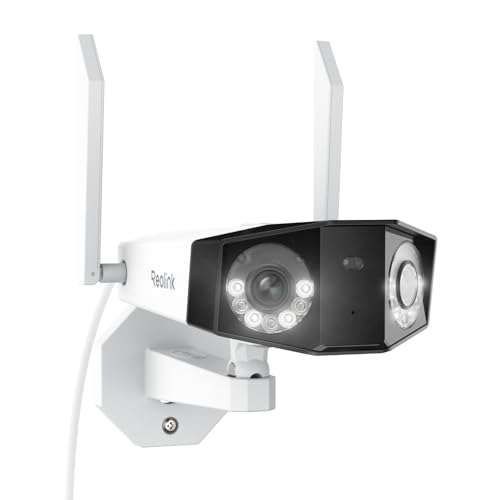
Pros
- Dual lenses provide 180-degree 4K panoramic coverage
- Dual-band Wi-Fi 6 connectivity on 2.4 and 5GHz
- Color night vision illuminates up to 100 feet
- Accurate person, vehicle, and animal detection
- No subscription required for local storage playback
Cons
- Plug-in power requires nearby electrical outlet access
- Remote features depend on Reolink app client
Image Stitching and Sensor Alignment
Dual-lens panoramic cameras use two separate image sensors and fixed focal lenses to capture adjacent views, merging them digitally into a single panoramic stream. When mounting outdoors, uneven ambient light across the two sensors can create a visible seam where the images meet. Keeping the installation point clear of deep overhangs ensures balanced exposure across both internal lenses.
High resolutions like 4K or 8MP across an ultrawide view distribute pixel density differently than standard narrow lenses. Maintaining detail at forty feet requires sufficient horizontal pixels so vehicle plates and faces remain legible. For property owners building a reliable record, knowing is security camera footage admissible in court reinforces the value of clear dual-lens alignment over software-distorted fisheye views.
Demarcation Seams: Installing panoramic dual-lens cameras indoors with uneven lighting causes unequal sensor exposure, creating visible center stitch lines.
Transmission Protocols and Network Video Recorders
Pushing high-resolution panoramic streams across local networks demands substantial bandwidth. While Wi-Fi 6 models offer flexible deployment on 2.4 GHz and 5 GHz networks, high-bitrate video benefits from Power over Ethernet cabling. Hardware compliance matters because some proprietary recorders refuse to decode secondary lenses on third-party streams, making it crucial to verify what is an NVR and how is it different from a DVR before finalizing equipment.
Video compression using H.265 or H.265+ formats reduces network strain and conserves local storage on micro SD cards or hard drives. Without modern compression, a continuous panoramic 4K stream can quickly overwhelm standard domestic routers. The Federal Communications Commission sets transmission limits that make efficient bitrates vital for wireless reliability.
Expert Examined
From Ray Okafor

The mistake I see most often is pairing an ultrawide PoE camera with an incompatible recorder. Always confirm ONVIF profile support and audio decoding with your specific NVR firmware before pulling Ethernet cables through your attic.
Read more about Ray Okafor| Setup Type | Network Feed | Ideal Placement |
|---|---|---|
| Dual 4MP Wi-Fi | Dual-band wireless | Patios and single garages |
| Dual 4MP PoE | Wired Ethernet | Driveways and side yards |
| Dual 8MP PoE | Wired Ethernet | Broad perimeters and lots |
Night Illumination and Sensor Exposure
Traditional infrared illumination often fails to cover a full 180-degree span evenly, leaving dark edges and washed-out centers. Newer dual-light hardware pairs infrared with warm supplementary spotlights that activate upon vehicle or human shape detection. Understanding what do the lights on a security camera mean helps you position spotlights without blinding adjacent neighbors.
Full-color night vision requires ambient illumination or active warm LEDs to maintain accurate color rendition up to sixty feet away. In deep darkness, black light color night vision balances contrast against moving subjects without blowing out facial features. Selecting hardware within dedicated security cameras categories certified by UL Solutions ensures outdoor power supplies and junction boxes resist moisture during inclement weather.
Pro Tip: Position supplemental spotlights away from direct reflective surfaces like white garage doors to prevent nighttime sensor glare.
Choosing the Right Camera for Your Property
If you want a wireless deployment that avoids running network cables through wall cavities, I would point you to the REOLINK 4K 8MP Security Camera Outdoor Dual Lens. It combines Wi-Fi 6 connectivity across both 2.4 GHz and 5 GHz bands with 4K clarity, 100-foot color night vision, and on-device animal and vehicle filtering without monthly subscription fees.
For wired installations tied to a dedicated local recorder, I would put the Anpviz 4K 8MP Dual Lens PoE IP Security Camera on an expansive driveway or open yard. Its 4096×1944 resolution captures broad detail at 20 frames per second, while the metal housing and dual warm lights deliver color imaging alongside support for 512GB local storage cards.
When working within an existing Wi-Fi setup on a simpler perimeter, I suggest the Hiseeu 4MP Dual Lens Wireless Camera,180-Degree. It balances dual-band wireless with black light color night vision, an integrated siren, and dual lenses that cover broad outdoor spaces without requiring PoE switches.
The Bottom Line
The single mistake most buyers make with ultrawide security hardware is treating it like a standard narrow bullet camera. Positioning a dual-lens unit too close to perpendicular walls or under low soffits obstructs one side of the 180-degree view and reflects night illumination straight back into the sensor.
Before mounting any hardware, connect the camera to your router inside the house to verify image stitching and recorder compatibility. Checking the feed on your phone or NVR monitor beforehand prevents having to take down exterior brackets if settings or protocols require adjustment.
FAQs
Do 180 degree cameras distort the picture like fisheye lenses?
Dual-lens panoramic cameras use internal digital stitching rather than curved single lenses, producing a flat panoramic image with minimal edge warping. Fisheye cameras bend straight lines into curves, whereas dual-sensor designs maintain normal vertical geometry across the entire viewing plane.
Can I connect a dual-lens PoE camera to any third-party NVR?
Not all NVRs handle stitched panoramic streams properly. Many dual-lens models require ONVIF protocol support or specific manufacturer firmware to decode both video channels and manage advanced functions like two-way audio and human shape detection.
Why does my panoramic camera show a line down the middle?
A vertical seam usually occurs when ambient light is uneven across the two lenses, such as when one lens sits in shadow while the other faces bright sun. Moving the camera to a location with consistent lighting balances the exposure levels.
How much local storage does a 4K 180 degree camera need?
A continuous 4K panoramic feed running H.265 compression uses roughly 40 to 60 gigabytes of data per day. A 256GB or 512GB micro SD card provides several days of continuous storage, while an NVR hard drive is best for weeks of history.
Sources
- Federal Communications Commission www.fcc.gov
- UL Solutions Standards and Safety www.ul.com