
Shopping for the best battery powered water leak detectors means deciding whether a nearby siren is enough or whether you need alerts away from home. Renters, homeowners, and landlords can use different setups depending on coverage, mounting location, and tolerance for battery maintenance.

Pros
- Dual probe sets for early leak detection
- 105dB alarm with four volume settings
- Five-year built-in battery
- IP67 waterproof design
Cons
- Cannot connect to WiFi directly
- H5044 gateway required for app monitoring
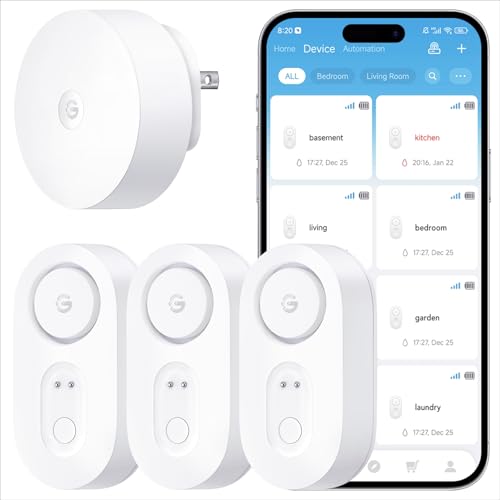
Pros
- 1,804-foot range through up to five walls
- SMS, email, and app push alerts
- 105 dB alarm with four volume levels
- IP67 waterproofing and five-year battery life
Cons
- Gateway supports 2.4 GHz Wi-Fi only
- Gateway pairs only with select GoveeLife sensors

Pros
- 0 to 120dB adjustable alarm with silent mode
- IP67 waterproof and dustproof construction
- Four bottom and two top sensor probes
- Includes 10 AAA batteries
- Five-year battery life
Cons
- Top probes may react to heavy humid mist
- Probes need regular wiping in humid areas

Pros
- Loud 120dB alarm for immediate alerts
- 37.8-inch cable reaches difficult corners
- Reusable sensor board after drying
- Three-pack covers multiple leak-prone areas
Cons
- 9V alkaline battery not included
- Included cable is under four feet

Pros
- Up to five years of battery life
- 100dB alarm with four volume settings
- Low-battery buzzer and LED warning
- IP66 waterproof construction
- Three-pack for multiple locations
Cons
- No Wi-Fi connectivity
- Battery replacement required after five years

Pros
- Six sensors with built-in 105 dB alarms
- Up to 2,034-foot open-air LoRa range
- App, email, and SMS alerts
- Up to five-year battery life
- Works during internet outages with YoLink Control-D2D
Cons
- Each sensor requires two AAA batteries
- Water leak and freeze monitoring only
Choose the Alert Path First
A local alarm is straightforward for a kitchen, bathroom, or laundry room where someone is usually nearby. Topvico and the standalone GoveeLife unit focus on audible alerts, while smart kits add app, email, or text notifications for second homes, basements, and detached areas.
Remote alerts require more than a sensor. The GoveeLife smart package includes its H5044 gateway, and the YoLink kit includes a hub, so you should plan for the hub’s location and network requirements. GoveeLife’s gateway supports 2.4G Wi-Fi, while YoLink uses a long-range LoRa connection and can provide local device-to-device actions during an internet outage.
Pro Tip: Place the sensor where the first water will collect, not on a shelf beside the likely leak. Under sinks, near water heaters, beside washing machines, and by sump pumps are practical starting points.
Match the Sensor to the Location
Dual-probe floor sensors work well under appliances and cabinets because they respond when water bridges the contacts. A cable-equipped design such as Topvico can put the detection board into a narrow corner while leaving the alarm unit easier to hear and reach.
Coverage matters in large homes. GoveeLife lists a range of up to 1,804 feet, while YoLink lists up to 2,034 feet in open air. Walls, floors, metal equipment, and the actual layout can reduce usable distance, so a long-range specification should guide placement rather than replace a signal check.
| Sensor style | Main strength | Suitable location |
|---|---|---|
| Floor probes | Direct pool detection | Under sinks and appliances |
| Cable sensor | Reach tight spaces | Sump pumps and RVs |
| Smart sensor | Remote notifications | Vacation homes and basements |
For more placement ideas, review where water leaks start in a house. A detector cannot help if it is placed far from the first pooling point.
Battery Life Is Not Maintenance-Free
Several products specify up to five years of battery life, but the battery format differs. YoLink sensors use two AAA batteries, Topvico uses a 9V battery that is not included, and RUIKORING uses AAA batteries. BLIZONTE adds a low-battery warning, which is useful when sensors are hidden under furniture.
Humidity also deserves attention. RUIKORING notes that mist can bridge its probes and trigger an alarm, so keep contacts clean and dry. IP66 and IP67 ratings describe resistance to water and dust, not permission to place a device where standing water will permanently conceal the alarm.
Before You Mount It: Do not treat a waterproof rating as protection from every installation mistake. Keep the alarm audible, avoid trapping it beneath stored items, and replace batteries promptly after a low-power warning.
Expert Examined
From Dana Whitfield

I keep leak sensors slightly forward of appliances rather than deep behind them. The common mistake I see is hiding the alarm where its sound cannot be heard, so the sensor should stay accessible for silencing, cleaning, and battery service.
Read more about Dana WhitfieldThe U.S. Consumer Product Safety Commission provides consumer safety information, but product ratings and alarm claims still need to be read from the individual package. For broader household protection, consider how a sensor fits with a sump pump alarm.
Which Setup Fits Your Home
I would put GoveeLife Upgraded Water Leak Detector with 105dB in a home that needs several local alarms, strong volume control, and long battery life without direct Wi-Fi connection. Its dual probes and IP67 rating suit damp areas, but remote phone monitoring requires the compatible H5044 gateway and an additional kit.
I would point you to GoveeLife Upgraded Smart Water Leak Detector 1s for a vacation property or distant basement where SMS, email, and app notifications matter. Its included gateway and stated long-range connection make it the more suitable GoveeLife choice when you need alerts beyond the room.
For the broadest sensor count and a whole-home platform, I would choose YoLink Water Leak Sensor 4 105 dB Alarm Kit. It includes six sensors and a hub, supports app, email, and text alerts, and can work with other YoLink devices. I would favor it for owners planning future shutoff or siren integrations.
The Bottom Line
The biggest mistake buyers make is treating every battery leak detector as remotely connected. Some units only sound locally, while smart models depend on a gateway or hub, so confirm the alert path before placing sensors in an unattended space.
If you only do one thing first, identify the home’s highest-risk locations and the distance between them. Then choose local alarms for nearby rooms or a hub-based system when a phone notification must reach you away from home.
FAQs
Floor probes are convenient under sinks, appliances, and water heaters where water can spread across a surface. Cable sensors are useful when the alarm unit must stay outside a narrow or difficult-to-reach area, such as a sump pump corner or RV compartment. Place them near likely first pooling points, including under sinks, beside washing machines, near water heaters, and around sump pumps. Keep the alarm accessible and audible rather than burying it behind storage or appliances. Follow the product’s low-battery warning and inspect each unit periodically, especially before travel or severe weather. Battery life varies by model and conditions, so a stated multi-year life should not replace routine checks. IP67 indicates protection against dust and temporary water immersion under defined conditions. It does not mean the detector will remain useful if permanently submerged, blocked by debris, or installed where its alarm cannot be heard.Are floor probes or cable sensors better for leak detection?
Where should battery water leak detectors be placed?
How often should leak detector batteries be checked?
What does an IP67 rating mean on a leak detector?
Sources
- U.S. Consumer Product Safety Commission, Consumer Safety Information www.cpsc.gov
- UL Solutions, Product Safety and Standards Information www.ul.com