
Shopping for the best Wi-Fi water leak detectors starts with one important split: do you need a sensor that alerts you, or a system that can shut off the main water line? Renters and appliance owners usually need compact sensors, while homeowners seeking whole-house protection may want automatic control.

Pros
- Automatic whole-home water shutoff
- Daily MicroLeak testing for hidden leaks
- 24/7 flow, pressure, and temperature monitoring
- Remote alerts and app control
Cons
- Requires installation on the main water line
- Limited to 3/4-inch plumbing

Pros
- Detects pooling water as shallow as 0.4 mm
- Dual 120 dB alarms for greater awareness
- Real-time phone alerts and 12-user sharing
- IP66-rated sensors for splash-prone areas
Cons
- Requires 2.4 GHz Wi-Fi setup
- 5 GHz Wi-Fi is not supported

Pros
- Dual probe sets for early leak detection
- 105dB alarm with four volume settings
- Five-year built-in battery
- IP67 waterproof design
Cons
- Cannot connect to WiFi directly
- H5044 gateway required for app monitoring
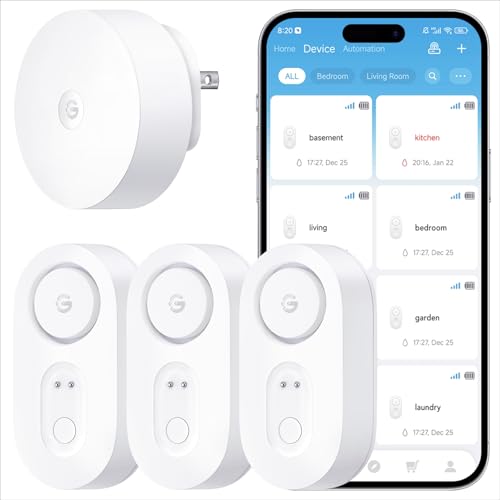
Pros
- 1,804-foot range through up to five walls
- SMS, email, and app push alerts
- 105 dB alarm with four volume levels
- IP67 waterproofing and five-year battery life
Cons
- Gateway supports 2.4 GHz Wi-Fi only
- Gateway pairs only with select GoveeLife sensors

Pros
- Three sensors for multiple leak-prone areas
- 24/7 moisture monitoring
- Smartphone moisture notifications
- Remote sensing disc reaches up to 48 inches
Cons
- Flo Smart Water Monitor sold separately
- App required for smartphone notifications

Pros
- Up to five years of battery life
- 100dB alarm with four volume settings
- Low-battery buzzer and LED warning
- IP66 waterproof construction
- Three-pack for multiple locations
Cons
- No Wi-Fi connectivity
- Battery replacement required after five years
Choose Between Local Alerts and Whole-Home Control
Point sensors sit near likely trouble spots such as washing machines, sinks, water heaters, toilets, sump pumps, and refrigerators. They detect moisture at the floor or through a remote sensing disc, then sound an alarm or send a phone notification when the model supports connected alerts.
A main-line device solves a different problem. The explanation of water shutoff sensors is useful before you buy, because most small sensors cannot stop water by themselves. Moen Flo Shutoff, 3/4" Automatic Water Leak uses flow, pressure, and temperature monitoring, daily MicroLeak checks, app control, and automatic shutoff.
Pro Tip: Place a point sensor where water would first collect, not on a nearby shelf or cabinet wall.
Match Detection to the Room
For a laundry room or basement, a wide wireless range can matter more than a compact design. X-Sense Wi-Fi Water Leak Detector Kit, 120 dB reaches up to 1,804 feet in open areas, detects water as shallow as 0.4 mm, and combines sensor and base alarms. Its IP66 housing suits damp, splash-prone locations.
GoveeLife Upgraded Smart Water Leak Detector 1s reaches the same stated range and adds SMS, email, and app notifications through its included gateway. It also offers IP67 protection, a five-year battery, adjustable volume, and a one-tap alarm silence feature. For a smaller setup, Moen Flo Detector, WiFi Enabled Water & Moisture includes a remote sensing disc with up to 48 inches of extension.
Placement advice matters especially near a sump pump or water heater. For common starting points, review where water leaks start in a house before deciding how many sensors you need.
Before You Mount It: Do not assume a Wi-Fi sensor can close a water valve. Confirm whether the product is a stand-alone alarm, a gateway-based system, or a main-line shutoff before relying on it during an absence.
Check Connectivity, Battery, and Water Resistance
Connectivity is not interchangeable across these products. X-Sense requires a 2.4 GHz Wi-Fi network, while the GoveeLife smart kit includes an H5044 gateway that supports 2.4 GHz Wi-Fi and only the specified H5059 or H5830 sensors. The separate GoveeLife Upgraded Water Leak Detector with 105dB cannot connect directly to Wi-Fi and requires that gateway for remote monitoring.
Battery-powered alarms reduce installation work, but you still need a maintenance habit. GoveeLife Upgraded Water Leak Detector with 105dB, GoveeLife Upgraded Smart Water Leak Detector 1s, and BLIZONTE Water Leak Detector 3 Pack each state up to five years of battery life. BLIZONTE also provides a low-battery warning, but it does not support Wi-Fi.
Expert Examined
From Ray Okafor

I keep sensors close to the exact appliance connection, because water can spread away from the original leak before an alarm is heard. The mistake I see most often is placing one unit in a central hallway instead of covering the water source.
Read more about Ray Okafor<table]
Device type | Key distinction | Best location
Point sensor | Local or phone alert | Appliances and fixtures
Gateway sensor | Remote notifications | Large homes and outbuildings
Main-line shutoff | Stops household flow | Water service entry
[/table]
Water resistance ratings help, but they do not tell you where to install a device or whether it can survive every situation. For broader prevention, pair sensor placement with instructions on how to shut off the water main. The U.S. Consumer Product Safety Commission also provides consumer safety information worth consulting for household water hazards.
Which Detector Fits Your Home
I would point you to Moen Flo Shutoff, 3/4" Automatic Water Leak if you own the property and want protection at the main water line. Its automatic shutoff, flow and pressure monitoring, temperature monitoring, daily MicroLeak checks, and app control address leaks that could continue after you leave home.
For several appliance areas without a valve installation, I would choose X-Sense Wi-Fi Water Leak Detector Kit, 120 dB. Its three sensors, 120 dB alarms, 0.4 mm detection, IP66 housing, and long stated range make it practical for basements, laundry rooms, and utility spaces.
I would reserve GoveeLife Upgraded Smart Water Leak Detector 1s for a larger property, detached garage, or vacation home where SMS, email, and app alerts are valuable. The included gateway and 1,804-foot stated range support distant placement, while IP67 protection and the five-year battery reduce routine attention.
The Bottom Line
The biggest mistake is treating every Wi-Fi water sensor as an automatic shutoff. Most models identify moisture and alert you, while only a main-line device can stop household water flow.
Start by identifying the highest-risk location and the action you need after detection. Then confirm the required Wi-Fi band, gateway pairing, water-resistance rating, and battery warning before mounting the first sensor.
FAQs
Point sensors suit appliances, fixtures, and individual rooms where you need an alarm or phone notification. An automatic shutoff belongs on the main water line when you want the system to stop household flow after detecting an abnormal condition. Place them on the floor beside washing machines, water heaters, sinks, toilets, refrigerators, and sump pumps. Use a remote sensing disc when the likely leak is inside a tight or hard-to-reach space. Several listed models state up to five years of battery life, but battery condition still deserves periodic attention. Choose a model with a low-battery warning when you want an alert before the sensor stops operating. IP ratings describe protection against dust and water exposure, not the detector’s ability to shut off plumbing. IP67 provides the higher water-ingress protection stated among these products, but placement should still match the likely leak path.Should I buy a point sensor or an automatic shutoff?
Where should water leak sensors be placed?
How often do water leak detector batteries need attention?
What does IP66 or IP67 mean on a water sensor?
Sources
- U.S. Consumer Product Safety Commission www.cpsc.gov
- NFPA www.nfpa.org
- UL Solutions www.ul.com