
Shopping for the best water leak detectors starts with one practical split: do you need an alert from anywhere, or a loud alarm only when someone is home? Renters, homeowners, and vacation-property owners each face different placement and notification needs.

Pros
- Three sensors included with gateway
- 70dB+ local sensor and gateway alarms
- Instant 2.4GHz WiFi app alerts
- IP67 waterproof construction
Cons
- Not a smoke or carbon monoxide alarm
- Requires gateway for remote alerts

Pros
- Six probes detect drips and pooling water
- Loud 120dB local alarm
- IP66 waterproof ABS housing
- Four volume modes plus mute
- Replaceable AAA batteries
Cons
- No WiFi, app, or hub alerts
- Requires two AAA batteries

Pros
- Five-pack covers multiple leak-prone areas
- WiFi-connected app alerts
- Sensitive water detection
- Smart-home integration
- Compact 2.84-inch dimensions
Cons
- App notifications depend on WiFi
- No stated alarm sound or decibel rating
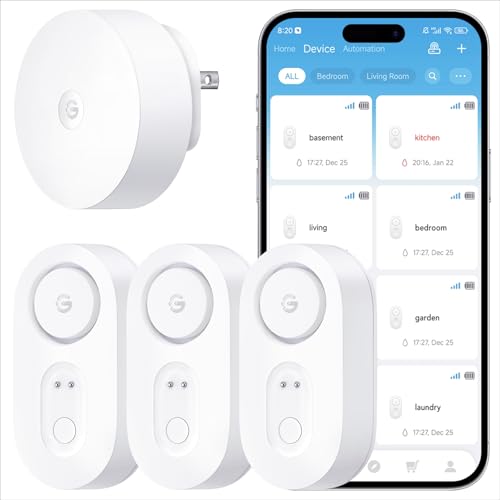
Pros
- 1,804-foot range through up to five walls
- SMS, email, and app push alerts
- 105 dB alarm with four volume levels
- IP67 waterproofing and five-year battery life
Cons
- Gateway supports 2.4 GHz Wi-Fi only
- Gateway pairs only with select GoveeLife sensors

Pros
- 100 dB siren with LED strobe
- Phone alerts through the companion app
- Two sensing areas included
- Expandable to 17 locations
Cons
- Requires Wi-Fi for app connectivity
- Not compatible with legacy D-Link sensors

Pros
- 1968-foot LoRa receiving range
- SMS, email, and app push alerts
- Up to 100dB leak alarm
- IP66 rating for damp areas
Cons
- Gateway supports 2.4GHz Wi-Fi only
- Alerts depend on gateway and app connection
Remote Alerts or Local Warning
A Wi-Fi-connected detector can notify you while you are away, which matters for basements, sump pumps, water heaters, and second homes. Heiman, Orbit, both GoveeLife systems, and D-Link provide app-based alerts, while the EZ2LOCATE model keeps the response local without Wi-Fi, an app, hub, or subscription.
Remote notifications are useful only if the gateway reaches every sensor location. The GoveeLife Upgraded Smart Water Leak Detector 1s lists a range of up to 1804 feet, while the GoveeLife Smart Water Leak Detector 2 with 1968ft lists up to 1968 feet and support for up to 100 sensors. For a smaller home, Orbit’s five-sensor package may provide broad coverage with less planning.
Pro Tip: Place one sensor near the highest-risk appliance first, then add coverage at the water heater, sump pump, washing machine, and refrigerator ice maker.
Match the Sensor to the Room
Probe placement affects what the detector notices. Models with top and bottom probes can respond to drips from above as well as pooling water below, while a sensing cable can reach around equipment that blocks a compact pod. D-Link includes a plug-in master with a water-sensing cable and a separate battery-powered pod.
IP ratings describe resistance to water and dust, not the ability to shut off a pipe. The listed products range from IP66 to IP67, but you should still position the device where it can be heard, reached, and dried after an alert. For broader placement advice, see where water leaks start in a house.
| Device type | Alert method | Best placement |
|---|---|---|
| Wi-Fi sensor | App notifications | Away-from-home areas |
| Local alarm | Audible siren | Occupied rooms |
| Cable sensor | Contact detection | Around appliances |
Battery Life and Maintenance
Battery claims vary by design. Heiman lists up to 10 years for its gateway, GoveeLife lists five years for both systems, and D-Link lists up to two years for its remote pods using AAA batteries. The EZ2LOCATE unit uses two AAA batteries and includes a low-battery warning.
Do not hide a detector behind stored boxes or place it where a battery replacement requires moving heavy equipment. Schedule regular visual checks, keep contact points clean, and learn how to shut off the water main before an alert occurs. The U.S. Consumer Product Safety Commission also provides broader household safety information.
Expert Examined
From Jenna Castellano

I keep leak sensors visible enough to reach because inaccessible batteries are easy to forget. The mistake I see is placing every sensor beside an appliance but none near the room’s lowest point, where escaping water may collect first.
Read more about Jenna CastellanoSmart-Home Compatibility and Safety Limits
D-Link works with Google Assistant for voice announcements, and GoveeLife Smart Water Leak Detector 2 with 1968ft supports Alexa voice assistance. Those features can make an alert easier to notice, but they do not replace a local siren or a clear response plan.
A water sensor reports moisture; it does not automatically stop the supply. Read whether water sensors shut the water off before assuming an alert prevents damage. In freezing climates, Heiman’s freeze alarm warns below 3°C, while pipe protection still depends on insulation, heat, and plumbing maintenance.
Before You Mount It: A detector cannot protect a room it cannot reach, and a sensor does not close a valve. Keep the water shutoff accessible and treat every alert as a prompt to inspect the source.
Which System Fits Your Home
I would point you to <a href="https://besafehomesecurity.com/Heiman Water Leak Detector for a home that needs several sensors, a dedicated gateway, and a freeze warning. Its three sensors support custom names in the app, the gateway supports up to 40 sensors, and the listed 656-foot range suits many basement and utility-room layouts.
For a detached garage, distant basement, or outbuilding, I would choose GoveeLife Upgraded Smart Water Leak Detector 1s. Its listed 1804-foot connectivity, SMS, email, and app alerts, IP67 housing, and adjustable alarm make it a strong fit where distance and multiple notification paths matter.
I would reserve 3 Pack Water Leak Detector 120dB 6 Probe IP66 for an occupied home that does not need remote access. Six probes detect drips above and pooling below, the alarm reaches 120dB, and setup needs only two AAA batteries without a hub or subscription.
The Bottom Line
The mistake most buyers make is choosing by alarm volume alone. A loud local siren may be easy to hear, but it cannot tell you about a leak while you are away, and a connected model is only useful if its gateway reaches the intended room.
If you do one thing first, map every likely leak point and decide whether someone will be home to hear an alarm. Then select the simplest system that covers those locations, and keep the shutoff valve accessible.
FAQs
Wi-Fi is needed for app, SMS, or email alerts from many connected systems, but not for a local-only alarm. The EZ2LOCATE model operates without Wi-Fi, an app, or a hub, while connected options use a gateway or Wi-Fi connection for remote notifications. Place sensors under sinks, near washing machines, water heaters, dishwashers, toilets, refrigerators with ice makers, and sump pumps. Keep them reachable for battery changes and place them where water can collect rather than behind stored items. Battery life depends on the model and normal usage. The listed products claim periods from up to two years for D-Link remote pods to five or 10 years for certain GoveeLife and Heiman components, so check the battery warning and inspect each unit regularly. An IP rating indicates protection against dust and water exposure under defined conditions. It does not mean the device can shut off plumbing, replace maintenance, or remain permanently submerged, so follow the product placement instructions.Do water leak detectors need Wi-Fi?
Where should I place a water leak sensor?
How often do leak detector batteries need changing?
What does an IP66 or IP67 rating mean?
Sources
- U.S. Consumer Product Safety Commission www.cpsc.gov
- UL Solutions www.ul.com
- National Fire Protection Association www.nfpa.org