
Choosing the best local control smart thermostats means deciding whether your existing hub or Matter controller should manage the thermostat, rather than treating remote app access as the main feature. You need to match that platform with your HVAC wiring, especially if a C-wire or separate adapter is involved.

Pros
- SmartThings, SwannOne, and Almond compatibility
- Personalized installation and wiring instructions
- Simple LED screen with limited icons
- Supports scheduling and remote control
Cons
- Compatible hub required for scheduling
- Additional ZigBee platform support is pending

Pros
- Matter support across major smart-home platforms
- Flexible 24/7 heating and cooling schedules
- Remote app and voice control
- Alerts for filters and system malfunctions
Cons
- C-wire required for some wiring configurations
- Not compatible with electric baseboard heaters
- Compatibility check required before purchase

Pros
- Matter support across major smart-home platforms
- No new app or account required
- Local and remote control through existing app
- Supports conventional and heat-pump systems
Cons
- Matter controller required for outside-home connectivity
- Not compatible with 120V or 240V systems
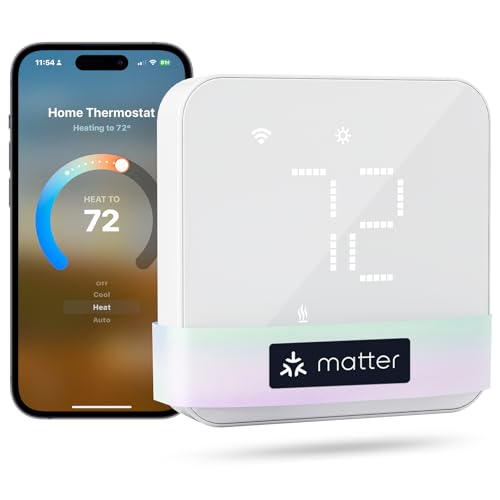
Pros
- Matter support for major smart-home platforms
- Flexible 24/7 heating and cooling schedules
- Remote app and voice control
- Smart alerts for filters and malfunctions
Cons
- C-wire may be required and is not included
- Not compatible with electric baseboard heaters

Pros
- ENERGY STAR certified
- Customizable 4.3-inch touchscreen
- Humidity monitoring for indoor air quality
- Works with Alexa, Matter, Apple Home, Google
Cons
- C-wire required for installation
- Not compatible with 120-240V electric baseboard heat

Pros
- Built-in mmWave radar detects human presence
- 4-inch full-color touchscreen
- Matter 1.4 supports major smart-home platforms
- Built-in Zigbee hub and Thread border router
Cons
- C-wire adapter sold separately when needed
- Apple Adaptive Temperature requires newer Apple devices
Start With the Control Platform
Local control is most straightforward when the thermostat fits the ecosystem already installed in your home. The Zen Thermostat – ZigBee Edition requires a compatible connected hub for scheduling and remote control, while the Matter models connect locally with platforms such as Apple Home, Google Home, Alexa, Home Assistant, or Samsung SmartThings.
The LUX TQ1-Black Matter Over WiFi Smart Thermostat takes a different approach: it connects through a Matter-enabled smart-home speaker or controller. That keeps configuration at the device and lets you use an existing smart-home app without creating another thermostat account. For more on platform choices, see our coverage of smart thermostats.
FYI: Matter is a smart-home interoperability protocol. A Matter thermostat still needs a compatible controller or platform for connected functions.
Verify HVAC Wiring Before Buying
Compatibility claims are not interchangeable. The meross Matter Smart Thermostats for Home models support many common systems, including heat pumps, air conditioners, furnaces, boilers, humidifiers, and dehumidifiers, but they do not support electric baseboard systems, millivolt thermostats, or two-wire systems. Some configurations require a C-wire.
The LUX model supports several conventional and heat-pump arrangements, plus millivolt heating, but excludes 120V and 240V line-voltage systems. Honeywell Home X7B Smart Wi-Fi Programmable works with specified conventional and heat-pump configurations, while its package includes a voucher for a Honeywell C-Wire Adapter if your system lacks one. Aqara W200 covers about 85% of HVAC systems and lists a separate C-Wire Adapter for systems without a C-wire.
Before You Wire: Never assume a thermostat is compatible because the wall plate looks similar. Identify your HVAC type and wiring first, then confirm the model’s exclusions and whether an adapter is included, sold separately, or required.
| Control type | Power requirement | Best fit |
|---|---|---|
| Zigbee hub | Connected hub required | Existing Zigbee home |
| Matter Wi-Fi | C-wire varies | Multi-platform homes |
| Matter controller | Controller and adapter options | App-free setup |
Separate Remote Access From Local Operation
Remote control is useful, but local operation matters if you want commands to continue within your home ecosystem when an outside service changes. Meross describes local Matter integration and adds schedules, usage tracking, alerts, and app control. Aqara W200 also emphasizes local Matter operation across major platforms.
Honeywell Home X7B adds a customizable 4.3-inch display, humidity monitoring, ENERGY STAR certification, and support for Apple Home, Google Assistant, Alexa, and Matter. Aqara W200 adds a 4-inch touchscreen and built-in mmWave radar for presence detection, although some Apple features require an Apple home hub and compatible Apple devices.
I keep the hub requirement visible during installation planning. The mistake I see is choosing a thermostat for its app, then discovering that scheduling or remote access depends on a controller the household does not own.
Expert Examined
From Ray Okafor

I keep a wiring photo and the HVAC model information together before selecting a connected thermostat. The recurring problem is not the smart-home platform; it is discovering after removal that the existing system falls outside the thermostat’s stated compatibility.
Read more about Ray OkaforFor related ecosystem planning, our Zigbee detectors for Home Assistant coverage can help you think through how other local devices fit alongside a Zigbee thermostat.
Which Thermostat Fits Your Home
I would point you to Zen Thermostat – ZigBee Edition if SmartThings, SwannOne, or Securifi Almond is already the center of your home. Its interactive installation guide and simple LED display suit someone who wants a restrained interface, but you must already have a compatible hub for scheduling and remote control.
I would choose meross Matter Smart Thermostats for Home for a household that wants flexible Matter platform support, schedules, usage tracking, filter alerts, and app control, provided the HVAC system passes its exclusions and the wiring is suitable. The lower-priced second meross model offers a similar local Matter direction, so compare the exact listing and C-wire requirements before ordering.
For a home centered on Apple Home, Google Home, Alexa, or SmartThings, I would point you to TQ1-Black Matter Over WiFi Smart Thermostat when setup without a new thermostat account matters. If presence sensing and a large color touchscreen are more important, Aqara W200 is the more feature-focused choice, with its radar sensor and Matter 1.4 local control.
The Bottom Line
The single mistake most buyers make is treating “local control” as proof that every feature works without extra hardware. Zen needs a connected hub, LUX needs a Matter controller for connectivity outside the home, and several models need a C-wire or adapter.
First, identify your HVAC system and photograph the existing wiring. Then choose the Matter, Zigbee, or app ecosystem that your household already uses, checking every listed exclusion before removing the old thermostat.
FAQs
Matter models can connect locally with compatible Apple Home, Google Home, Alexa, Home Assistant, or Samsung SmartThings platforms. The Zen model uses Zigbee and requires a compatible connected hub for scheduling and remote control. Some meross configurations require a C-wire, and the LUX model lists a C-wire adapter sold separately. Honeywell includes a voucher for a C-Wire Adapter when needed, while Aqara lists its adapter separately for systems without a C-wire. The listed meross models do not support 110V, 120V, or 240V electric baseboard heaters. Honeywell also excludes 120V and 240V electric baseboard heat, so verify the system type before purchase. Matter allows compatible smart-home platforms to communicate with the thermostat through a shared protocol. It does not remove the need for a compatible controller, suitable wiring, or an HVAC system within the model’s supported configurations.What type of smart thermostat gives the most local control?
Do these thermostats need a C-wire?
Can I use a smart thermostat with electric baseboard heat?
What does Matter certification mean for a thermostat?
Sources
- U.S. Department of Energy, Energy Saver. www.energy.gov
- ENERGY STAR, Smart Thermostats. www.energystar.gov
- UL Solutions, Smart Home and Connected Products. www.ul.com