
Shopping for the best smart thermostats with phone app starts with identifying the equipment behind the wall, because a central HVAC thermostat cannot replace a mini-split controller or an electric floor-heating thermostat. The key choice is system compatibility, and this selection is for homeowners who want remote temperature control without guessing at wiring or hub requirements.

Pros
- Remote app control and real-time monitoring
- 7-day programmable temperature scheduling
- Backlit LCD for dark rooms
- Temperature control within 2°F
Cons
- Requires a 24V C-wire and no batteries
- Works only with 2.4GHz Wi-Fi

Pros
- Remote control through Smart Life App
- Alexa and Google Home compatible
- 7-day or 5-1-1 scheduling
- Supports non-programmable mode
Cons
- Requires C-wire, cannot use batteries
- Not compatible with multi-stage systems
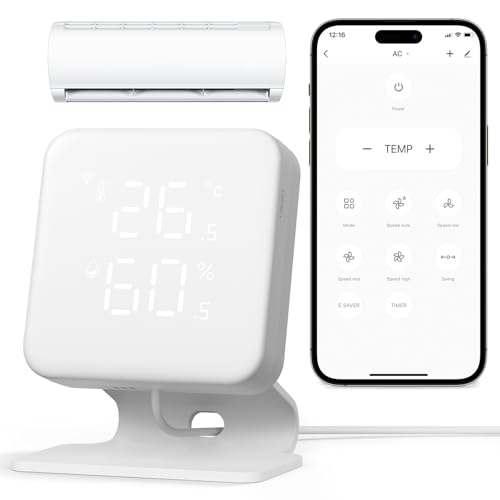
Pros
- Works with 300+ AC brands
- Built-in temperature and humidity display
- Alexa and Google Home control
- 7-day schedules and geofencing
Cons
- 2.4GHz WiFi only, no 5GHz
- Requires IR line of sight

Pros
- Smart app control from anywhere
- 16A capacity supports up to 3200W
- 7-day schedules help save energy
- Alexa and Google Assistant compatible
Cons
- Requires compatible electric floor heating
- Remote control depends on app connection

Pros
- 0.5°C temperature accuracy
- 5 to 35°C adjustable range
- Seven-day schedule with six daily phases
- App and Alexa remote control
Cons
- Zigbee hub required and sold separately
- Made for electric floor heating systems

Pros
- Dual-stage heating and cooling control
- Supports up to two external sensors
- LoRa range up to 2,034 feet
- Alexa, Google Home, IFTTT, and Home Assistant support
Cons
- Hub required and sold separately
- Requires 24VAC system with C-wire
Match the thermostat to your heating system
Start with the equipment type, not the app name. The Riseem model is for conventional single-stage systems with one heat and one cool circuit, while the XuLuaba model covers several additional arrangements, including some heat pumps without auxiliary or emergency heat. Both require a C-wire and 24V power rather than batteries.
Mini-splits, window units, and portable air conditioners need a different approach. The smart thermostats category includes products that may look similar but work differently, and the WOOX controller sends infrared signals instead of connecting to central HVAC wiring.
Electric radiant floor heating also needs its own thermostat class. Lithomy is designed for electric floor systems up to 16A and 3200W, while the ngnsky Zigbee model requires a compatible Tuya Zigbee gateway. Neither should be treated as a conventional furnace thermostat.
Check the Wiring First: A thermostat that does not match the equipment can work abnormally or fail to operate. Confirm the system type, terminal labels, voltage, and whether a C-wire or hub is required before removing the existing thermostat.
Phone control is not the same on every model
Most of these devices provide remote temperature changes and schedules, but their connection methods differ. Riseem and WOOX use 2.4GHz Wi-Fi, XuLuaba works through the Smart Life app, and the floor-heating models add either app-based Wi-Fi control or Zigbee connectivity.
YoLink Thermostat 2 is aimed at dual-stage HVAC and heat pumps. It supports external sensors, schedules, ECO mode, and the YoLink app, but it requires a hub sold separately. Its LoRa connection can reach up to 2,034 feet according to the product information, making the hub requirement an important part of the purchase.
| System type | Connection need | Suitable option |
|---|---|---|
| Conventional HVAC | C-wire, 2.4GHz Wi-Fi | Riseem or XuLuaba |
| Mini-split or portable AC | IR line of sight | WOOX |
| Electric floor heat | 16A circuit or Zigbee hub | Lithomy or ngnsky |
Voice compatibility may also influence your decision. XuLuaba, WOOX, Lithomy, YoLink, and ngnsky list support for voice platforms, but that does not remove the need to confirm the underlying HVAC or floor-heating compatibility.
Schedules, sensors, and installation limits
Choose scheduling features around your routine. Riseem provides seven-day programming, XuLuaba adds 5-1-1 and non-programmable modes, and both floor-heating choices support weekly schedules. YoLink adds external sensor support for monitoring another area.
Wireless requirements deserve attention before installation. WOOX needs infrared line of sight to the air conditioner, while Riseem and WOOX do not support 5GHz Wi-Fi. The Zigbee model requires a Tuya Zigbee gateway, and YoLink requires its own hub, so remote control may involve another device beyond the thermostat.
For broader home energy planning, the site’s Smart Energy and Climate Control category can help you consider thermostats alongside other connected climate devices. If your system has unusual terminals, compare them against the manufacturer’s compatibility notes rather than relying on the thermostat’s appearance.
Expert Examined
From Ray Okafor

I keep seeing thermostat projects go wrong because the buyer identifies the old wall control but not the equipment it operates. I would photograph the terminals, record the system type, and confirm the power arrangement before disconnecting anything.
Read more about Ray OkaforSafety matters especially with floor heating and line-voltage equipment. The Consumer Product Safety Commission provides general home safety information at CPSC.gov, but the thermostat’s own wiring instructions remain the direct source for installation details.
Pro Tip: If your home Wi-Fi uses one network name for both bands, confirm that a 2.4GHz connection is available before pairing a Wi-Fi thermostat.
Which thermostat fits your home
I would point you to WiFi Thermostats for Home Smart Thermostat only when you have a conventional single-stage, 1-heat/1-cool system with a C-wire. Its seven-day schedule and phone control suit a homeowner who wants straightforward remote adjustments, but its restrictions exclude heat pumps, multi-stage equipment, and systems without the required wiring.
For a home with a compatible heat pump, heat-only setup, or two-transformer arrangement, I would consider Smart WiFi Thermostat for Home with App Remote. Its 5-1-1, seven-day, and non-programmable modes give you more scheduling choices, although heat pumps with auxiliary or emergency heat and multi-stage systems are excluded.
I would choose WOOX Smart AC Controller for a ductless mini-split, window unit, or portable AC that responds to an infrared remote. It is not for central HVAC, and the controller needs line of sight, but it adds app control, schedules, geofencing, and temperature and humidity display without a hub.
The Bottom Line
The mistake most buyers make is treating every phone-controlled thermostat as interchangeable. System type, C-wire power, 2.4GHz Wi-Fi, infrared control, floor-heating load, and hub requirements can completely change which model fits.
If you do only one thing first, identify the equipment and wiring before comparing schedules or voice features. Then select a thermostat whose stated compatibility matches that system exactly.
FAQs
A mini-split needs a controller designed for ductless equipment rather than a conventional wired HVAC thermostat. WOOX uses infrared signals from the original remote and requires line of sight to the AC receiver, while its product information excludes central and ducted systems. Several models require a C-wire, including Riseem, XuLuaba, and YoLink Thermostat 2. Riseem also requires 24V power and cannot run on batteries, so you should verify the terminal labels and power arrangement before installation. No product facts here support using the floor-heating models for central HVAC. Lithomy is designed for electric radiant floor heating, while the ngnsky model is also for electric floor heating and requires a Tuya Zigbee gateway for remote control. A hub-required thermostat needs a separate gateway to connect its thermostat to the app and other smart-home services. YoLink Thermostat 2 requires a YoLink hub, and the ngnsky model requires a Tuya Zigbee gateway, both sold separately according to the product information. Check the HVAC type, terminal labels, voltage, C-wire availability, Wi-Fi band, and any hub requirement. Also confirm special limits such as infrared line of sight, heat-pump restrictions, multi-stage exclusions, or the electrical load rating for floor heating.Which smart thermostat type is right for a mini-split?
Do these smart thermostats need a C-wire?
Can a floor-heating thermostat control central HVAC?
What does a hub-required thermostat mean?
What should I check before mounting a smart thermostat?
Sources
- US Consumer Product Safety Commission www.cpsc.gov
- UL Solutions www.ul.com