
Shopping for the best smart thermostats with humidity control starts with identifying the heating or cooling system, not the display. The main split is between wired HVAC thermostats, high-voltage baseboard controls, and IR controllers for room air conditioners, so this selection suits homeowners narrowing down a model that actually matches their equipment.

Pros
- Supports 229+ AC brands and 8,000+ models
- Alexa and Google Home voice control
- Daily schedules and smart automation
- Built-in temperature and humidity sensor
Cons
- Requires Tuya Smart or Smart Life app
- Not a standalone AC or heat pump

Pros
- Works with 120V to 240V electric heating
- Humidity sensor and touchscreen
- Scheduling and geofencing support
- Apple Home, Alexa, and Google compatible
Cons
- Requires a neutral or second live wire
- Limited to electric baseboards and fan-forced heaters
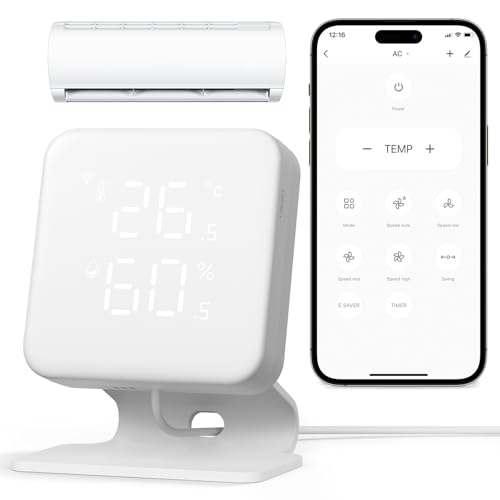
Pros
- Works with 300+ AC brands
- Built-in temperature and humidity display
- Alexa and Google Home control
- 7-day schedules and geofencing
Cons
- 2.4GHz WiFi only, no 5GHz
- Requires IR line of sight

Pros
- 4.3-inch customizable touchscreen display
- Occupancy and presence detection
- Humidity monitoring for indoor air quality
- ENERGY STAR certified with smart-home compatibility
Cons
- C-wire required, adapter voucher included
- Not compatible with 120-240V electric baseboard heat

Pros
- ENERGY STAR certified
- Customizable 4.3-inch touchscreen
- Humidity monitoring for indoor air quality
- Works with Alexa, Matter, Apple Home, Google
Cons
- C-wire required for installation
- Not compatible with 120-240V electric baseboard heat

Pros
- App and voice control
- 4.8-inch color touchscreen display
- Six-period 5+1+1 scheduling
- Power-off data memory
Cons
- 95-240V range may limit system compatibility
- White finish only
Match the thermostat to your system
A humidity sensor is useful only when the device can control or coordinate with the equipment in your room. The Honeywell Home X7S Smart Wi-Fi Programmable and Honeywell Home X7B Smart Wi-Fi Programmable work with conventional systems, heat pumps, hot water heat, and forced air, but neither works with 120 to 240V electric baseboard heat.
For electric baseboards or electric fan-forced heaters, the Mysa Smart Thermostat V2 for Electric Baseboard is the purpose-built option in this group. It supports 120 to 240V systems and requires one neutral or second live wire, while the Smart Air Conditioner Controller and WOOX Smart AC Controller send commands to compatible IR-controlled units instead of replacing a wired HVAC thermostat.
Before You Wire It: Confirm the system type and required wiring before installation. A thermostat intended for conventional HVAC should not be connected to electric baseboard wiring, and the WOOX controller requires a clear IR line of sight to the air conditioner.
Humidity sensing is not the same as humidity control
These products primarily monitor humidity and use that information for comfort or automation. The Smart Air Conditioner Controller includes a temperature and humidity sensor, while WOOX adds live readings, history trends, and automatic rules based on temperature and humidity.
The Honeywell Home models describe humidity monitoring for indoor air quality, with additional HVAC equipment or accessories potentially required. That distinction matters if you expect the thermostat itself to add or remove moisture. For broader connected-home advice, see our coverage of Smart Energy and Climate Control.
| Device type | Key humidity feature | Best location |
|---|---|---|
| Wired HVAC | Humidity monitoring | Forced-air systems |
| High-voltage | Humidity sensor | Electric baseboards |
| IR controller | Humidity rules | Window or mini-split AC |
Connectivity and daily automation
Remote access is available across several formats, but the network requirements differ. WOOX uses 2.4GHz WiFi and supports schedules, geofencing, Alexa, and Google Home; the Smart Air Conditioner Controller works through Tuya Smart or Smart Life and also supports Alexa and Google Home.
Mysa provides Android and iOS control, scheduling, geofencing, Apple Home, Alexa, and Google compatibility. Honeywell Home adds Matter certification, Apple Home support, and 2.4 or 5GHz WiFi, while LANRU offers app grouping, device sharing, a six-period schedule, and data memory during a power interruption.
Expert Examined
From Jenna Castellano

I keep seeing buyers focus on humidity numbers before checking the equipment connection. The avoidable mistake is choosing a polished HVAC thermostat for a baseboard circuit, or expecting an IR controller to operate a wired system. Start at the wall or air conditioner, then compare automation features.
Read more about Jenna CastellanoIf connected devices are part of a wider home setup, our HomeKit doorbell camera coverage explains why ecosystem support should be checked before purchase rather than assumed from a voice-assistant logo.
Which model fits your room
I would put the Mysa Smart Thermostat V2 for Electric Baseboard at the front of the shortlist for a room heated by 120 to 240V electric baseboards or electric fan-forced heaters. Its humidity sensor, touchscreen, scheduling, geofencing, and mobile control fit a homeowner who needs a dedicated high-voltage thermostat, provided the wiring includes a neutral or second live wire.
I would point you to the Smart Air Conditioner Controller for a window, portable, mini-split, or heat-pump unit that uses an IR remote. Its built-in temperature and humidity readings, automation scenes, and remote voice control make more sense than a wired thermostat in that room.
For a conventional forced-air or heat-pump system, I would consider the Honeywell Home X7B Smart Wi-Fi Programmable. It provides humidity monitoring, ENERGY STAR certification, Matter support, and broad assistant compatibility, but you should confirm the system has the required C-wire arrangement and remember that electric baseboard heat is excluded.
The Bottom Line
The mistake most buyers make is treating every humidity-reading thermostat as interchangeable. A high-voltage baseboard control, wired HVAC thermostat, and IR air-conditioner controller solve different equipment problems.
If you only do one thing first, identify the system voltage or control method at the installation point. Then verify wiring, compatibility, and network requirements before weighing screens, schedules, or voice features. The ENERGY STAR program can also help explain efficiency labeling where it applies.
FAQs
Humidity monitoring appears in wired HVAC thermostats, high-voltage thermostat products, and IR air-conditioner controllers. The important distinction is whether the device only reports humidity or can use readings in automation rules, as WOOX and the Smart Air Conditioner Controller specify. The Mysa Smart Thermostat V2 for Electric Baseboard is designed for 120 to 240V electric baseboards and electric fan-forced heaters. The Honeywell Home X7S and X7B specifically do not work with electric baseboard heat. The Honeywell Home X7S and X7B require a C-wire, with a voucher for a Honeywell Home C-Wire Adapter included if the existing system lacks one. Other products use different connection methods, so check the system-specific requirements before installation. Matter certification indicates that the Honeywell Home X7S and X7B are designed for interoperability with supported smart-home platforms. It does not change the thermostat’s heating compatibility, wiring needs, or humidity equipment requirements.What type of thermostat has humidity control?
Can these thermostats work with electric baseboard heat?
Do smart thermostats need a C-wire?
What does Matter certification mean on a thermostat?
Sources
- ENERGY STAR. www.energystar.gov
- US Department of Energy. www.energy.gov