
Shopping for the best WiFi enabled thermostats starts with matching the control to your HVAC system, especially its wiring and heat-stage setup. This selection suits homeowners deciding between a conventional thermostat, a broader smart-home model, or a controller for a mini-split or room air conditioner.

Pros
- Remote app control and real-time monitoring
- 7-day programmable temperature scheduling
- Backlit LCD for dark rooms
- Temperature control within 2°F
Cons
- Requires a 24V C-wire and no batteries
- Works only with 2.4GHz Wi-Fi

Pros
- Remote control through Smart Life App
- Alexa and Google Home compatible
- 7-day or 5-1-1 scheduling
- Supports non-programmable mode
Cons
- Requires C-wire, cannot use batteries
- Not compatible with multi-stage systems

Pros
- Conventional and heat-pump compatibility
- Matter certified for smart-home integration
- Flexible seven-day scheduling options
- Auto-away and filter reminders
- Indoor humidity display option
Cons
- Requires a 24 VAC C-wire
- Not compatible with 120 to 240V baseboard heat

Pros
- Energy Star certified
- Color touchscreen and app control
- Works with Alexa, Google Assistant, and HomeKit
- Compatible with 85% of systems
Cons
- Power Extender Kit sold separately
- SmartSensor sold separately
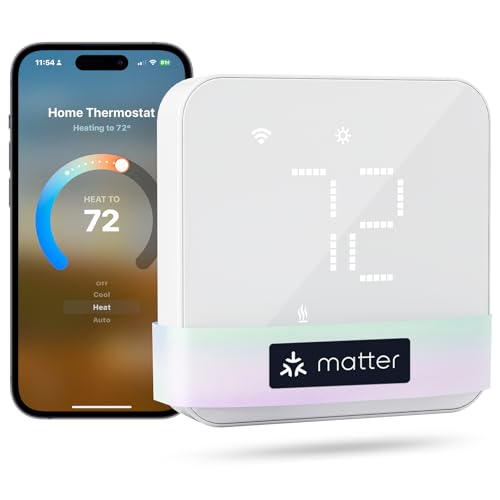
Pros
- Matter support for major smart-home platforms
- Flexible 24/7 heating and cooling schedules
- Remote app and voice control
- Smart alerts for filters and malfunctions
Cons
- C-wire may be required and is not included
- Not compatible with electric baseboard heaters

Pros
- Works with over 20,000 AC models
- AI-based Comfy Max climate control
- Schedules continue during internet outages
- Alexa, Google, SmartThings, and IFTTT support
Cons
- 2.4 GHz Wi-Fi required
- IR remote compatible units only
Match the thermostat to your HVAC wiring
A C-wire is the first filter for several products here. The Riseem model, XuLuaba model, and Honeywell Home X2S require 24 VAC C-wire power, while the meross model may require one depending on the wiring configuration. The ecobee Smart Thermostat Essential can use a separately sold Power Extender Kit in homes without a C-wire.
System type matters just as much. Riseem is limited to conventional single-stage 1 heat and 1 cool equipment, while XuLuaba excludes multi-stage systems and heat pumps with auxiliary or emergency heat. Honeywell Home X2S supports up to 2 heat and 2 cool conventional systems and up to 2 heat and 1 cool heat pumps.
Before You Wire:
Choose by equipment, not just connectivity
For conventional HVAC, app control and schedules may be the main reason to upgrade. Riseem works on 2.4GHz WiFi and offers 7-day programming, while XuLuaba adds 5-1-1 scheduling, 7-day scheduling, Smart Life control, Alexa compatibility, and Google Home compatibility.
Meross is a stronger fit if Matter integration is central to your home. It connects with Apple Home, Amazon Alexa, Google Home, Home Assistant, and Samsung SmartThings, while Honeywell Home X2S adds Matter certification, flexible scheduling, auto-away, humidity display, and filter reminders.
If your cooling comes from a mini-split, window unit, or portable AC with an infrared remote, a wall thermostat designed for conventional HVAC is the wrong category. The Cielo Breez Max controls compatible IR-equipped units over 2.4GHz WiFi and must sit within 6 to 12 feet with a clear line of sight.
| Device type | Key requirement | Best placement |
|---|---|---|
| Conventional HVAC | C-wire and system match | Existing thermostat wall |
| Broad HVAC | Compatibility check | Existing thermostat wall |
| IR room AC | 2.4GHz and line of sight | Six to twelve feet away |
Scheduling and smart-home trade-offs
Flexible schedules are useful when your routine changes by weekday or weekend. Honeywell Home X2S supports 7-day, 5-1-1, 5-2, and non-programmable modes, while meross provides 24/7 scheduling with home, away, and sleep routines through its app.
The ecobee Smart Thermostat Essential adds a color touchscreen, app energy tracking, automatic adjustments for home and away periods, and optional SmartSensor support. Its compatibility checker is worth using because the product supports most 24 VAC equipment but still has defined system limits.
Expert Examined
From Jenna Castellano

I keep seeing thermostat projects stall because the buyer checks WiFi compatibility but not the terminal labels. I would photograph the existing wiring, identify the HVAC type, and confirm the C-wire before removing the old control.
Read more about Jenna CastellanoSmart-home labels can also mean different things. Matter is a connectivity standard intended to help compatible devices work across supported platforms, while app control simply means the thermostat can be managed through its own software. The Connectivity Standards Alliance maintains information about Matter and its ecosystem.
Pro Tip: Save the current wiring layout before disconnecting anything, then compare it with the new thermostat’s supported terminals and system requirements.
Which thermostat fits your home
I would put Smart Thermostats shoppers with a conventional single-stage 1 heat and 1 cool setup toward the WiFi Thermostats for Home Smart Thermostat. It is the most focused match for that wiring profile, with 7-day programming, remote app adjustments, and a backlit display. You must have a C-wire and 2.4GHz WiFi.
For a wider conventional or heat-pump setup, I would point you to the Honeywell Home X2S Smart Wi-Fi Thermostat, White. Its broader stage support, Matter certification, auto-away feature, humidity display, and filter reminders make it a better fit for households that want more system flexibility. I would choose the ecobee Smart Thermostat Essential when a color touchscreen, wider 24 VAC compatibility, optional room sensing, and a no-C-wire path using the separately sold PEK matter most.
For a mini-split, window, or portable AC with an IR remote, I would skip conventional wall thermostats and choose the Breez Max Smart WiFi Thermostat for Mini-Split. Its placement and line-of-sight requirements are different, but its schedules and AC-focused controls are designed for that equipment.
The Bottom Line
The most common mistake is treating WiFi support as proof that a thermostat will work with your HVAC system. C-wire needs, heat stages, heat-pump options, voltage, and terminal support decide compatibility before app features matter.
If you only do one thing first, identify your HVAC system and photograph the existing wiring. Then compare those details with the product’s compatibility notes, including the special placement requirement for an IR-based room-air-conditioner controller.
FAQs
A mini-split, window, or portable AC with an infrared remote needs a controller designed for IR equipment rather than a conventional wall thermostat. Breez Max is intended for compatible IR-controlled units and should sit within 6 to 12 feet in the AC’s line of sight. Riseem, XuLuaba, and Honeywell Home X2S require a C-wire and cannot run on batteries. Meross may require one depending on the wiring, while ecobee can use a separately sold Power Extender Kit when a home lacks a C-wire. Compatibility varies by model. Riseem does not support heat pumps, XuLuaba excludes heat pumps with auxiliary or emergency heat, and Honeywell Home X2S and ecobee support specified heat-pump configurations. Matter certification indicates compatibility with supported smart-home platforms using the Matter standard. Honeywell Home X2S and meross provide Matter-related integration, but you should still confirm the platform and HVAC compatibility for your setup.Which type of smart thermostat fits a mini-split?
Do these WiFi thermostats require a C-wire?
Can I use a thermostat with a heat pump?
What does Matter certification mean for a thermostat?
Sources
- US Department of Energy, Energy Saver www.energy.gov
- Connectivity Standards Alliance, Matter csa-iot.org