
Choosing the best self-monitored home security systems with cameras means deciding whether you want local recording, app alerts, or professional response when you are away. Renters, families, and owners of larger properties need different combinations of wiring, coverage, and connectivity.

Pros
- No monthly fees or subscriptions required
- Dual WiFi and 4G cellular alert channels
- Includes 22 pieces with camera and sensors
- Loud base siren rated over 110dB
Cons
- Incompatible with 5GHz wireless networks
- MicroSD storage card sold separately
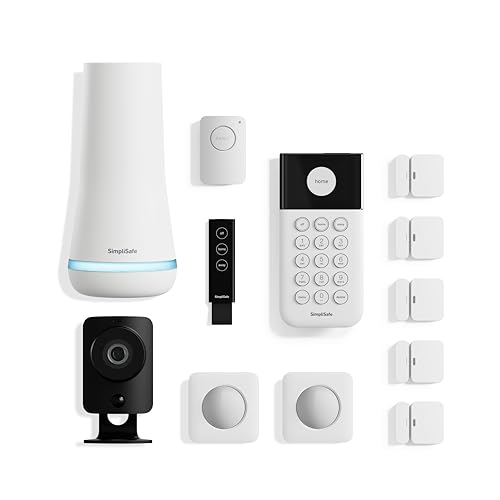
Pros
- Motion sensors cover 35 feet, pet-safe under 60lbs
- Wired camera includes stainless steel privacy shutter
- Panic button features discreet silent alert mode
- Integrates with Alexa and Google Assistant
Cons
- Emergency police dispatch requires paid monitoring subscription
- Indoor security camera requires wired power connection
- Monitoring services and hardware supported only in the US

Pros
- PIR motion and door/window sensors
- 120dB real-time alarm siren
- 2K camera with remote monitoring
- WiFi and 4G dual connectivity
Cons
- No 5G network support
- MicroSD card sold separately

Pros
- Pre-installed 500GB hard drive for 24/7 recording
- AI human and vehicle motion detection
- 80ft infrared night vision with 24 LEDs
- Expandable 8-channel DVR accepts 4 extra cameras
Cons
- Requires running physical BNC wires to DVR
- Includes only four cameras for an 8-channel DVR

Pros
- 5MP resolution with 122-degree wide field of view
- IP67 weatherproofing for outdoor rain and snow
- Night vision range up to 80 feet
- Includes 500GB hard drive with no monthly fees
Cons
- Wired cameras require running physical cables
- Night vision restricted to black and white

Pros
- Included 1TB hard drive with no monthly fees
- 4MP resolution with full color night vision
- Wide 135-degree viewing angle per camera
- Dual-band 2.4GHz and 5GHz Wi-Fi connectivity
- Direct HDMI port for offline local monitoring
Cons
- Advanced vehicle and pet AI requires paid subscription
- Requires four daily hours of direct sunlight for power
Start With the Monitoring Model
Self-monitoring usually means you receive alerts through an app and decide what happens next. The PGST systems use Smart Life or Tuya app control, while the ZOSI and OHWOAI systems provide mobile viewing and motion alerts without monthly fees. Hiseeu also supports remote viewing through EseeCloud and keeps recordings on a local hard drive.
SimpliSafe takes a different route. Its app controls the system independently, but optional professional monitoring can alert emergency responders, and the package includes a free month of that service. That makes it a practical choice if you want self-monitoring most days but prefer a response option during travel or busy periods.
Before choosing, decide whether your household can respond to every alert. A camera showing an event is useful, but the right response plan matters just as much. The rules around security camera footage are also worth understanding before you record shared or public-facing areas.
Pro Tip: Choose app alerts and local recording together when you want remote awareness without depending entirely on a subscription.
Match Coverage to the Property
Wireless camera systems suit locations where running cable is difficult. Hiseeu includes eight solar-powered outdoor cameras, supports up to ten channels, and can operate with a base station connected to a display for local viewing. Its dual-band WiFi support adds flexibility for remote access, while the cameras are designed for outdoor use.
Wired systems are better suited to a fixed layout where you want a stable connection and continuous recording. ZOSI includes four cameras, a 500GB hard drive, eight DVR channels, and night vision up to 80 feet. OHWOAI also uses four wired cameras, with 5MP video, a 122-degree lens, and night vision up to 80 feet.
For a broader explanation of recorder terminology, review how an NVR differs from a DVR. The distinction helps you understand whether footage is stored by a network recorder, a DVR, a memory card, or a base station.
Before You Mount It: Do not place cameras where a bright light points directly into the lens, and do not assume a camera replaces every door or motion sensor. Confirm that each view covers the approach you actually need before fixing the mount.
Check Storage, Alerts, and Privacy
Local storage is a major dividing line among these systems. PGST supports a separately purchased microSD card up to 256GB, while ZOSI includes a 500GB hard drive and Hiseeu includes a 1TB hard drive. OHWOAI records through its wired system and offers live viewing, playback, and alerts through the HonestView app.
Detection features also differ. ZOSI identifies people and vehicles, OHWOAI focuses on human movement, and Hiseeu offers PIR and AI detection for people, vehicles, and pets, with some AI functions tied to an upgradeable cloud plan. SimpliSafe adds room motion sensors with a 35-foot detection range and a 90-degree field of view.
Expert Examined
From Jenna Castellano

I keep seeing homeowners focus on camera resolution while overlooking where alerts and recordings go. I would map the entry points first, then confirm the storage method and app connection for each area before deciding on image quality.
Read more about Jenna CastellanoPrivacy controls matter inside the home. SimpliSafe’s indoor camera has a built-in stainless steel shutter, and ZOSI includes privacy masking for selected regions. For more context, see what security camera indicator lights mean before assuming a light signals recording, access, or an error.
Which System Fits Your Home
I would point apartment residents toward Wireless Home Security Systems,22Piece WiFi+4G App when they want a large sensor package, one HD camera, app control, WiFi and 4G connectivity, and no monthly fees. Its compact SOS device and remote alerts also suit homes where family members may need a simple emergency control.
I would put SimpliSafe 12 Piece Wireless Home Security System in a household that values an indoor camera, a privacy shutter, room motion coverage, and the option of professional monitoring without a long-term contract. For a larger outdoor property, I would choose Hiseeu Solar Security Cameras Wireless Outdoor because its solar cameras, 1TB base-station storage, expandable channels, and local display support fit broad coverage needs.
The Bottom Line
The biggest mistake is treating every camera system as interchangeable. A no-fee alarm kit, a wired DVR, and a solar base-station system solve different coverage and storage problems.
If you only do one thing first, mark every entry, driveway, side path, and interior area you need covered. Then select the system whose camera type, recorder, and connectivity match those locations.
FAQs
Wired systems suit fixed layouts and continuous DVR recording, while wireless systems are easier to place where cable is inconvenient. Solar wireless cameras can be especially useful for outdoor or off-grid locations. Aim cameras at the approaches and doors you need to observe, while placing motion sensors where they can cover room movement without being aimed at distracting activity. Confirm the viewing area before permanent mounting. App alerts and remote viewing depend on the system’s available connection. Local storage can preserve footage at the property, while PGST systems can use WiFi or a 4G SIM for alarm communication. AI detection identifies selected activity such as people or vehicles to reduce irrelevant alerts. The exact detection categories vary, and some Hiseeu AI functions require an upgraded cloud plan.Should I choose a wired or wireless camera system?
Where should I place cameras and motion sensors?
How do self-monitored systems work during a power or internet problem?
What does an AI detection feature mean?
Sources
- National Fire Protection Association www.nfpa.org
- UL Solutions www.ul.com