
Shopping for the best security cameras without wifi means deciding between a wired PoE connection and cellular service. The right choice depends on whether the camera will stay near a network cable or watch an off-grid property, vehicle, cabin, or remote gate.

Pros
- Dual sensors deliver 180-degree view without distortion
- Full-color night vision operates down to 0.005 lux
- AI motion detection identifies humans and vehicles
- IP67 weather-resistant housing for outdoor exposure
Cons
- Requires consulting support for third-party NVR compatibility
- Best performance limited to specific ANNKE NVR models

Pros
- 5MP resolution recording at 25 frames per second
- Infrared night vision reaching up to 100 feet
- Local storage support for up to 512GB microSD
- Free app access without monthly subscription fees
Cons
- Incompatible with third-party NVRs or systems
- Requires a wired PoE switch or NVR connection
- MicroSD card not included in package

Pros
- 4K video with 160-degree wide view
- 2800mAh rechargeable battery
- Includes prepaid 4G SIM trial
- AI alerts for people, cars, and pets
Cons
- Requires an active 4G network
- Memory card not included

Pros
- 4G LTE works without WiFi
- Solar panel with 8000mAh battery
- 2K color night vision
- 64GB microSD card included
Cons
- Cellular data plan required after trial
- Needs 4G LTE coverage at installation

Pros
- Built-in SIM auto-selects major 4G LTE networks
- Included solar panel eliminates fixed outlet needs
- 360-degree horizontal and 90-degree vertical PTZ rotation
- 2K 4MP resolution with selectable color night vision
Cons
- No Wi-Fi support, cellular connectivity only
- MicroSD card not included for local storage
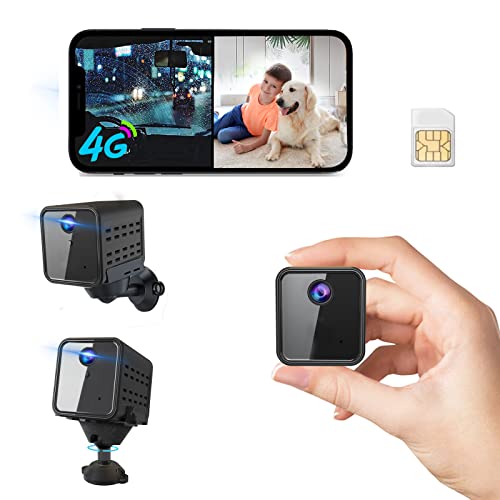
Pros
- Radar motion detection through glass up to 12m
- Crisp 2K QHD resolution over 4G LTE
- Included prepaid SIM card with 300MB trial data
- MicroSD slot supporting 128GB loop recording
Cons
- Requires paid monthly cellular plan after trial
- Setup requires strong outdoor cellular reception
- Restricted to United States cellular networks
Cellular or PoE Changes the Installation
PoE cameras such as the ANNKE 6MP PoE Security Camera Outdoor and REOLINK model use Ethernet for both connection and power through compatible equipment. That arrangement suits a house, workshop, or business with an existing network route, but it does not solve surveillance at a cabin with no wired internet.
Cellular models use 4G LTE instead of WiFi, so you need usable carrier coverage at the mounting location and an active data plan after any included trial data ends. YISPK includes a 4G SIM with a free data trial, while FOSSENXE, Heyall, and vebiliki also include cellular setup provisions described in their listings.
Pro Tip: Check the cellular signal at the exact mounting point before permanently attaching a camera. A strong signal indoors may not carry to a metal shed, basement, or remote gate.
Power and Storage Matter Off the Grid
Battery cameras remove the need for an outlet, but charging becomes part of ownership. FOSSENXE combines an 8000mAh battery with solar charging, Heyall includes a solar panel, and YISPK uses a rechargeable 2800mAh battery that can also operate while charging.
Local storage can reduce dependence on cloud recording, but capacity varies. FOSSENXE includes a 64GB microSD card and supports expansion, while Heyall accepts an SD card up to 256GB but does not include one. YISPK and vebiliki support local cards up to 128GB, with cloud storage available as an option on each listed model.
Before You Mount It: A solar panel still needs direct sunlight, and a cellular camera still needs network coverage. Do not hide either component behind dense materials or place the panel where shade will leave the battery depleted.
Match Detection to the Area
Detection features are not interchangeable. REOLINK identifies people, vehicles, and animals, ANNKE focuses on people and vehicles, and YISPK also identifies pets. FOSSENXE uses PIR human detection with AI auto tracking, while vebiliki uses radar detection that can work through glass at a stated distance.
Pan-and-tilt coverage can reduce blind spots at a remote property. Heyall offers 360-degree horizontal and 90-degree vertical PTZ movement, while FOSSENXE provides 360-degree live view. Fixed PoE cameras may be preferable when you want a stable view and reliable recording through an NVR.
Before choosing a detection mode, consider the scene rather than selecting the longest feature list. A driveway may benefit from vehicle alerts, a barn from human detection, and a window-facing installation from radar sensing. The meaning of security camera status lights can also help you diagnose connection or night-vision behavior.
Expert Examined
From Jenna Castellano

I keep seeing people mount a cellular camera first and investigate coverage later. The better sequence is to check signal, test the planned charging position with the camera accessible, and only then finish the mounting hardware.
Read more about Jenna CastellanoWhich Camera Fits Your Property
I would point you to FOSSENXE 4G LTE Cellular Security Camera for a farm, ranch, or construction site that needs solar support, human detection, PTZ tracking, and included local storage. Its 2K color night vision, 8000mAh battery, and support for Verizon, AT&T, and T-Mobile make the setup practical where WiFi is unavailable, provided coverage is available.
For a portable camera that may move between a car, cabin, garage, or campsite, I would choose YISPK 4G LTE Hidden Camera,Cellular Security. It is battery-operated, supports a 160-degree view, includes a 4G SIM trial, and stores events on a card or in the cloud.
I would reserve ANNKE 6MP PoE Security Camera Outdoor for a wired property. Its dual-lens design creates a 180-degree feed, and its compatibility with ANNKE NVRs makes it a stronger fit when Ethernet and NVR recording are already part of the installation.
The Bottom Line
The mistake most buyers make is treating no WiFi as no connection requirement. Cellular cameras still depend on 4G coverage and a data plan, while PoE cameras require Ethernet, compatible recording equipment, or both.
If you only do one thing first, stand at the planned mounting location and confirm the connection and power plan. Then choose cellular, solar, battery, or PoE based on that physical reality rather than camera resolution alone.
FAQs
Neither is universally better. Cellular models suit cabins, farms, vehicles, and other locations without WiFi, while PoE models fit properties with Ethernet cabling and compatible NVR equipment. Mount it where the cellular signal is usable and the lens covers the activity area without obstruction. Solar models also need direct sunlight on the panel, and metal structures may weaken the signal. Use the included solar panel where applicable, keep it exposed to direct sunlight, and fully charge the battery before installation. Check the battery periodically, especially during extended cloudy weather. Cellular models require cellular data service after any included trial data is used. The exact plan and renewal process depend on the camera and its supported carrier options. Those ratings describe resistance to dust and water under defined conditions, not immunity to every storm or installation error. Mount the camera and cable connections according to the maker’s instructions and protect vulnerable power points.Are cellular security cameras better than PoE cameras?
Where should I mount a 4G LTE security camera?
How do I keep a battery security camera powered?
Do these cameras need a monthly cellular plan?
What does IP65 or IP67 mean on a security camera?
Sources
- Federal Communications Commission www.fcc.gov
- UL Solutions www.ul.com
- US Consumer Product Safety Commission www.cpsc.gov