
Installing the best cellular security cameras solves the challenge of monitoring property borders, farms, or equipment yards situated miles past the reach of traditional Wi-Fi. The real divide in these devices centers on whether your location demands intermittent motion captures or continuous video recording against harsh outdoor weather.

Pros
- 4K color capture with built-in 100-lumen spotlight
- Continuous solar charging with 9,400 mAh battery
- Automatic switching between Wi-Fi and 4G LTE
- Full 360-degree pan and tilt AI tracking
- Includes 32GB SD card and multi-carrier SIM
Cons
- Replacement SIM cards must be data-only
- Color night spotlight range limited to 26 feet

Pros
- Continuous solar charging with high-capacity battery
- 2K resolution with color night vision
- 360-degree coverage with PIR human detection
- Includes SIM card with seven-day trial
- IP66 waterproof and fireproof outer casing
Cons
- Requires ongoing monthly cellular data subscription
- Memory card not included for local storage
- Operates only within the United States

Pros
- No WiFi required with built-in SIM
- Solar powered for off-grid installation
- 2K full-color night vision
- 336° pan, 90° tilt, 4X zoom
Cons
- Each camera requires a separate data plan
- U.S. use only

Pros
- 4G LTE works without WiFi
- 5W solar panel for continuous outdoor power
- 355° pan and 90° tilt coverage
- Color night vision up to 49 feet
Cons
- Requires an ongoing cellular data subscription
- Built-in SIM works only in the United States

Pros
- No WiFi required, built-in 4G LTE SIM
- Solar-powered 24/7 recording
- 355-degree pan and 90-degree tilt
- Person and vehicle detection alerts
Cons
- Cellular subscription required after trial
- SIM cannot be removed or replaced
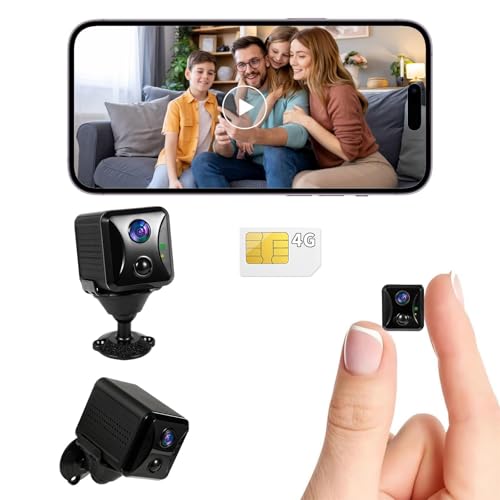
Pros
- 4K video with 160-degree wide view
- 2800mAh rechargeable battery
- Includes prepaid 4G SIM trial
- AI alerts for people, cars, and pets
Cons
- Requires an active 4G network
- Memory card not included
Carrier Bands and SIM Flexibility
Cellular hardware relies on LTE networks operated by major wireless providers. While traditional internet hardware ties directly to fixed wiring, a cellular unit operates essentially like a smartphone equipped with specialized optical sensors. Understanding carrier distribution in rural zones is essential because dead spots instantly cut video access, regardless of camera hardware quality.
Many budget outdoor units come with a pre-installed, non-removable SIM card that connects through virtual networks or fixed contracts. Other advanced units permit swapping in your own data-only card, granting the freedom to select whichever national network has the tallest, clearest transmission tower near your fence line.
Carrier Lockout: Verify local cellular coverage across AT&T, T-Mobile, and Verizon at the mounting post before purchasing, especially for devices with non-removable built-in cards.
When selecting hardware, checking whether a model works exclusively within United States boundaries prevents accidental activation failures. Certain models automatically cycle among networks to find the strongest local radio signal, while single-carrier models drop offline entirely if a specific tower experiences an outage. Regulations from the Federal Communications Commission oversee these operational spectrum allocations.
Solar Capacity and Recording Demands
Power availability dictates whether an off-grid device can stay awake continuously or must sleep between events. Most solar cameras remain in a low-power standby state until an internal PIR sensor detects thermal motion from a human or vehicle. This approach preserves battery reserve through consecutive cloudy days.
| Camera Type | Power Drain | Placement |
|---|---|---|
| Motion Standby | Very Low | Remote Gates |
| Continuous 24/7 | High Draw | Busy Jobsites |
| Compact Battery | Moderate | Indoor Vehicles |
Attempting continuous video capture without a dedicated high-output solar panel and large storage cell quickly depletes off-grid batteries. Units designed for 24/7 recording require significant sunlight exposure to recharge their internal cells while powering image sensors day and night. For properties considering hardwired perimeter builds, reading what is an NVR and how is it different from a DVR provides additional perspective on continuous recording architectures.
Expert Examined
From Jenna Castellano

The mistake I see most often is angling a solar panel flat toward the sky rather than tilting it toward the winter sun. Dust and leaf debris accumulate quickly on flat glass, cutting solar collection by half within weeks.
Read more about Jenna CastellanoMotion Detection Accuracy and Video Storage
Cellular data plans carry strict transmission caps or tiered monthly billing structures, making false triggers expensive and annoying. Modern units incorporate onboard processing to distinguish between human movement, passing vehicles, and swaying branches. High-resolution sensors capture detailed footage, but transmitting 4K clips across mobile networks consumes data far faster than transmitting standard definition streams.
Local micro-SD storage ensures essential evidence remains preserved on-site even if network connectivity falters. Stored clips can later be reviewed remotely through companion mobile apps or pulled directly from the physical card. In high-liability areas, property managers often evaluate whether is security camera footage admissible in court to confirm that local timestamps and file formats meet evidentiary standards.
Pro Tip: Format your micro-SD card directly within the camera companion application during initial setup to prevent file corruptions during unexpected power cuts.
In addition to daytime clarity, nighttime performance relies on integrated spotlights or infrared emitters. Examining what do the lights on a security camera mean helps you discern whether the camera is actively transmitting data or illuminating a perimeter intruder.
Selecting Hardware for Your Property
For large perimeters where boundary coverage requires continuous tracking and exceptional resolution, I would point you toward the eufy Security 4G LTE Cam S330. Its 4K visual clarity and motorized pan-tilt frame allow clear license plate identification up to thirty feet, while its multi-carrier automatic switching ensures the camera maintains connection by jumping to the strongest available network.
When you need uninterrupted around-the-clock surveillance on an active work site rather than short event clips, I recommend the ELYSOO No WiFi Security Camera Outdoor. Its always-on continuous recording capability handles active construction locations where transient motion triggers might miss crucial activity between workers and machinery.
For temporary indoor surveillance, vehicle security, or discrete interior monitoring in off-grid cabins, the YISPK 4G LTE Hidden Camera,Cellular Security is a sensible choice. Its compact footprint, internal battery, and wide 160-degree viewing angle fit tight spaces where large solar brackets cannot be mounted.
The Bottom Line
The single thing most buyers get wrong is underestimating ongoing cellular plan requirements and carrier dead zones. A camera with premium resolution becomes useless if the built-in SIM card cannot lock onto a reliable local cellular tower from your designated mounting tree or post.
Before driving screws into a fence post or exterior wall, test signal strength at that exact elevation with a standard cellular handset. Confirm that the location receives clear line-of-sight sunlight throughout the day so your solar setup can sustain continuous battery power.
FAQs
Do cellular security cameras require a monthly subscription?
Yes, all cellular cameras require an active cellular data plan to transmit live feeds, video clips, and alerts to your phone. Some models utilize non-removable SIM cards that require subscriptions through their dedicated app, while others accept standard data-only SIM cards from major mobile carriers.
Can cellular security cameras operate without solar panels?
They can run on internal rechargeable batteries alone, but their operating life will drop significantly depending on motion trigger frequency. Adding a dedicated solar panel provides continuous daily recharging, eliminating the hassle of manually dismounting the camera for charging.
How much data do cellular security cameras consume?
Data consumption varies based on resolution and how frequently you access the live stream. Simple motion-activated event clips generally consume between one and three gigabytes monthly, whereas continuous 24/7 video streaming requires large or unlimited data tiers.
What happens to footage if the cellular signal drops?
Most models save video events directly onto an onboard micro-SD card regardless of mobile signal status. Once the cellular connection recovers, you can remotely retrieve the captured footage through the mobile application.
Sources
- Federal Communications Commission www.fcc.gov
- Federal Trade Commission www.ftc.gov