
Installing the best cameras for home security requires matching your mounting locations to specific power and wireless constraints rather than buying the highest resolution available. A long driveway demands independent power and passive infrared detection, while an indoor nursery calls for pan-and-tilt tracking on higher wireless frequencies. Clear coverage happens when your hardware matches the physical environment.
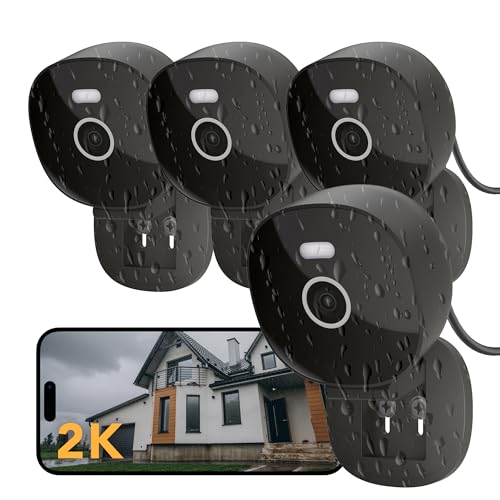
Pros
- Crisp 2K resolution with color night vision
- IP65 weather resistance against rain and snow
- Automated siren and bright white spotlight deterrent
- Works with Alexa and Google Home systems
- AES256 video encryption protects recorded footage
Cons
- Requires nearby electrical outlets for constant wired power
- Micro SD card not included for local recording

Pros
- Dual-band 2.4GHz and 5GHz WiFi connectivity
- 2K resolution with 10-meter night vision
- 340-degree horizontal and 80-degree vertical rotation
- Continuous 24/7 recording supported on local storage
Cons
- Micro SD card not included in package
- Playback requires paid subscription or separate card

Pros
- 4MP resolution with full-color night vision
- PIR and AI detection for people and vehicles
- 5000mAh battery with solar-panel compatibility
- Two-way audio and configurable siren alarm
Cons
- 2.4GHz WiFi only
- MicroSD card not included

Pros
- Included solar panel with 59-inch charging cable
- 2K resolution with color night vision spotlight
- IP65 weatherproof rating for rain and snow
- Human detection mode reduces unwanted motion alerts
- Local microSD card support up to 128GB
Cons
- Incompatible with 5GHz Wi-Fi networks
- MicroSD card not included in the box
- Cloud storage requires subscription after 3-day trial

Pros
- PIR detection with AI recognizes people and vehicles
- Sharp 2K video with full-color night vision
- Infrared illumination extends up to 33 feet
- IP66 weatherproof casing handles outdoor exposure
Cons
- Battery requires recharging every 1 to 3 months
- Requires 2.4GHz Wi-Fi connection only
- MicroSD card for local storage not included

Pros
- Dual-band 2.4GHz and 5GHz Wi-Fi connectivity
- 2K 3MP resolution with 32-foot night vision
- Continuous 24/7 recording to local microSD storage
- Includes adhesive tape and screw mounting options
Cons
- Remote recorded playback requires paid cloud subscription
- Fixed viewing angle requires manual physical adjustment
Power Delivery and Wireless Reliability
Outdoor perimeter surveillance often forces a trade-off between installation convenience and continuous capture. Battery units let you position hardware on detached sheds or fences where line voltage does not exist. However, battery-operated units rely on sleep states to preserve power, waking up only after a motion trigger occurs.
Continuous recording requires a dedicated wired power supply, eliminating wake-up lag and captured activity gaps. For remote placements without outlets, integrated solar panels provide ongoing maintenance-free charging under direct sunlight. Before installing battery hardware outdoors, consider what the lights on a security camera mean so status changes do not drain your power reserves unnoticed.
| Power Source | Best Placement | Recording Style |
|---|---|---|
| Wired 110V | Porches and entries | Continuous 24/7 |
| Battery | Fences and outbuildings | Event clip only |
| Solar Hybrid | Sunlit rooflines | Extended event |
Radio frequency also dictates connection stability across your property. The Federal Communications Commission regulates consumer wireless spectrum, with most budget models operating on the 2.4 GHz band to maximize signal penetration through solid exterior walls. Indoor models frequently include 5 GHz connectivity, which handles higher data bandwidth for multi-camera streams across shorter distances.
Resolution and Day-Night Sensor Optics
Visual clarity involves more than raw sensor pixel counts. A 2K or 4MP optical sensor provides enough pixel density to recognize facial features and read license plates across an average driveway. Higher pixel counts also permit digital zooming into recorded footage without turning the critical details into unrecognizable blur.
Expert Examined
From Ray Okafor

The mistake I see most often is aiming an infrared lens directly through a glass window pane. The infrared illumination bounces straight back off the glass, blinding the sensor at night and ruining your footage.
Read more about Ray OkaforNight vision implementations split into standard infrared black-and-white mode and active color night vision. Standard infrared uses discreet LEDs to illuminate subjects without drawing attention to the unit. Color night vision relies on integrated white spotlights, which illuminate the coverage area to capture clothing colors while actively deterring trespassers.
Storage Architecture and Local Data Retention
Securing your video files is as important as capturing them. Cloud subscriptions offer effortless remote backups and multi-user access, but recurring monthly fees accumulate quickly across multiple lenses. Local microSD card storage eliminates recurring payments and preserves surveillance records even if your home broadband drops out.
Chain of Custody: Formatting memory cards incorrectly or losing network time synchronization can ruin file integrity. If an incident occurs, understanding whether security camera footage is admissible in court hinges on unbroken timestamps and tamper-proof storage methods.
Properties utilizing multiple continuous-recording streams should evaluate dedicated network storage instead of standalone memory cards. Comparing standalone drives to structured recording systems aligns with what is an NVR and how it differs from a DVR when planning whole-house infrastructure. Selecting encrypted video protocols ensures that both cloud streams and on-device files remain protected against unauthorized viewing.
Matching Hardware to Your Property
For an exterior perimeter that lacks nearby electrical outlets, I would point you toward the Fazoxo 2K Security Camera Wireless Outdoor. Its included solar panel eliminates the hassle of taking the unit down for recharging, while its integrated spotlight supplies full-color recording when motion triggers after dark.
If you need comprehensive interior monitoring for broad communal spaces, I recommend the GNCC Cameras for Home Security 5Ghz WiFi Indoor. Its mechanical 340-degree horizontal panning and dual-band wireless support let you monitor large living rooms smoothly without creating blind spots.
For complete yard surveillance on a budget, the 2 Pack 4MP Security Cameras Wireless Outdoor delivers sharp 1440p resolution across two battery-powered units. The onboard person and vehicle recognition algorithms filter out nuisance alerts caused by windblown branches or passing stray animals.
The Bottom Line
The single mistake most buyers make is purchasing exterior cameras without measuring real-world wireless signal strength at the target mounting point. A high-resolution camera mounted outside a brick or stucco wall will drop frames and miss events if the Wi-Fi signal cannot reliably carry the video feed back to your router.
If you only do one thing before drilling mounting holes, carry your phone to the exact exterior spot, connect to your local 2.4 GHz network, and run a basic streaming test. Verifying stable network throughput first prevents intermittent disconnects, missed security alerts, and unnecessary exterior holes on your home.
FAQs
Do wireless cameras record continuously or only on motion?
Most battery-powered wireless cameras record only short event clips when their passive infrared sensors detect movement to conserve power. Continuous 24/7 video capture typically requires a wired power connection, as continuous operation would drain a standard rechargeable battery within a couple of days.
Can security cameras function during a home internet outage?
Cameras equipped with a local microSD card slot will continue recording motion events or continuous streams directly to physical storage during an internet outage. However, you will temporarily lose remote viewing access, two-way communication, and smartphone push alerts until home connectivity returns.
What is the optimal mounting height for outdoor cameras?
Outdoor security cameras perform best when installed between eight and ten feet above the ground. This height keeps the equipment out of easy reach of intruders while maintaining a downward angle steep enough to capture clear facial features rather than the tops of hats.
Does dual-band Wi-Fi support matter for indoor cameras?
Dual-band support allowing connection to 5 GHz networks provides higher data transfer speeds and avoids the heavy interference typical of crowded 2.4 GHz household frequencies. This ensures responsive remote pan-and-tilt controls and smoother live video playback on home networks.
Sources
- Federal Communications Commission www.fcc.gov
- National Institute of Standards and Technology www.nist.gov