
Deploying the best 8K security cameras and ultra-high-resolution arrays requires balancing extreme pixel density against strict local network limitations. While dual-lens panoramic sensors cover entire property lines, raw footage rapidly overwhelms standard consumer storage drives. Choosing the right system depends on whether you need a self-contained recorder or standalone networked feeds.

Pros
- 12MP 3840x2880 resolution at 20fps
- Wide 121-degree viewing angle
- Color night vision with three modes
- IP67 waterproof outdoor rating
- AI human and vehicle motion detection
Cons
- MicroSD card not included
- May require manual IP configuration

Pros
- 180-degree panoramic dual-lens coverage
- Detailed 8MP video at 20fps
- Accurate human and vehicle motion detection
- 100-foot smart color night vision
- IP67 weatherproof rated housing
Cons
- Two-way audio requires specific Anpviz NVR
- PoE switch or power supply not included
- No Mac or Linux software support

Pros
- Pre-installed 2TB hard drive for 24/7 recording
- Single-cable PoE connections reach up to 330 feet
- Expandable storage supports extra 8TB eSATA drive
- Runs independently offline via internal DHCP function
- Free mobile and desktop apps without subscription fees
Cons
- Works exclusively with Reolink brand IP cameras
- Firmware updates required before initial camera setup
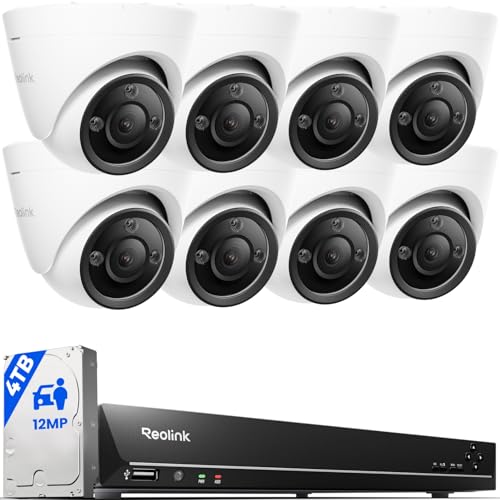
Pros
- High-resolution 12MP video with spotlight color night vision
- Onboard smart detection for people, vehicles, and pets
- Included 4TB hard drive for local video storage
- Sixteen PoE ports expandable up to 24 channels
- Built-in speaker allows two-way audio communication
Cons
- Requires running physical Ethernet cables for PoE cameras
- Battery camera compatibility limited to select models

Pros
- 180-degree panoramic coverage with dual lenses
- Sharp 4K video at 20 frames per second
- Dual warm lights activate color night vision
- Human and vehicle shape detection alerts
- Local storage slot supports up to 512GB SD
Cons
- Two-way talk requires an Anpviz U Series NVR
- Frame rate caps out at 20fps in 4K

Pros
- 180-degree panoramic dual-lens coverage
- 4K 8MP resolution with 65ft color night vision
- IP66 weatherproof metal housing
- Power over Ethernet for single-cable setup
Cons
- Incompatible with Reolink, Lorex, and Amcrest NVRs
- Tech support limited to weekday business hours
Resolution Versus Panoramic Stitching
Single-lens sensors above eight megapixels produce exceptional center clarity but narrow your horizontal perspective. When monitoring broad driveways or open acreage, dual-lens cameras combine two optical feeds to generate a continuous 180-degree image without fish-eye distortion. This panoramic configuration preserves uniform detail from edge to edge instead of degrading clarity at the perimeter.
Extreme image resolution also alters how on-device hardware operates under load. High-resolution units require active processing to run onboard human and vehicle filters, which changes how status indicators behave. Checking what do the lights on a security camera mean helps verify that your unit is actively streaming rather than stuck in an internal reboot loop.
| Camera Style | Field of View | Primary Purpose |
|---|---|---|
| Single Turret | 121 Degrees | Focused entry gates |
| Dual Lens Stitch | 180 Degrees | Full perimeter walls |
| Multi Camera Array | 360 Degrees | Complete estate boundaries |
Local Storage and Bandwidth Demands
Pushing massive video streams across a residential router creates immediate operational friction. Understanding what is an NVR and how is it different from a DVR is critical because high-resolution IP setups process compression onboard before sending data over ethernet lines. Without efficient H.265 encoding, multi-camera arrays can saturate your internal switches and degrade home internet performance.
Network Bottleneck: High-bitrate video streams can congest residential networks. Always run dedicated Cat6 cabling back to an isolated switch rather than sharing general household traffic.
Local hard drive capacity must match your chosen sensor resolution. Continuous recording from several twelve-megapixel feeds fills a standard storage drive within a few days. The Federal Communications Commission oversees equipment compliance for high-speed network interfaces, ensuring high-throughput local hardware does not emit harmful interference across residential frequencies.
Expert Examined
From Ray Okafor

I keep seeing homeowners plug ultra-high-resolution cameras into generic home routers and wonder why their smart TV buffers. The mistake I see is skipping an isolated network switch, which floods the entire local network with heavy continuous data streams.
Read more about Ray OkaforNight Illumination and Sensor Exposure
Dense image sensors require substantial ambient illumination to maintain fast shutter speeds after dark. When ambient light drops, high-resolution cameras with small pixels introduce digital noise unless supported by warm supplemental spotlights or integrated infrared LEDs. Clear footage matters during investigations, especially when determining if is security camera footage admissible in court after an intruder trespasses.
Pro Tip: Position panoramic cameras at least eight feet off the ground to prevent vehicle headlights from blinding low-lux optical sensors during nighttime captures.
Integrated motion-activated floodlights also serve as an active deterrent by surprising trespassers before they approach entry points. Systems equipped with alternating strobe lights and audible sirens create immediate visible boundaries, converting a passive recording device into an active perimeter defense post.
Matching High Resolution to Your Property
For an expansive property needing comprehensive coverage right out of the box, I would point you to the REOLINK 16CH 12MP PoE Security Camera System. This package delivers eight twelve-megapixel cameras paired with a dedicated sixteen-channel recorder housing a four-terabyte hard drive, giving you immediate capacity for continuous multi-camera archiving without overwhelming your personal router.
If you already own an open-platform video recorder and need an expansive boundary monitor, I recommend the Real HD 8MP 4K Dual Lens PoE IP Security Camera. Its dual-lens array provides a continuous 180-degree panoramic field in an IP66 metal housing, and its compliance with federal procurement standards makes it exceptionally reliable for third-party platforms like Milestone or Blue Iris.
For standalone gate or entryway monitoring where you do not want a bulky recorder running continuously, I would suggest the Hiseeu [12MP HD] 12MP PoE IP Camera. It records sharp 3840 by 2880 footage directly to an onboard memory card up to 512 gigabytes, offering a compact 121-degree view with built-in color night vision.
The Bottom Line
Most buyers mistakenly believe that buying the highest pixel rating automatically guarantees readable license plates and faces at fifty feet. In practice, improper camera positioning, weak nighttime illumination, and network compression artifacts degrade high-resolution video faster than a lower-resolution camera configured with the correct focal length.
Before buying high-bandwidth hardware, map your mounting points and pull direct Cat6 ethernet cables to a centralized utility space. Securing dedicated physical wiring and sufficient hard drive storage first ensures your ultra-high-definition cameras perform reliably without choking your household devices.
FAQs
Can an ultra-high-resolution security camera identify license plates at night?
Legible nighttime plate capture requires fast shutter speeds and optical zoom rather than pure pixel count. Ultra-wide panoramic lenses disperse illumination across a broad area, which causes fast-moving reflective plates to blur unless supplementary spot lighting is positioned directly along the vehicle lane.
How much bandwidth does a high-resolution IP camera use?
A single camera streaming above standard 4K consumes between eight and fifteen megabits per second using efficient H.265 compression. Multiple cameras streaming simultaneously require a gigabit switch and an isolated local network to prevent household streaming congestion.
Do panoramic dual-lens cameras leave a blind spot in the center?
Dual-lens surveillance cameras use internal stitching software to merge two sensor streams into an unbroken 180-degree view. While optical seams may show minor alignment shifts within five feet, the center field of view remains fully covered beyond that distance.
Will high-resolution security cameras work without an internet connection?
Hardwired PoE cameras connected to an on-site network video recorder function continuously without internet service. You can record, playback, and view footage on a local monitor, though remote smartphone notifications require an active broadband connection.
Sources
- Federal Communications Commission www.fcc.gov
- Underwriters Laboratories Standards www.ul.com