
Congested home networks frequently throttle video feeds, making the best 5GHz security cameras essential for properties crowded with smart appliances. Higher transmission frequencies bypass saturated radio bands to deliver crisp video without stuttering, provided your mounting points sit within good signal range.

Pros
- 2K video resolution with color night vision
- Continuous 24/7 recording with no monthly subscription
- Dual-band 2.4GHz and 5GHz Wi-Fi 6 support
- Motorized 340-degree pan and 90-degree tilt tracking
- IP66 weatherproof casing handles rain and snow
Cons
- MicroSD card not included for local storage
- Requires constant wired power connection

Pros
- Full 360-degree pan and 90-degree tilt coverage
- Pre-installed 64GB SD card with no subscription
- Dual-band 2.4GHz and 5GHz Wi-Fi connectivity
- Built-in AI detection for humans and pets
Cons
- App restricted to United States and Canada
- Not suitable for pointing through window glass
- AI video summaries require optional Pro membership
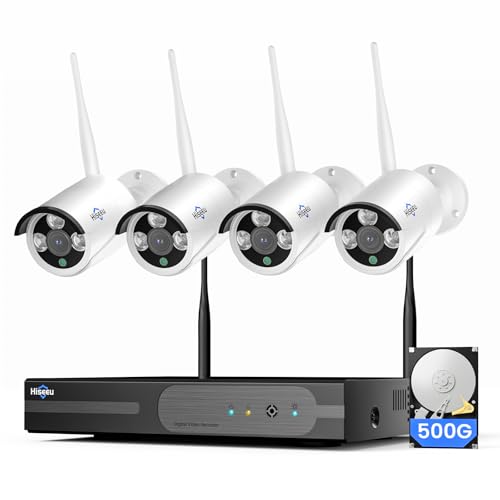
Pros
- Pre-installed 500GB hard drive without subscription fees
- Dual-band WiFi connectivity plus standalone local monitoring
- Expandable 16-channel NVR with 4K color night vision
- Weatherproof IP66 housings rated from minus 13 degrees
Cons
- Plug-in wired power requires nearby outdoor outlets
- Comes with four cameras despite sixteen channel capacity

Pros
- Pre-installed 3TB drive, no monthly fees
- AI human detection filters pets and shadows
- IP66 weatherproofing down to -13 degrees
- Expandable 16-channel NVR for extra cameras
Cons
- Requires wired power outlets for each camera
- Wireless range limited to 100-foot distance

Pros
- 4K 8MP video with color night vision
- 2.4GHz and 5GHz WiFi support
- AI person and vehicle detection
- Local SD storage up to 512GB
Cons
- 24/7 recording consumes more battery
- SD card not included

Pros
- Dual-band 2.4GHz and 5GHz Wi-Fi connectivity
- Includes 64GB local storage card in box
- Cordless battery lasts up to six months
- IP66 rating protects against rain and snow
- 2K UHD resolution with integrated spotlight
Cons
- Color night vision requires spotlight activation
- Requires mobile app for adjustments and alerts
Understanding Dual-Band Frequency Limitations
Moving up to a five-gigahertz transmission channel dramatically increases data throughput for high-resolution video streams. This bandwidth jump ensures that crisp 2K and 4K footage travels quickly to your phone without buffering. However, higher radio frequencies struggle to penetrate dense masonry, brick veneers, and double-pane low-E glass windows.
A standard 2.4GHz connection travels farther outdoors, but it fights for airtime against baby monitors, microwave ovens, and neighborhood routers. Dual-band equipment lets devices switch between frequencies based on signal strength. Placing cameras along outer walls requires checking that your router signal reaches the exterior perimeter cleanly.
Frequency Trade-Off: Higher 5GHz radio frequencies transmit faster data rates across short distances, whereas 2.4GHz signals travel farther through solid exterior walls.
Power Architecture and Continuous Recording
High-frequency transmission demands steady current, which creates a sharp divide between battery-operated hardware and wired systems. Battery units enter a low-power sleep state until an onboard motion sensor wakes them, preserving energy at the cost of short recording gaps. Continuous surveillance around driveways and entry doors works best with permanent line power.
Wired plug-in models and multi-camera bundles provide uninterrupted 24/7 capture directly to an onboard drive or local network hub. If you prefer a centralized setup for whole-property coverage, learning what is an NVR and how is it different from a DVR helps clarify how multi-channel hubs manage heavy video streams from wireless outdoor sensors.
| Power Source | Best Range | Typical Recording |
|---|---|---|
| Battery Wireless | Line of sight | Motion events only |
| Wired Plug-in | Mid-range exterior | Continuous 24/7 |
| Dedicated NVR Kit | Whole property | 24/7 multi-channel |
High-resolution streams also trigger active monitoring indicators on modern hardware. Checking what do the lights on a security camera mean ensures you understand whether a solid or flashing light indicates network transmission issues or active local recording.
Router Placement and Outdoor Signal Integrity
Positioning your base router or access point determines whether dual-band wireless links perform reliably outside. The Federal Communications Commission regulates consumer wireless power output, which means signal degradation across thick exterior framing remains an unavoidable reality for all consumer gear.
Exterior Attenuation: Placing a 5GHz camera more than thirty feet away through multiple interior walls often causes unexpected connection drops and degraded video streams.
Before fastening brackets to brick or siding, check local signal health on your mobile phone at the exact installation spot. If signal levels drop below two bars, shifting the unit closer to a window or adding a mesh node indoors often restores stable high-speed transmission.
Expert Examined
From Ray Okafor

I see homeowners install high-bandwidth cameras on remote detached garages and wonder why the live stream freezes. If your unit sits far from the home router, configure that specific camera to stay locked on the 2.4GHz channel rather than allowing it to hunt for a weak 5GHz link.
Read more about Ray OkaforSelecting Your Dual-Band Surveillance Gear
For monitoring an open living room or nursery, I would point you to the SensForge 2.5K Indoor Pan-Tilt Security Camera. Its 360-degree rotation, included 64GB memory card, and indoor proximity to your main router make it a smooth choice for crowded domestic Wi-Fi networks.
For wide perimeter surveillance across a front yard and rear patio, I recommend the blurams 2Pack Security Cameras Outdoor Wired. Continuous plug-in power enables reliable 24/7 recording onto a microSD card, while Wi-Fi 6 dual-band compatibility keeps live viewing fast and responsive across multiple mounting angles.
If you require completely wire-free installation on a rental fence or entryway, I suggest the realhide 2K Wireless Outdoor Security Camera. It combines dual-band connectivity with an internal six-month battery and an included 64GB storage card, simplifying placement without running outdoor electrical cords. You can explore more perimeter monitoring strategies in our complete security cameras section.
The Bottom Line
The single mistake most buyers make with dual-band equipment is assuming five-gigahertz transmission will reach the far corners of their property. While it clears up network congestion and eliminates stuttering video indoors or near exterior walls, high frequencies drop off rapidly when pushed through brick, stucco, and stone facades.
Before drilling pilot holes, test your network strength at the target mounting surface using a handheld device connected to the matching band. If the connection wobbles, mount the hardware closer to an access point or use equipment that balances high-speed streams with stable local recording.
FAQs
Do 5GHz security cameras reach as far as 2.4GHz models?
No. Five-gigahertz radio waves operate at a shorter wavelength, which makes them attenuate faster when traveling through exterior wood, drywall, and masonry. They excel at delivering high bandwidth across shorter distances but cover less physical range than traditional 2.4GHz wireless hardware.
Can dual-band cameras work if my router only broadcasts one network name?
Yes. Modern mesh routers and dual-band gateways use band steering under a single network name to guide hardware to the optimal band. Quality cameras communicate with these routers automatically, selecting the strongest available frequency during pairing.
Why does my camera video freeze if the signal shows connected?
Wireless interference or packet loss along the edge of your network can cause video player dropouts even when a link displays full signal strength. High-resolution streams require continuous data throughput, so heavy wall density between the camera and router often causes stream freezing.
Does streaming 4K video over 5GHz consume all home internet bandwidth?
It uses noticeable local network capacity, but modern cameras rely on efficient H.265 compression to cut bandwidth requirements by half. Your external internet upload speed only gets tapped when streaming footage to a phone app away from home.
Sources
- Federal Communications Commission Equipment Authorization www.fcc.gov
- UL Solutions Safety Standards for Electronic Surveillance www.ul.com