
Installing the best 4K security cameras for home protection resolves the blur that renders standard footage useless when reading license plates or identifying faces at a distance. Yet eight million pixels require serious local storage and heavy data bandwidth, forcing homeowners to decide between hardwired PoE pipelines and convenient dual-band wireless networks.

Pros
- Up to 100 feet night vision in darkness
- IP66 aluminum metal weatherproof housing
- Built-in microphone for one-way audio capture
- 1080P high-definition resolution with IR-cut filter
Cons
- Requires separate CCTV cable and power supply
- Compatible only with HD-TVI analog DVRs
- No speaker for two-way audio talk

Pros
- 80ft night vision in total darkness
- IP66 weatherproof rating for outdoor mounting
- 4-in-1 video output for wide DVR compatibility
- OSD menu switches signal modes in five seconds
Cons
- DVR and power supply sold separately
- Video and power cables not included

Pros
- True 4K 3840x2160 resolution with IR night vision
- Motorized 355-degree pan and 90-degree tilt
- Dual-band 2.4GHz and 5GHz wireless support
- Included 1TB hard drive requires no subscription
- 16-channel NVR supports up to 16 cameras
Cons
- Cameras and NVR require plug-in electrical power
- Simultaneous app viewing capped at 4 users
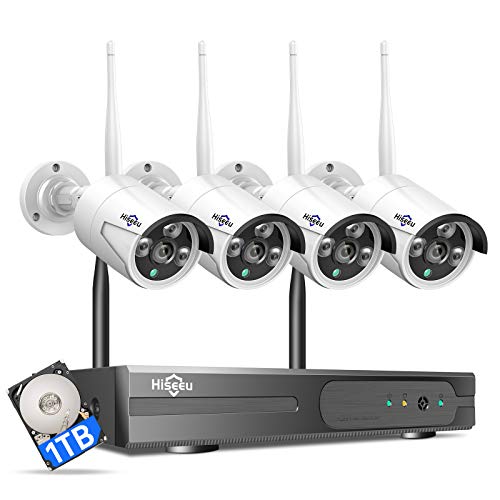
Pros
- Pre-installed 1TB hard drive with zero subscription fees
- Continuous 24/7 recording via corded plug-in power
- IP66 weather resistance rated from -13°F to 122°F
- AI human detection filters out pets and shadows
- Scalable 4K NVR system supports up to 10 channels
Cons
- Corded plug-in setup requires nearby power outlets
- One-way audio permits listening only without two-way talk

Pros
- Crisp 4K video with 24/7 continuous recording
- Motorized 360-degree pan-and-tilt auto tracking
- Color night vision via integrated deterrent spotlight
- On-device AI tracks humans, pets, and crying
- Local SD card storage without subscription fees
Cons
- HomeKit streams capped at 1080P resolution
- Micro SD card not included in box

Pros
- Vivid 4K 8MP resolution with CMOS sensor
- Smart dual lights switch to color night vision
- Built-in 2TB hard drive for 24/7 recording
- AI detection filters human and vehicle motion
- IP67 weather resistance on outdoor turret housings
Cons
- Wired PoE setup requires running network cables
- Six cameras included for eight available channels
Resolution Versus Real-World Network Demands
True 4K video feeds push 3840 by 2160 pixels per frame, creating massive video files that choke standard home Wi-Fi networks. When multiple cameras transmit high-bitrate footage simultaneously, standard routers drop frames or degrade resolution automatically. Using modern H.265 compression cuts this bandwidth footprint significantly compared to older video encoding standards.
For large properties, network architecture dictates overall system reliability. Before deciding on equipment, understanding what is an NVR and how is it different from a DVR helps avoid bottlenecking your video feeds through outdated coaxial wiring.
Bandwidth Reality: True 4K streams require 4 to 8 Mbps upload speed per camera under modern H.265 compression.
Hardwired Power over Ethernet lines supply both electrical current and video transport through one durable network run. Wireless alternatives offer faster setup, but they still require nearby power outlets for continuous twenty-four-seven surveillance feeds.
Night Illumination and Sensor Capabilities
Standard infrared night vision produces high-contrast black-and-white images, but fine details wash out under reflective porch lights. Dual-light setups combine discreet infrared arrays with motion-triggered LED spotlights to illuminate dark corners and capture true color profiles. Maintaining clear illumination helps verify details if you wonder whether is security camera footage admissible in court after an event.
| Camera Architecture | Primary Connection | Ideal Placement |
|---|---|---|
| PoE Turret | Cat6 Ethernet Cable | Outdoor Soffits |
| Dual-Band Wi-Fi PTZ | AC Power and 5GHz | Driveways and Yards |
| Indoor Pan-Tilt | AC Power and 2.4GHz | Nurseries and Hallways |
Weather resistance ratings determine where these housings survive prolonged exposure. Outdoor bullet and turret casings rated at IP66 or IP67 keep heavy driving rain, blowing dust, and sub-zero temperatures from penetrating internal circuits, according to guidance from the Federal Communications Commission on exterior electronics.
Expert Examined
From Ray Okafor

The mistake I see most often is placing 4K cameras directly facing streetlights. The strong point source blinds the auto-exposure sensor, turning your driveway shadows completely pitch black.
Read more about Ray OkaforCoverage Angles and Pan-Tilt Mechanics
Fixed bullet cameras excel at monitoring narrow entry gates, driveways, and side yards where predictable traffic flows. However, wide open spaces often leave dead zones unless you deploy pan-and-tilt motorized bases that follow movement across broad yards.
Mounting Caution: Placing high-resolution cameras behind standard window glass reflects infrared LEDs back into the lens, ruining night recording entirely.
Modern motorized heads incorporate onboard tracking algorithms that lock onto moving human or vehicle silhouettes. You can review how smart detection functions compare by checking do security cameras have facial recognition before selecting your hardware setup.
Choosing Your Home Surveillance Hardware
If you want complete perimeter coverage without running Ethernet through finished walls, I would point you to the Hiseeu 4K Security Cameras Wireless Outdoor. Its 355-degree pan mechanics and included 1TB hard drive give expansive coverage across sprawling backyards without recurring monthly subscription fees.
For dedicated indoor spaces, I recommend the eufy Security 4K Indoor Camera E30 two-pack. The on-device artificial intelligence easily tracks pets and distinguishes crying sounds while integrating cleanly with platforms like Apple HomeKit.
Homeowners building a permanent wired surveillance backbone should invest in the ANNKE 8CH 4K PoE Security Camera System. Its six commercial-grade IP67 turret cameras, continuous 2TB storage drive, and smart dual-light night vision provide dependable twenty-four-seven evidence gathering.
The Bottom Line
The single biggest mistake buyers make in this category is buying 4K cameras expecting purely wireless battery operation. High-definition imaging requires constant electrical power to run image processors, illuminate spotlights, and deliver reliable twenty-four-seven recordings to your recorder.
If you take only one initial step, assess your power access points around the home exterior before ordering any equipment. Knowing whether you can run Ethernet through the attic or plug adapters into exterior outlets immediately narrows your search to the right hardware.
FAQs
Do 4K security cameras require a monthly subscription?
Most 4K camera systems equipped with an NVR or local SD card slot operate without subscription fees. Models featuring local hard drives record continuous twenty-four-seven footage directly to the recorder inside your home.
Can 4K security cameras run on battery power alone?
True 4K video processing consumes significant electrical power, making pure battery operation impractical for continuous surveillance. Most reliable systems use plug-in adapters or single-cable Power over Ethernet connections for stable performance.
How much hard drive space does a 4K camera require?
A single 4K camera using modern H.265 compression typically requires 30 to 45 gigabytes of storage per day for continuous recording. A standard 1TB hard drive usually stores about a week of continuous footage across four cameras.
Do I need professional installation for PoE 4K cameras?
PoE installation involves routing Cat6 cables from the central NVR to each mounting location. Homeowners comfortable navigating crawlspaces, attics, and running low-voltage wiring can complete the job using standard tools without hiring an electrician.
Sources
- Federal Communications Commission Equipment Authorization www.fcc.gov
- National Electrical Manufacturers Association Enclosure Standards www.nema.org